
Exhibitions Auckland
MICHAEL DUNN
Rodney Fumpston: Etchings, Drawings & Collages 1977-78
Thinking back to Rodney Fumpston's exhibition at the Barry Lett Galleries a few over-riding impressions remain. Firstly, a reminiscence of delicacy, of refinement and careful packaging. Even the frames of the collages and prints were tinted in shades of grey to avoid any crudeness, any ripples on the immaculate surface-beauty of Fumpston's art. Here is someone who is concerned with taste, even tastefulness, at a time when rawness veering on crudity is fashionable with many artists. This sense of tastefulness showed up most clearly in the collages, where a few objects, such as post-cards were positioned against coloured grounds of yellow, red or grey. The effect was not unlike that of expensive advertising - the sort of thing once found in Vogue magazine. One of the themes, package holidays, tended to reinforce this echo and add to the faint aura of shallowness that somehow remained despite the serious intentions of the works.
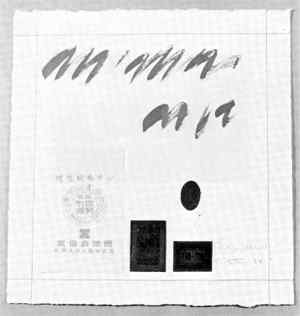
RODNEY FUMPSTON
Package Holiday 4 1978
boxed within 560 x 600 mm.
(Barry Lett Galleries)
Fumpston's interest in Oriental art was very evident in the prints: especially in his use of calligraphic patterns (possibly ideograms) that were not easily decipherable - if indeed they were meant to be. It seemed that facility at times led the artist very close to being clever at the expense of conveying his true meanings. In this respect, even the drawings of gardens were marred to some extent by the repetition of certain hand gestures, suggestive of speed and creative ease, but a little dissatisfying in the end. Ultimately, the subject matter seemed merely an excuse to make drawings of a certain type so that the effect of grey, or grey-black tones, close together and very dense on the page, carried the main meaning.
This leads on to the question of the importance of subject matter in Fumpston's work. If I read things correctly, subject is subordinate to visual considerations - very much so. Fumpston is not much involved with any kind of illusion of realism. But, on the other hand, subject does provide an important trigger for the kind of mood or atmosphere that he seeks. Certain kinds of lighting, certain types of experience - such as that of being close up to vegetation in the Garden series - are critical in the inspiration of his work. What I suspect is that the balance between the concerns of subject and the concerns of printmaking or drawing is not always kept. Often the subject element is trivial, or so slight that we are left with the feeling of a delicate confection with no real substance. No amount of technical skill can overcome that problem.
These questions, however, in no way undermine the achievement of Rodney Fumpston, who has established himself as a major talent on the New Zealand print making scene.