
Exhibitions Christchurch
MICHAEL THOMAS
Neil Dawson: House Alterations
Bing Dawe: Three Sculptures 1978
Sculpture is alive in Christchurch. In spite of the painting shows and mixed exhibitions over the Christmas period, the work of two Christchurch sculptors, Neil Dawson and Bing Dawe, who held separate exhibitions late last year at the Brooke Gifford Gallery, remains most powerfully in mind.
On entering Neil Dawson's show the interest of the spectator is immediately aroused by the unexpected places in which the tiny House Alteration pieces appear. Each work measures no more than 15 x 10 x 10 cms., and is mounted on the wall at an appropriate level. Constructed in fine piano wire or laminated custom-board carved and painted, the houses protrude into the gallery space from unlikely heights and corners. It is as if the 'forgotten' parts of the gallery have been rediscovered as the viewer is made to look up at a pole house leaning precariously between wall and ceiling, or into a corner in which the simple cube of a house is placed. The angle from which each construction is viewed has been carefully thought out and the part of the room into which each fits seems an integral part of the work. White walls serve as a background on which the shadows - a vital element in the majority of pieces - can be clearly seen.
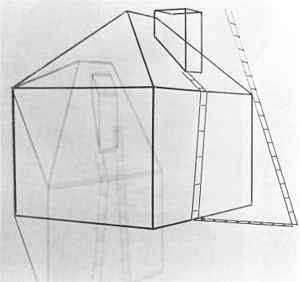
NEIL DAWSON
Structure
wire construction
(Brook/Gifford Gallery)
Nothing can be taken for granted in Neil Dawson's work. On examining some of the wire pieces one is surprised to find essential structural elements which have been deliberately omitted, as if to defy gravity. The back half of the houses for instance are in fact missing although the shadows cast by the front corners give the illusion of a complete structure. Technical feats are successfully achieved to convey these illusions, and in Structure the most characteristic work in the show, a chimney supported solely by the end of one thin wire strut is so perfectly aligned with the roof angle that the viewer is fooled into believing there are other supports.
Dawson's sculptures are three-dimensional 'equivalents' of drawings. Wire and nylon mesh is used to indicate tone and solidity in a similar way to pencil shading, and the interplay between wire lines and linear shadows creates a fascinating ambiguity.
The first frontal impression of the solid painted houses is that they are flat. They look like flags due to the strong contrast between the red roof, white walls and black windows. In these works Dawson interprets aspects of perception distortion in a three-dimensional way. Magnification for instance shows the middle part of a house enlarged to form a circular shape; and in another work entitled Enlargement a tiny wooden house about 1cm in height stands supported only by a thin 'shadow' of wood in front of an enlarged version of the same building. The danger of these little painted houses looking 'toylike' is not. always overcome, and in Illumination - a wooden 'Monopoly-shaped' house which is painted entirely black except for the white windows - the content is too obvious; there is just not enough in the work to elevate it from being anything more than just a very expensive little model-house.
In complete contrast to Dawson's House Alterations, the Three Sculptures 1978 exhibited by Bing Dawe are large wooden pieces that have a primitive North American Indian flavour: they evoke a time when man rather than machine shaped the environment.
The main parts of the three structures are stained wooden poles which have actually been carved from rectangular planks. Stones have been lashed to the poles to make joints, and skin been stretched across some parts as if to catch the wind.
A Tree Study - Before Coal consists of two posts, hollow in some places, which are wedged almost vertically between floor and ceiling, with a tensioned goatskin strung between them. Included in this work is a stone-and-stick mechanism which derives from the ancient fire-making tools.
In Spider, stones resembling human joints connect timber limbs which lead to a wooden cross at the centre of which the mechanism of a windmill has been recreated in the natural media of wood, stone and thong.
This fusion of engineering and natural structure is the crux of Dawe's sculpture; his particular concern is with the basic joint mechanisms to be found both in man-made and natural things. He makes numerous studies of skeletal forms, Maori bird traps, primitive machines, and parts of engines. These are absorbed and later appear in his work; the engineering principles are the same but the materials are natural.
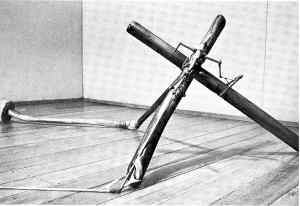
BING DAWE
Spider - A Windmill Study
The results, as in Spider, can appear somewhat confused. There are some successful details but the works are less resolved as a whole, the least realised aspect being their composition in space. Work of this kind suffers when it is placed in a new environment, and the wooden floor of the gallery tends to confuse rather than clarify the pieces. Bing Dawe is now working on the idea of combining the plinthe with the sculpture to help overcome the problem of relating a work to unforseen spaces.
Dawe's work has a very powerful and individual character. It is not like any other sculpture that I have seen and has several different 'dimensions', some of which are yet to be more fully developed.