
Exhibitions Auckland
WYSTAN CURNOW
John Bailey: Four into Twenty-Five: Units & Drawings
John Bailey's show of April last year involved a use of the grid format new to New Zealand painting. What is it about grids? For a start, John Tarlton, in a recent essay, Some Younger Abstract Painters, kept on about 'closed and definitive' compositions, about grid patterns which 'regulate form'. And so perpetuated a common-place misreading. Upwards of thirty years ago it became possible and appropriate to talk of 'open form' and 'composition by field'. Actually, the terms are Charles Olson's and were applied to poetry: but contemporaneously with late Pollock and talk of his 'over-all' compositions. After which, of course, we come to 'colour field', and, more latterly, to composition by 'grid' - these anyway among other possible kinds of open form. And so, somehow, the point has to be made that open form doesn't like this talk of closure, regulation, definition and so on.
Let me be clear what I mean by grid composition in New Zealand art. It has nothing to do, for instance, with Constructivist-derived abstraction. It was first used by Geoff Thornley in his Albus series of 1974. (The works of the previous year do not, incidentally, qualify, and he was soon to drop the grid for the field format already emerged in the Albus works). Richard Killeen was quick to follow, and for three years or so was to work the grid as solidly as Ian Scott has since 1977. The grid is 'open' because the 'incidents' which compose the whole do so democratically instead of hierarchically. They energize the field without rendering it any less all-of-a-piece.
One attraction of the grid is, by contrast with the colour field, that it does restore incident, but without back-tracking to expressionist gesture. Unless, or course, you are Allen Maddox, or Robert McLeod. And what is important about this, John Bailey's first one-man show, is that with it he has done more, with the exception of Killeen in his last show, to restore the force of incident in our painting.
All the works in the show developed from the largest of them: Four into Twenty-Five, Three by Three. In a catalogue note the artist had this to say of its genesis:
By counting 12341 / 23412 into 25 squares laid out, five vertically and five horizontally, a constant diagonal image occurred. The same image also bound the four corners of the work.
This is the pattern:
1 2 3 4 1
2 3 4 1 2
3 4 1 2 3
4 1 2 3 4
1 2 3 4 1
in which 1 provides the constant diagonal and bounding images. With the work in question each of the squares is itself divided into four squares or quarters:
4 1
3 2
The 'image referred to above is thus a square with all but the top right-hand quarter blacked out. The image for number 2 is a square with all but the bottom right-hand quarter blacked out: image for number 3 all but the bottom left-hand quarter blacked out, and so on. This gives the first of the three 'rhythms' referred to in the title. The second rhythm depicted is produced by laying over the first: another rhythm produced by counting 2341 I. 32143 and so on. The third by counting 34123 / 43214 and so on, over the first two. In the laying-over process blacked-out areas disappear when laid over white and white areas remain so when laid over black. Were a fourth rhythm to exist, the image or blacked out area would disappear completely and the image would thus cancel itself out.
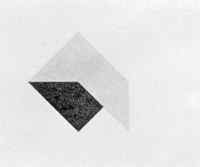
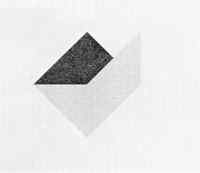
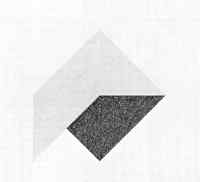
JOHN BAILEY
Combined Image Series / 4 1979
gouache and conté crayon
(collection of the University of Auckland)
It should be said straight off that the mathematical interest here is strictly limited to the business of visualizing number sequences. That is, while the choices of the 5x5 grid, and of the quartered image, are mathematically arbitrary in relation to one another and to the counting procedure, they do facilitate the visualisation of number sequence. If you like, the choice of this grid - although some others would do as well - lies in the curious behaviour of numbers which results in their 'closing off' the grid in the way that they do.
I doubt that this curiosity is of any great mathematical moment, but it does give a 'definitive' form to the grid which does not commit the artist: he means nothing by it. The form is metaphysically neutral - it's simply an example of one of the things numbers do. Secondly, it is the result of a process, or procedure. It's the process which is of interest. It is set in motion. The result is provisional to that extent.
These considerations do, however, lead me to question the materials Bailey has used for Three by Three Rhythms. All three are on a single support and the blacked out areas of the image are in low relief. The work is highly finished and has somewhat the look of a wall piece. The drawings, on the other hand, involve pencil, conte, crayon and gouache on textured paper. (Combined Image Series/4, reproduced above, is an example.) There are several series or sequences, but each item is on a separate support. The materials and the presentation of the drawings are much more at one with the provisional, uncommitted character of the work.
Certainly, Three by Three Rhythms has some didactic value in relation to the drawings, but there are further reasons for preferring the latter. They are the result of either turning the grid 45° on its axis. and blocking in only the constant images produced by the counting rhythms, or of dividing the image into equilateral triangles instead of squares and blocking in two or more conjoined diagonal images. Pencil lines remind us these are still incidents selected from a grid and we can attempt to picture the whole in our heads. This adds a step. We've moved from numbers, to a depiction of numbers, and now we have a depiction of a depiction. This complicated considerably the status of the area surrounding the image. The image itself becomes a statement of shape and figure/ground relationships normally buried in grid paintings. It is a statement only made possible by the 'conceptual' basis of the work. The sense of release these drawings have is most apparent in those in which colour is introduced.
The conceptually based grid can be traced back to the work of Sol LeWitt and Mel Bochner. Indeed, Three by Three Rhythms is reminiscent of Bochner's early drawings, and the drawings suggest links with Bochner's wall paintings of the early 1970s. However, Bochner's number drawings reflect philosophic interests outside of Bailey's concerns and the wall paintings are, unlike Bailey's drawings, unrelated to any grid format. That said, it is clear that Bochner opened up the territory and it still looks a large and fruitful one - in which Bailey is working. So far as I am aware no other New Zealand artist has either recognised the territory, its important or its size.