
Exhibitions Auckland
JOHN TARLTON
Artists on Artists
Copying others is necessary, but what a pity to copy oneself.
PICASSO
The recent exhibition at Peter Webb Galleries, Artists on Artists, was in experiment in displaying the stylistic and contextual influences of other artists (both locally and internationally, past and present) upon the works of a selection of New Zealand artists. The result was a rather mixed bag: ranging from the intellectual, the internalized, the sombre, to tongue-in-cheek satire.

ROSS RITCHIE
Four Days 1964
enamel on hardboard 120 x 122 mm.
To understand, both in theory and practical application, the way in which another artist has come to terms with representing form and space is an honourable and necessary exercise for the working artist who prefers to grow rather than simply pastiche his earlier works. Finding the begging, the borrowing, and the stealing of others' innovations is the delight of both critic and informed audience alike: whether it be the influences of Raphael upon Ingres, Velazquez upon Picasso, or Mondrian upon McCahon. Indeed, Picasso himself thought that painting in the manner of another artist was a good idea, for in the mistakes made by attempting to render exact copies, the artist can perhaps see his own truthful directions more clearly.
Chagall becomes Pat Hanly's mentor in the latter's Deluge painting from the Fire Series of the early 'sixties. In this work Hanly has openly borrowed from the older master's pictorial compositions and attitudes in order to imbue Deluge with a poetic intensity which might otherwise not have been possible. Although the painting is definitely influenced by Chagall, it remains very much Hanly. The artist has used Chagall's mannerisms merely as a tool, a means to an end.
Nigel Brown turns to Gauguin's Yellow Christ in respect of the placement of Christ and other similarities of composition. like Hanly, Brown has used Gauguin as a starting point, a theme and an association, from which he can fill his canvas with aspects of the New Zealand experience in relation to landscape elements and depicted surrounding figures. Brown even seems to have introduced into his Yellow Christ some self-parody: pastiching himself by representing figures easily identifiable as those found in his earlier Axemen, Lemon Tree and People in Bed series.
The finest work on display, in my opinion, is the large painting Origins by Ross Ritchie, which dates from 1965. This was a time when the artist was attempting to reconcile his paintings in terms of current aspects of American-influenced Abstract Expressionism. In Origins, Ritchie has redirected the artistic Pioneering information established by Larry Rivers in his Dutch masters paintings. This immediate debt to Rivers's style and composition ebbs quickly after closer observation of Origins. A portrait of Francis Bacon (an important influence upon Ritchie's earlier figurative style), emerges from the action-painted drips and splashes, while most of the 'burghers' are visually relegated to being mere structural 'markers' for Ritchie's investigations into colour-movement and over-and under-painting. Even the background has somehow been blown away; and we can begin to see Ritchie's own mature style, which would crystallize later in his Reefton Series, formulating itself.
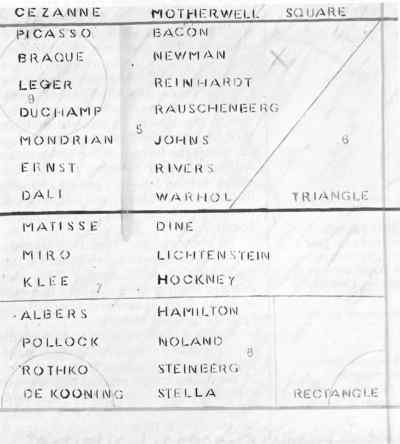
RALPH PAINE
Artistic Licence 1979
oil on unstretched canvas, 100 x 90 mm.
Francis Bacon also appears in the mixed media intaglio print by Roy Dalgarno. The possibility of a stagnant and rather academic composition based upon simple duality of subject is relieved by Dalgarno's use of over-printed objects into the side by side arrangement. The background figures, which act as a flattened area for the Bacon portraits, also assist in alleviating a sense of stagnation in terms of composition.
John Coley's shallow boxes relate directly to the works of Joseph Cornell, Saul Steinberg, and, to a lesser degree, that of Louise Nevelson. Coley's Locked, Barred and Packaged (like his other assemblages on display) concerns itself with the visual possibilities of compartmentalizing information, sectionalizing and forcibly ordering colour, texture, form, and the psychological connotations inherent in the association of apparently incongruous objects in close, yet separate, environments.
Among the more sombre homages to other artists are the Paul Klee-inspired, all-encompassing head-form by Gordon Crook, and the academic Kirchner pastiche painted by the artist Philip Clairmont.
On the lighter side, which sees homages in the categories of pun, innuendo, and so on, is the work by Mark Thomas. Thomas presents a homage to the New Zealand painter Dick Frizzell in his use of a stylized fish-form, immediately familiar to the viewer as that used as subject-matter or compositional device by Frizzell. Thomas's Frizzellian trout rises from a green-and-blue sea of felt in the quest for a delicately-painted fish-hook and line. Although Jeffrey Harris has contributed two serious pencil studies after compositions of Bellini and Giorgione, he has also included a subtle little exercise of humour in his painting Van Gogh Landscape, a work which exaggerates to the point of absurdity the use of an impasto technique, as well as taking a few intellectual sparring punches at New Zealand painters such as Philip Trusttum, who, upon returning from a study trip to Europe could not seem to exorcise the influence of Van Gogh from his work. The excesses of application also seem geared toward painters such as James Ross, who occasionally build up their works to such volumes and textures that they begin to resemble doormats of pigment. Richard MacWhannell's influence in his hand-coloured serigraph Suit and Tie John would appear to be himself, since the work is based upon a small painting exhibited at a recent figurative artists' exhibition at Peter Webb Galleries. There are, however, certain similarities to works by R.B. Kitaj in its slight distortion and disposition of the repeated body-form.
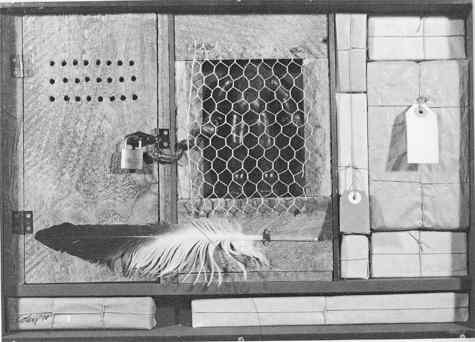
JOHN COLEY
Locked, Barred and Packaged, 1979
assemblage, 38 x 55 mm.
On an over-all view, Artists on Artists seems somewhat too quickly conceived. Many New Zealand painters and printmakers who might have contributed were not represented. But if the exercise was thin in representation, it was solid in theory, and sustained the imaginative background work and presentations of Rangitoto Special and Works for Children - exhibitions which have been prepared by the Webb Galleries. The whole concept of influences upon New Zealand artists is an important one, and such exhibitions as Artists on Artists act, not only as interesting thematic displays, but also as valuable art-history lessons for those interested in the roots and origins of contemporary New Zealand painting.