
Book review
Women Artists - Recognition and Reappraisal from the Early Middle Ages to the Twentieth Century by Karen Petersen and J.J. Wilson
Published by The Women's Press, London, 1976
Reviewed by GILLIAN CHAPLIN
Women Artists is a book which for the first time informs the general public about those artists in history who are women. It deals particularly with Western traditions, beginning with the early Middle Ages and concluding with the 1970s. There is also, however, a chapter contributed by Lorri Hagman which covers Chinese women artists - those individuals who challenged the Confucian saying that 'Only the untalented woman is virtuous'. Here, the period studied is more impressive, though predictably more cursory, starting around 3000 B.C.
The authors, Karen Petersen and J.J. Wilson, say that the only place they found no women artists was where they 'have not yet looked'. This is a most impressive and far-ranging work by two women both highly trained in comparative literature and committed to this research by their feminism. They are also rectifying what can only be seen as a glaring absence of any relatively accessible material on the women who have figured in the history of art. Because of its unique and monumental nature, this is a fairly responsible task and the authors have produced a work which is very readable while sustaining high standards of scholarship. I found it refreshing, extremely informative and definitely a catalyst to further discovery.
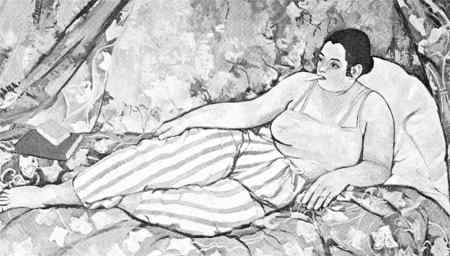
SUZANNE VALADON
La Chambre Bleue
Musee Nationale d'Art Moderne,
Paris
The book does not attempt to analyse women's art or the idea of female imagery in artistic endeavour. Rather, it is a comprehensive catalogue (well illustrated) and a resource book which deals chronologically with women artists "and their biographical details. '... Though specialists may take exception to our interpretations, the absence of formal analysis, our preoccupation with biography, our leaps and bounds, the book is intended for what Virginia Woolf (and Samuel Johnson) called the "common reader".' It is also, by virtue of the extensive bibliography and footnotes, a marvellous source for what I can see as a particularly engaging area of study and inspiration. Very little research has been done on women artists of the past: more common is the firmly-expressed belief that none exists. This book indicates how truly erroneous that idea is.
Personally, I felt frustrated by a greed for more analysis - arising, I think, from the dearth of such texts as this. It is perfectly obvious that without making basic facts available, the sort of questions and quests that Judy Chicago, for example, explores in Through the Flower - My struggle as a woman artist, can not yet be encompassed by texts like that in Women Artists. The authors have made a major contribution to the history of art. Although Karen Petersen and J.J. Wilson do not attempt any art historical criticism, they do deal with the social conditions, prevalent attitudes and the kinds of stresses and restrictions with which women have had to contend. In the twentieth century the problems are perhaps a little less direct or obvious than they might have seemed to fourteenth century women, who were, for instance, excluded from the increasingly-lucrative work of tapestry-making by the instigation of guild rules forbidding any pregnant or menstruating woman from working on the looms. On the other hand, there were the attitudes that artists such as Berthe Morisot and her sister Edma were exposed to in the nineteenth century, as reflected in their drawing-master's letter to their mother: 'Considering the character of your daughters, my teaching will not endow them with minor drawing room accomplishments; they will become painters. Do you realise what this means? In the upper class milieu to which you belong, this will be revolutionary, I might almost say catastrophic'. In conclusion, here is a quote from the book's preface:
'The works of women need exposure; they need sharing with the largest possible audience to develop a special vocabulary of appreciation and the same joy of recognition that men's art has received over the centuries'.