
Book review
People by Alfred Eisenstadt
Published by Penguin Books, London, 1979.
Reeling by Pauline Kael
Published by Marion Boyars, London, 1977.
Reviewed by WILLIAM DART
Both these books are populist editions of earlier volumes which set out to provide some comment and reflection on the life-styles and vagaries of twentieth century man. Kael does this in a somewhat second-hand manner by analysing and criticising films which have attempted it at first hand - successfully or unsuccessfully as the case may be: Eisenstadt's only crutch is the camera lens that he uses to catch the great personalities of the last forty years at work and play.
Eisenstadt's subjects range from George Bernard Shaw (playing a spinet in his Whitehall Court flat in 1932) to a series of photographs taken almost forty years later, reflecting on the hippie set of the late sixties. How does he fare as an objective commentator on his times? If we are to believe his own introduction, Eisenstadt thinks of himself as a realist. He instances a photograph of Carole Lombard that typifies the type of work the readers of Life magazine demanded - to see their stars as 'human beings not dolls'. Actress Paulette Godard inscribed in his book: 'Happiness is the absence of pain, retouching is the absence of beauty'.
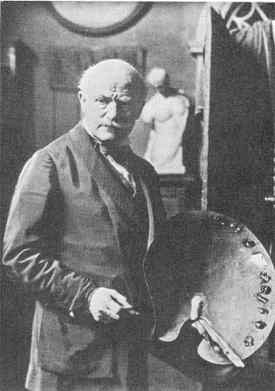
Eisenstadt's photograph of Philip de Laszlo, highest paid painter of royalty and international society in the 'twenties and 'thirties, in his London studio, 1932
At times Eisenstadt's reality catches some visions worthy of Diane Arbus herself. The photograph of spectators at President Kennedy's Washington inauguration, their faces covered with home-made balaclavas, only holes ripped for eyes, nose and mouths, seems like a piece of contrived surrealism: and then there are the photographs of stage actors beneath layers of garish stage makeup; or the delightful Je t'adore with a young Parisian bride and groom embracing in a street full of traffic. Change the setting to the Bronx and it could indeed be a work by Arbus.
In the big power game played by New York film critics, the name of Pauline Kael exerts a good deal of influence. Although others, such as Andrew Sarris, are a good 'deal more creative as critical forces (Kael has attempted nothing as encyclopaedic or pioneering as Sarris's American Cinema directory), she still talks more 'good sense' perhaps than, say, John Simon, whose acidic and somewhat misogynist writings represent a more extreme standpoint. But then criticism is, by definition, a parasite on the art it criticises, and Kael's 'common sense' sometimes seems rather over-cautious and slightly philistine in many instances. (How many of us long for those halcyon days of the late fifties and 'sixties with Herman G. Weinberg writing his quite idiosyncratic Coffee, Brandy and Cigars column in Film Culture, taking a positive delight in proving that every famous first in the history of film had in fact been previously aired in some obscure German film of the early decades of this century!)
Often Kael might take some pointers from Weinberg's pithy and slightly tongue-in-cheek style. One can deflate films such as the 1973 Lost Horizon: but does its ridiculousness warrant so many thousands of words, when the anonymous critic of Time magazine in the mid-sixties (a vintage period this) could do it much better in a few hundred? Kael's extended critique on Norman Mailer's Marilyn book is a justified piece of critical deflation; but then her hyperbolic praise for fellow critic Arlene Croce's book on Astaire and Rogers seems positively incestuous - critics criticising other critic's criticisms!
Where Kael can really extend herself is in the central essay of the book, On the Future of the Movies, which dates from 1974. It is a bleak future, according to the writer; and indeed bleak it will be as long as we discuss directors like Lamont Johnson in the same breath as Robert Altman. This is all the more noticeable when an artist like Michael Ritchie does not even warrant a mention - even though he had directed some noteworthy films during the period the reviews cover (1972-1976), and shown a promise he was to fulfil in the later Smile and Semi-tough.
It takes a great man to admit he is wrong. Even Andrew Sarris has recanted his former rather harsh views on Billy Wilder in the last few years. Perhaps Kael will be able to readjust her critical stance with the added perspective of time. Judging by the number of volumes of collected film criticisms she has published, she could have a good deal of revision to do.