
Book review
Indirections A Memoir 1909-1947 by Charles Brasch
Published by Oxford University Press, Wellington, 1980
Reviewed by ROSS FRASER
My memories of Charles Brasch are from a period when, as one of the Auckland City Art Gallery staff, I with the others, Colin McCahon, Peter Tomory and Hamish Keith, used to meet him on his visits north in search of material, either literary or painterly, for his quarterly magazine Landfall. We certainly thought of him then as a generous patron of painters as well as the avuncular publisher of the work of young poets, writers and critics; and in 1958 the Gallery mounted an exhibition of the collection of paintings he had got together with his friend Rodney Kennedy.
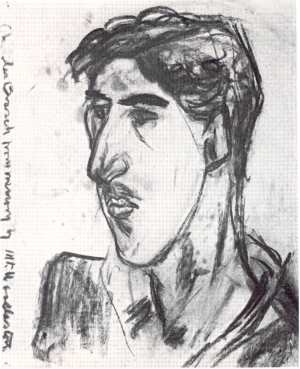
M.T. WOOLLASTON
Portrait of Charles Brasch
charcoal drawing
In addition I of course already knew his poems; and soon after had a hand in the publication of what was then his only sustained prose-piece, Present Company: Reflections on the Arts (originally delivered as a lecture to the Auckland Gallery Associates).
Meeting Charles in those days he struck one as a man of great reserve. I remember that when I had asked him an importunate question at a small dinner party he rebuked me with a quotation from Gibbon to the effect that 'history does not relate' the particular personal information I sought from him.
Now, with the appearance of his memoir Indirections, in a book most sympathetically edited by his old friend James Bertram, one is astonished to realise that history does relate much of what one was keen to know about this mysterious man. Or is it rather the case that, when he retired from his editorship of Landfall in 1967, Charles Brasch set out to become his own historian: at least of the part of his life that ended in the death of his grandfather Willi Fels and the founding of Landfall early in 1947? The result is certainly a major contribution to the corpus of New Zealand writing.
It had seemed to me that the earlier Present Company tended to read like a litany of names - everyone from Homer and the writers of the Gospels through to Tolstoy, Wagner and Cezanne was there. And the lecturer/writer seemed to opt for a view of art that leaned perhaps a little too heavily on the 'life-enhancing' aesthetic of Bernard Berenson. With Indirections Brasch has stuck more to local concerns. Even those chapters of the book that deal with the years spent in Oxford, Europe, the Mediterranean, outline the essential picture of a New Zealander abroad.
In reading the descriptions of memories of childhood's sensory impressions - overwhelmingly 'of things seen' - I was reminded of Ruskin's Praeterita: there is a similar romantic sumptuousness in the prose. Certainly, the tone of a past era pervades this whole work: but it commands one's respect none-the-less.
Readers interested in the history of New Zealand painting will find Chapter 15, New Zealand Interlude, of special relevance. Brasch tells here of his first meeting with the painter M.T. Woollaston, in the late 'thirties, in his clay-brick house at Mapua, Nelson. In these pages he relates too, his first becoming aware of the works of R.N. Field, Colin McCahon, Evelyn Page, Leo Bensemann and Kennaway Henderson.
Although, as I have said, Indirections breaks off at the beginning of the Landfall years (and it would have been valuable to have his words on this rich period), the book is, quite simply, required reading for anyone who is seriously concerned about the development of the arts in this country.