
The Sydney Biennale
WYSTAN CURNOW
Where was I? When I left off, in Art New Zealand 10, I was in New York, was in Toronto, was in L.A. This is Sydney. Pierre Restany, art critic, Director of the French Pavilion at the 1978 Venice Biennale, is talking to a large audience at Sydney University; he's saying: 'You belong to a country that is very far away'. And I'm thinking, with my head full of words as usual: awayness-awareness. Yes, I've got it.
Sydney, then. Ten to eight on Wednesday morning, April 25: ANZAC DAY. And here I am, breakfasting in Coluzzi's storefront cafe on Victoria Street just off the Cross, on capuccino and croissants (opposite is a small sandstone church, St. John's, tolling its bells), and knowing: this could not be home. Around me, survivors of that second, so-called World, war, talking Italian.
This Biennale I was here for had for its theme European Dialogue. And, as its showpiece, an exhibition of that name at the Art Gallery of New South Wales. This consisted of works (one or two apiece) by over seventy artists, one Australian for every two Europeans - a couple of New Zealanders were thrown in for good measure, or something. Plus, also at the Gallery: Recent European Photography. Plus, at the Australian Centre for Photography: The Uses of Photography in Europe. In Sydney, either to carry out, or talk about, their work were: Ulay, Marina Abramovic, Klaus Rinke, Jurgen Klauke, Mario Merz, Hamish Fulton, Daniel Spoerri, Ulricke Rosenbach, Daniel Buren. Plus, official and unofficial, a grand welter's-worth of films, performances, seminars, panels, lectures, exhibitions and partying all around the town. Earful, eyeful, mouthful, bellyful. For five weeks.
Of which I took in ten days or so. And missed, what's more, much which took place in that time. I can enjoy such superfluities best when I know what I'm missing - but part of the time I didn't know. So, by the time I'd discovered Vlricke Rosenbach's video pieces, how by training a camera on, or attaching it to, a moving body (her own) at odd angles, she brought home strangely, intimately, video's physical potency - by that time I'd missed her live performance. As they happen, Rosebach's pieces make strong 'feminist statements'. And I'd better say now that several dialogues, not to say conflicts, animated this Biennale. Not the least of them being to do with the representation of women artists. Meetings, first in Sydney, and later in Melbourne, wanted a 50/50 male/female split. That demand was met, actually. At least as far as the Australian contribution went. And whether it was weakened thereby I couldn't say, though highly ho-hum works from Sandra Taylor, Olive Bishop and Ann Newman suggested it was. From Melbourne in particular came the demand for a 50/50 Australian/Overseas split. And, from Sydney in particular the demand for a non-elitist, community-arts oriented Biennale. Neither were met.
The pressure was for decentralisation, at national and international levels. The talk suggested that sectional interests had a worth distinct from and at least equal to artistic worth. Or, that artistic worth was fact a smokescreen for the sectional interests of the powers that be in the Art World. Biennales are, in this light, showrooms in which the Multi-National Art World Corporation (Head Office, New York) displays its wares and flexes its muscles. What did Sydney mean by its Biennale? Would this - its third - be a further attempt to put Australia on the map of World Art? Or, would it show the way to a radically new kind of Biennale? In the event, Sydney kind of had it both ways: getting on to the Map by pointedly holding 'dialogue' with Europe behind New York's back. But what is a dialogue? Who in fact dialogued with whom or what and about what? Well, that's hard to say. Certainly, most of the scheduled talk about the Biennales, for and against, was just a kind of chatter.
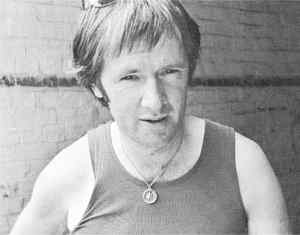
James Mack
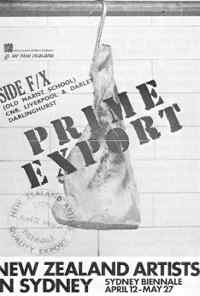
Where New Zealand fitted into all this is anybody's guess. The idea, at one stage, had been to have six official New Zealand participants and an Australian/New Zealand drawing show to go with the European drawing show. It was dropped, said Nick Waterlow, Director of the Biennale, because the budget was low ($120,000 or $10,000 less than the National Gallery (Canberra) had recently paid for a Francis Bacon) - this was how he put it. And because of the pressure to up the Australian and women's content. Reaction among New Zealand artists, especially those who'd been involved with Mildura, and in the offices of the Q.E. II Arts Council, was sharp. An entire New Zealand art scene was air-lifted to Sydney. Five art gallery staff, two Arts Council staff, one Students Arts Council representative, one art school representative, two art writers (me and Neil Rowe) and the rest artists and art students. Some fifty people in all. At a cost, in travel subsidies and on the spot expenses, of $14,500. More than ably led by James Mack, a hardened hit-man cum camp-mother from the Arts Council, the New Zealanders made base at the old Marist Brothers School Building in Darlinghurst. Re-named Side F/X (side-effects, dummy) by the occupants, the East City Group, a community-arts co-op initiated by Richard Maude, who made them more than welcome, it offered a rudimentary home for many. From there they set about making their mark in/on the city's spaces. With impromptu shows (Nick Spill at the Sculpture Centre, for example), readings (Gary McCormack, for example, on the Cross, in pubs, on campuses), performances (Barry Read in the Domain, Richard Von Sturmer at the Sydney College of the Arts), installations (Peter Wild and Jacqueline Fraser in Green Park) on-site works (Pauline Rhodes in an empty lot near The Rocks). And papering its walls with pretty punky art posters. There was a New Zealand presence at the Biennale all right. But what did the New Zealanders mean by it? Were they muscling in, after a piece of the Art World action? Or, were they saying: forget Europe, how about some real trans-Tasman dialogue?
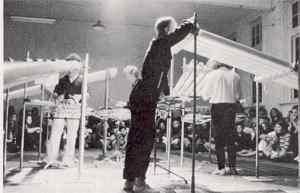
From Scratch in performance in Sydney
Dialogue? Let me speak for myself. I looked at, heard about, a lot of mostly contemporary European art in a short time. I didn't talk back at all. To put together his show, Waterlow went looking for work which escaped labels. That made sense. Seventies art is, after all, distinctively without labels. There've been no 'movements' recently. Whatever the reason my theory is art writers, whose 'movements' were mostly bullshit anyway, have lost their nerve in the face of the naked intentionality of post-object art: you can't get away with description anymore. Whatever - Waterlow's show was a proper pot pourri. Also, he went looking in Europe, and so (for me) came up with a number of new names. Like Head, Klauke, Gostomski, and Paolini. It was a sampler though. The result was I got more out of Hamish Fulton and Mario Merz because they also talked about their work. From Klaus Rinke, who showed some of his films - Mutation (1971) and My Wooden Ways are my Waterways (1978) were real eye-openers. And Ulay and Marina Abramowitz, who also put on a most elegantly simple performance. As to whether there was a 'dialogue' between Australian and European works: that's something for the Australians to judge.
Dialogue? We, all of us, exist at one remove at least from one another. Dialogue presupposes knowing about the distances, plural, that do obtain in any given situation. We have our own, New Zealand, distances. And one thing about Sydney was that it closed gaps between Christchurch, Wellington and Auckland. Much good contact was had between students from New Zealand and those from Sydney and Adelaide. Jim Allen and the Sydney College of the Arts had much to do with that. The thing is that Mildura, the Australia-New Zealand Post-Object show (Adelaide, 1976), the Biennale, and Terry Reid, Jim Allen, John Lethbridge, Adrian Hall in Sydney, Noel Sheridan in Adelaide, Tom McCullough in Melbourne, all add up a large trans-Tasman knowledge in Australia. (Does that register at higher echelons of art administration there, I wonder?) The other thing is: whether or not New York is on the wane, whether or not its influence has been malign or benign, there's this to be said for the arguments - they bring home to us the phenomenon of distance. The push for a plurality of art centres is always a propos, especially to us who will always be at the arse-end of the world. And Sydney stays where it is, too small to stand alone - it can do with what is relatively proximate, energy from Auckland or Adelaide, say. Bought or borrowed. And right now, the more movement of art, information and artists among our cities the better. Much of the dialogue I had, or heard, had to do with this. Continuity of Contact is lacking. How about a publication; edited in turn in Sydney, in Auckland, in Melbourne, in Christchurch, and so on. Where's the traffic from Australia to New Zealand? So far the initiatives and funding have come mostly from this side. Manawatu's Art in the Mail is now touring Australia, I'd like to see an Australian equivalent of our New Zealand at Mildura tour here.
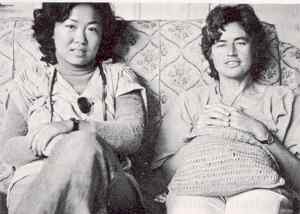
Eva Yuen and Pauline Rhodes
What do we get in return for Bruce Barber's 'E' performance, or from From Scratch? II was standing next to Nick Waterlow at the Art Gallery of NSW listening to From Scratch doing Drumwheel, and when it was over he turned to me, saying: that is the best thing, the best event of the Biennale. I knew what he meant. Had done, all along. But he should've been at Marist Brothers for the Saturday night performance. And had he heard them at the Maidment Theatre in Auckland last year, or this year there, twice. Had he been to a rehearsal in that tiny concrete shed of their's on an empty lot in Ponsonby - then he would've known what I knew: Saturday night was the night. That was it. For From Scratch the payoff from over two years' work, most of it in that tiny concrete shed, on two brilliant but difficult rhythm works devised by Philip Dadson. He is the main force behind From Scratch, even though the works are deeply democratic in conception and execution. What it is about Philip, at least what I've felt about him, is this: his aim is true. He's someone who can wait; I think he knows his work takes its own good time. I think he has great faith in what he is doing and in the people he is doing it with. Drumwheel and Out-In, are the best things to come of that faith.
Though they are very hard to do (it took eighteen months to learn how to play Drumwheel) From Scratch works are in no way hard to take. They engage one immediately, and from the ear on down. And that night, with a series of recent Auckland performances behind them, aft acoustically happy space, and a sizeable interested audience, the group swung into Drumwheel with a new ease. So, well before some guy had slipped out near the end only to return stark naked to prance around the group, before Don McGlashan ended it with the creamiest drum roll I have heard in my life and the audience burst back with exultant shouts and handclaps, I knew this was the best night.
From Scratch consists of Philip Dadson, Geoff Chapple (who missed Sydney), Wayne Laird, Don McGlashan and Gary Wain. These last three have Conservatory training and Wayne Laird plays traps for the Auckland Symphonia. But in this group they have had to develop skills of group performance seldom heard outside tribal communities. And to learn and explore instruments unique to the group. Like the pitched pipes (plastic down pipes, arranged Pan-pipe like) which were inspired by Solomon Island stamping tubes. Like the growlers, developed from a Chinese toy. These last are various-sized and shaped discs on strings swung round the head in the manner of bullroarers. The climax of Drumwheel for me is the sight and sound of four great growlers describing their whirring circles in the air above, around the heads of the performers. I've got to say this is music to the ears first, but to the eyes and the body, too. Especially at this moment. While the players tap, pat, beat, thump, whack their ways through their patterns, patterns constantly on the move, the sound they are making is, incidentally, a choreography. And when they lose touch with percussion and those growlers climb into the air, they bring images, musical and visual both', of inspiration, exhalation, levitation, release from gravity.
Terry Reid
Like most of the New Zealand party, I missed Bruce Barber's performance. But not Bruce himself who flew in from Vancouver not long before I flew out. He has just taken a job as lecturer in performance at Simon Fraser University. Bruce and I, we have this relationship whereby we provoke in one another the heaviest of art talk and the rest back off one by one appalled at the intellectual intensity of it all. Barry Lett, for one. Currently in Sydney, and because of Bruce, I say, I neglected his invite to come and see his new paintings, and regret that.
What I did see, however, was Peter Roche's performance at Marist Brothers. Survived it more like. As few did: most people backed off one by one while in the course of ninety minutes the performer cut himself with razor blades, stuck needles into himself, slit open an ox tongue and tied each half to the sides of his head, gave himself an emitic, threw up, gave himself an enema. . . On a small blackboard to one side of the performance area was written: Act I, The Saviour, II, The Warrior, III, The Beast, IV, the Lover, V, The Child. I'll not say more. First because I made no notes after. Trapped in a vicious sado-masochistic circle, out of which I couId've stepped at any time but like the good critic I am, never did - I ended up, like the performer, recovering. And I made no notes. Second, if you're disgusted by this summary description, that's itself a foot in the door of what is, like it or not, a work of some consequence. I've now seen two of Peter Roche's subsequent performances. I can't guarantee blood when he comes to your town, but can promise art to be reckoned with. Look out for Peter Roche.