
Chris Booth's Design for the Theatre
BRIAN McNEILL
Is there a place for painters and sculptors in the Theatre? We are sure that there is: and in future issues of Art New Zealand we will be taking an occasional look at some New Zealand artists who have managed to include stage and costume design in their work. In this article we focus on Chris Booth, who is currently combining his career as sculptor with that of set designer at Auckland's Mercury Theatre.
Prior to his engagement at the Mercury, Booth's working knowledge of stage design was slight: although his interest in set-composition dates back to his student days in Christchurch, where he was particularly fascinated by the work of Oskar Strnad, the Austrian stage designer (loosely of the Bauhaus school) who later designed sets for the German director Max Reinhardt.
Booth's next introduction to the Theatre was through the late Dame Barbara Hepworth. He was serving his apprenticeship in Cornwall in the late 'sixties as assistant to the three English sculptors Denis Mitchell, John Milne and Steve Walker. Hepworth lived just across the way and helped to encourage Booth, at one stage persuading the Cornwall County Council to buy several of his pieces. During one of his visits to Hepworth's studio he remembers being impressed by a design (all in steel) for Tippett's A Midsummer Marriage that Hepworth had executed for a production of the opera at Covent Garden in the nineteen-forties.
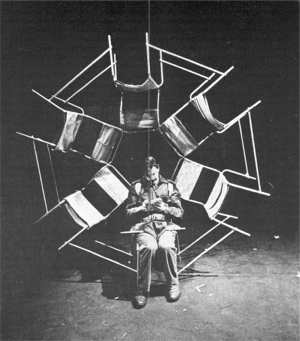
Privates on Parade:
George Pensotti with Chris Booth's
wheel of chairs
In 1971 Chris Booth returned to New Zealand and settled in Northland. He received an Art Council grant in 1978 and in 1979 was chosen as one of six environmental sculptors asked to submit models for the new sculptural work to be placed in Auckland's Aotea Square. Lack of funds drove Booth into Auckland in 1979. In the middle of the year he approached the Mercury for a job (not as a set designer but as a general roustabout). At that time the Mercury was considering training a new designer and Booth's arrival coincided with these intentions.
His first three projects were for Mercury Two - a much smaller, and budget-wise more frugal, space than Mercury One. For his first production, Don Juan Comes Back From the War, his brief from director George Pensotti was simply: 'Give me something that will so amaze the audience that when they enter the theatre they'll be stunned'. On asking how much money was available for this challenging undertaking he was told: 'No more than one hundred and fifteen dollars'. He managed to do it for a hundred.
Booth's next two plays, Abigail's Party and Writer's Cramp were relatively tame and offered little scope for imaginative design. Privates on Parade was his first shot at Mercury One and here again the director, Robert Alderton, threw open to him the whole design concept.
Privates on Parade revolves around an army concert party in Malaya and deals in vast dollops of campery, camaraderie and conflict. It is also a fast-moving script - combining song and dance in a series of spirited scenes that move from bedroom to dressing-room to railway carriage and on to a host of tatty colonial halls. Booth's finished set for Privates certainly looked stunning: with a huge phallic canon dominating stage-centre. This was unquestionably the work of a sculptor, as was the Ferris-wheel-like combination of chairs that stood stage-right for most of the action.
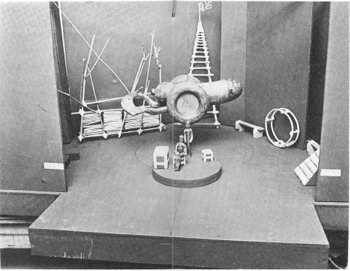
Chris Booth's model
for Privates on Parade set
Now I have always believed that a set should complement as unobtrusively as possible the playwright's intentions; and while certain aspects of the Privates set did this superbly, the cannon and chairs, for me at any rate, struck a discordant note. Booth personally didn't much care for the play, yet he insisted to me that both the cannon and chairs were integral to the mood of the play. He also pointed out the versatility of the cannon, with the circle of coloured lights inset into the downstage wheel serving as a backing to the bar, the mirror on the back wall of the bedroom and the dressing-room mirror. In the last scene, the snout of the cannon swung down and offered a symbolic representation of a ship's gangway.
When it came to discussing the chair-sculpture his explanation of its purpose appeared far less convincing. To Booth the chairs symbolised several things. . . the engine wheels that carried the troupe off on their tour, a military medal, movement up-country, and so on. None of these allusions had occurred to me when watching the play and I couldn't help feeling that the sculptor in so insisting had overshadowed the necessary clarity of the stage designer. Having said all that however one must now state that the over-all design for Privates was visually stimulating and eminently workable in a manner hitherto unseen at the Mercury for a considerable time.
Chris Booth's most recent design for the Mercury was the set for Uncle Vanya. Extremely simple and flexible, it relies for its effectiveness on the use of seasoned unpainted timber capturing the essence of a crumbling villa in pre-revolutionary Russia. Booth's knowledge of raw materials stands him in good stead when it comes to the choice of materials required on stage. He knows very well what they can and cannot be made to do. As a sculptor he also has a clear awareness of the spatial order of things. He plans for the human form, and the movement of actors and light against his structures are always taken into account.
The one major transitional problem for Booth is one of adaptability. As a sculptor he has been used to working alone (usually in some remote rural area). Suddenly he has found himself amongst a highly volatile group of individuals, all laying down certain requirements that must be met within a specified time. He works, as do most stage designers, in three stages. First, he reads through the script three or four times to get the feel of the play, and marks down scene changes, prop and costume requirements. Consultation with the director then leads him on to the second stage - the making of a model. Once the model is seen to work he transfers his attention to the final set, supervising at each interval the construction and painting of materials.
Chris Booth puts as much energy into a stage design as he does into a piece of sculpture; and for this reason he is tending to become increasingly selective in the work he undertakes. Unless the demands of the play offer a challenge he is not particularly interested in the project. 'So many of the plays put on over here have been done elsewhere - all the problems have already been solved.' .What he now wants to do is move into the more experimental areas of stage design. The idea of a new New Zealand play previously unproduced excites him tremendously. As he says: Then the whole thing is wide open!