
Meeting Points
Looking at the Work of Alberto García-Alvarez
LUCINDA BENNETT
Let us begin at the intersection of two lines. Like the hands of a clock, or a drawing compass laid on its side upon the architect’s desk. Forgotten planks of wood, offcuts stacked for a fire. A complicated crucifix or a simple garden trellis, incorrectly assembled. Yet there is something careful in the way Alberto García-Alvarez has coloured and placed these pieces of wood. They are like sigils, meticulously arranged to summon or to seal, angles and hues chosen to enhance their power.
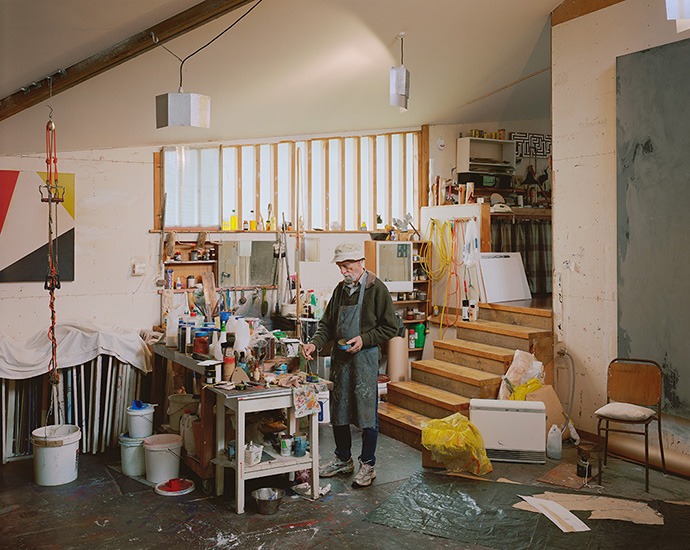
Alberto Garcia-Alvarez Mixing Pigments in His Studio 2013
(Photograph: Chris Corson-Scott)
The artist calls his wooden constructions ‘crossings’, but of what? Of objects, of wood over colour, blue over yellow, yellow over dark, over silver? Of ideas, perspectives, emotions, crossing paths, over obstacles, beyond prejudices? Or perhaps these constructions stand in for the act of crossing. A voyage across the sea, the fording of a stream. Often, we humans will create concrete markers to signify a safe place to make a crossing. We cross, guided by lines, lights, flags and poles. Zebra stripes, a peg thrust in the mud tied with a scrap of white cloth. We cross when the storm subsides, when the way is clear.
Idly scrolling through dictionary entries, searching for meaning I may have missed in the word ‘crossing’, I read that, in architecture, the intersection of the nave and transept in a church is referred to as the crossing. Meanwhile, in the soupy science of genetics, crossing refers to the act of mixing different species or varieties of plants or animals to produce hybrids or crossbreeds, entities that belong doubly or not at all. It seems that science and religion both are concerned with crossings, with the physical and metaphysical possibilities of two lines meeting.
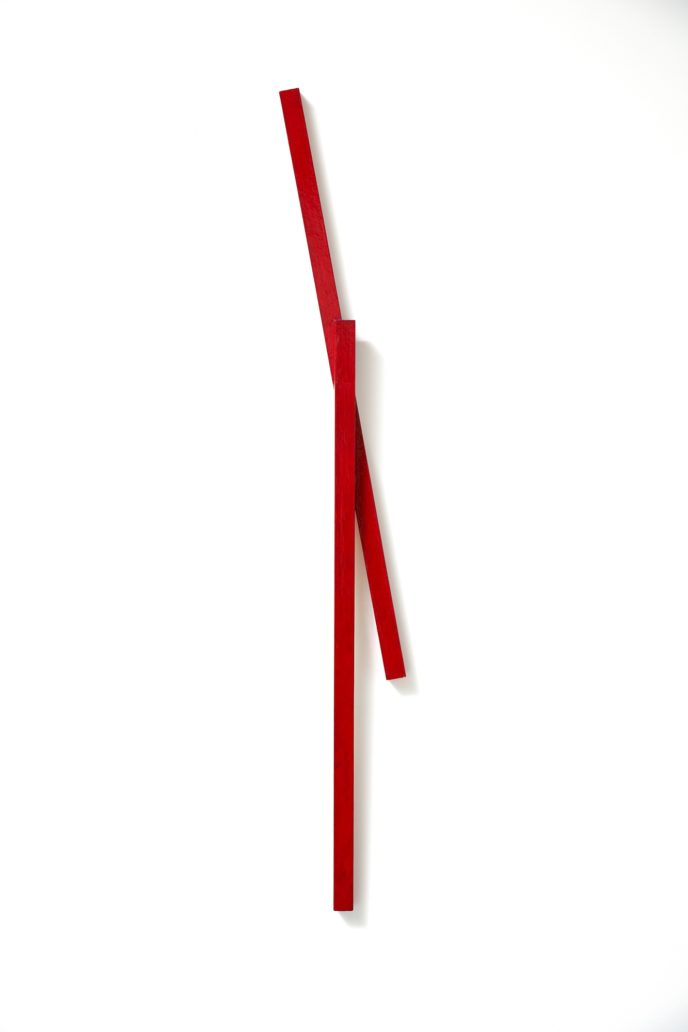
ALBERTO GARCÍA-ALVAREZ 2019-Black Light June 2019
Mixed media on wood, 1315 x 160 x 60 mm.
It occurs to me that scrolling is anathema to crossing. In networked space, there are no crossings, only links. We jump from site to site, we do not follow linear paths. Even the most complex of García-Alvarez’s Crossings have a fixed point. In fact, this ‘fixed core’ might be one of the only consistent threads in his practice. Across lithograph, painting and sculpture (I use the word sculpture loosely here, for García-Alvarez’s wooden constructions are so frontal as to be read as paintings), there seems always to be an area of stillness, a meeting point between belief and doubt, a stable eye amid a restless painted storm. Take, for example, the irregularly shaped paintings he made in the mid-1980s. I have nicknamed these ‘folded paintings’ in my notes, for when I first came across them, I thought of origami. C225 (1984) looks almost like a half-made paper plane, albeit in a sooty, McCahon-esque palette. Novia (1985) brings the starchy drape of a Japanese kimono to mind, rectangle sleeves, rhombus through the torso, black triangle lapels. The simple grace of origami rests on the clean folds, all lines returning to the centre. Similarly, García-Alvarez’s lithographs from around this time seem built of folds, gesturing towards the ephemerality of perception, the way we can only view a piece of an object at a time but, as we move around it, we can build an impression of the thing in our minds. Works such as Monte Alban (1983/84) appear to be folding in on themselves, each piece of its ‘object’ seeming to become hidden beneath gossamer folds, tightening around its fixed core. In his Crossings, the crossing is the fixed point, the place where all lines layer and converge. Perception is lightly challenged again as we move around these constructions, each edge painted a different colour, our sense of each plank as a discrete object becoming confused. Are these separate slabs of wood, or separate segments of colour? What of a silver plank, glimmering and ghostly? Or a matte grey plank or board that appears desperate to melt into the background? Questions of perception agitate around the fixed core. These are alert, restless pieces of art, with fixed centres but no fixed meanings.
* * *Since he first began making his painted wooden constructions in Sausalito, California, in 1967, García-Alvarez has returned regularly to the series, producing more than a hundred of them. His most recent exhibition, Labyrinth at Tim Melville Gallery, included Crossings from 2015, 2017, 2018, 2019; raw-looking constructions painted with blocks of silver, black and brights, shown alongside (and in conversation with) a large, web-like, monochromatic painting from 1991.
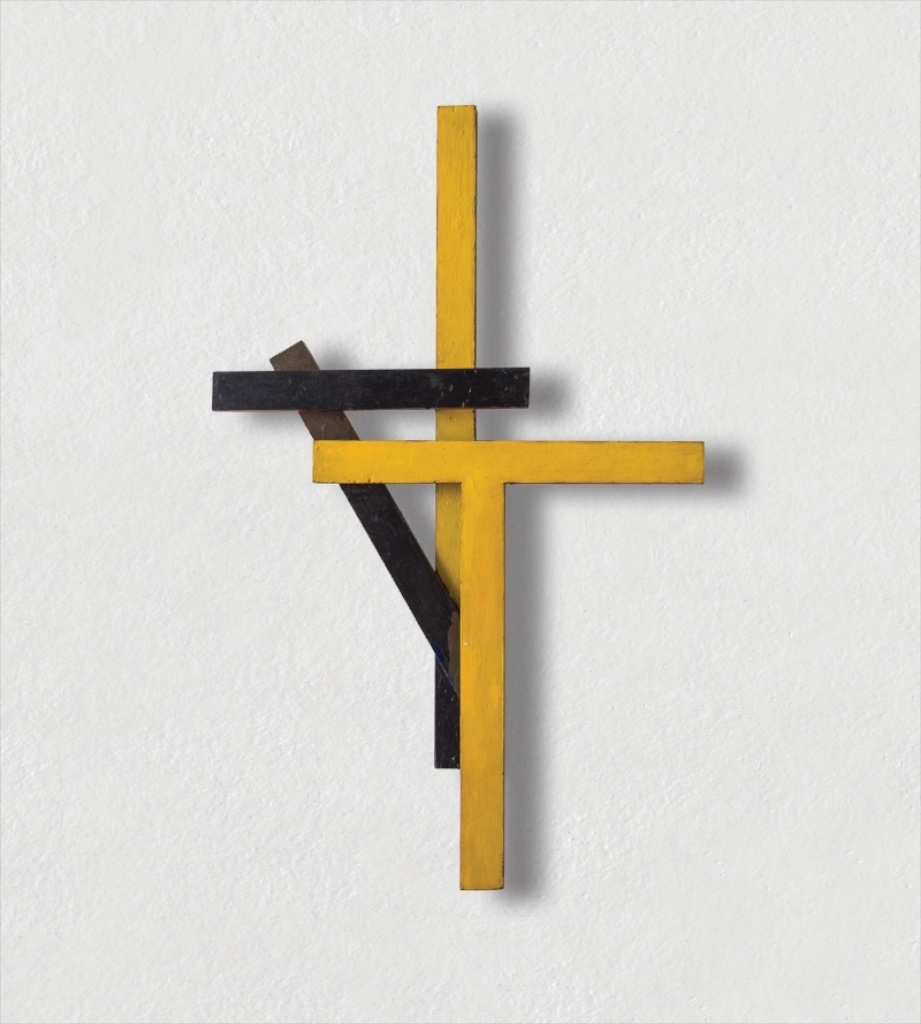
ALBERTO GARCÍA-ALVAREZ 1976-6 1976
Oil on wood, 820 x 520 mm.
How fitting, for an artist who has travelled so far, to keep returning to the subject of crossings. For García-Alvarez, there have been two major crossings in his life; the first being his crossing of the Atlantic from his home in Barcelona (where he was born in 1928) to California in the early 1960s. In Spain, García-Alvarez had attended the Llotja Art School and made his name as one of the founders of the FLAMMA group (1947–53), working on religious murals and frescoes such as the chapel of Saint Sebastian in Tossa de Mar (1956), and the chapel of the Sacraments in the Church of Belén, Barcelona (1953).
In California, he continued to work at a large scale, fulfilling religious commissions, including a series of frescoes for the Redemptorist Seminary in Oakland, and a full, ambitious artistic fit-out for the newly built St Louis Bertrand Church, which saw him design and install a series of frescoes depicting the 14 Stations of the Cross, an ambitious stained-glass window project, two large concrete-cast sculptures and a baptismal font carved in Carrara marble. Meanwhile, in his studio practice, García-Alvarez was deep into his explorations of abstraction, and in California he began exhibiting his paintings alongside minimalists including Frank Stella and Brice Marden, as well as staging solo exhibitions at San Francisco Museum of Modern Art and San José Art Centre. If I seem to have suggested a chasm between García-Alvarez’s religious commissions and his abstract explorations, it is only a superficial one, summoned to give some semblance of structure to a practice that evades chronology. Each thread in García-Alvarez’s work twists together with another to become a sheet that sprawls across his whole practice. An example: as Andrew Bogle has noted in his 1985 Art New Zealand article, García-Alvarez’s abstractions were greatly influenced by the necessary geometrical concerns of fresco technique.(1) As the artist himself explains, ‘In fresco you have to prepare an area where you are going to work. Then at the end―since you can’t paint the full thing―you cut with a knife all around the area and peel off the surrounding mortar, so you can apply fresh mortar for the next area.’(2) He goes on to describe the way he is always searching for hard lines when making a fresco, the edges of a silhouette or a piece of architecture where you can make an incision without the join being visible in the finished work. Bogle writes, ‘there is an extraordinary formal consistency to his work that can be traced right back to the church murals in Barcelona and Majorca. In fact his method with the early murals was to make a number of abstract studies to provide an overall framework within which he could place his figures.’(3) In this way, we see the time, space and mediums García-Alvarez’s threads are woven across, how the religious commissions do not so much inform the abstractions as the two exist together; are crossbreeds, perhaps, able to be two things at once.
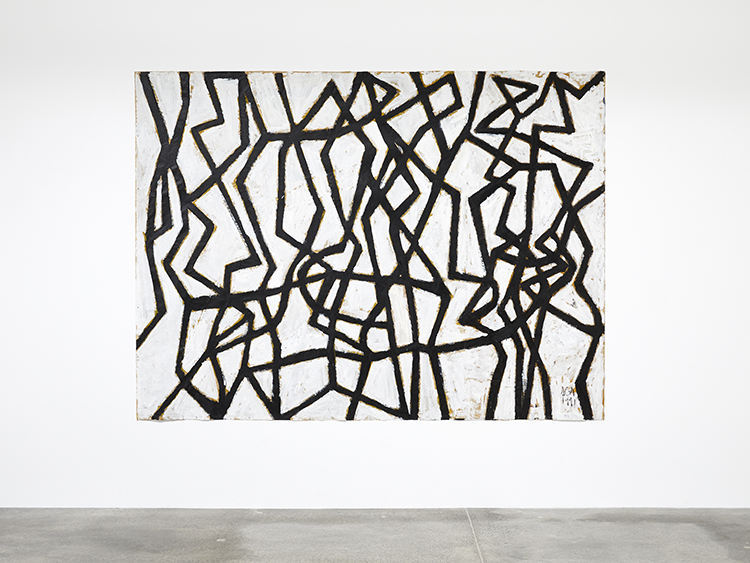
ALBERTO GARCÍA-ALVAREZ 1991-54 1991
Mixed media on paper, 1860 x 2500 mm.
García-Alvarez’s next great crossing came in 1973, when he traversed the Pacific, transitioning from teaching across California universities to a new role at Elam School of Fine Arts in Auckland. Having been head-hunted by painter Robert Ellis, García-Alvarez spent a year as a visiting senior lecturer before deciding to settle in New Zealand, remaining at the school until his retirement in 1994. During his Elam decades, García-Alvarez exhibited his large abstract paintings and prints, including mounting a 1984 exhibition at the Auckland City Art Gallery that focused on his remarkably sizable lithographs. He also continued to receive commissions for public works, his most visible being the 1979 Collective Mind, an enormous ceramic mural on the western side of the University of Auckland’s Science Building, facing onto Princes Street.
Retirement for García-Alvarez never meant retirement from painting. Since 1994, he has focused on the ‘daily practice of painting’―something he believes ‘essential in order to have an alert mind’.(4) He continued to work steadily towards his own personal vision, not showing any of his art until his 2009 exhibition at ST PAUL St gave audiences an opportunity to rediscover his work. In 2012 he mounted a solo show at Tim Melville Gallery, followed by a 2015 exhibition at City Gallery Wellington. Two years later, the Fundacio Vila Casas in Barcelona staged a major solo show, marking six decades since the artist’s last exhibition in Spain.
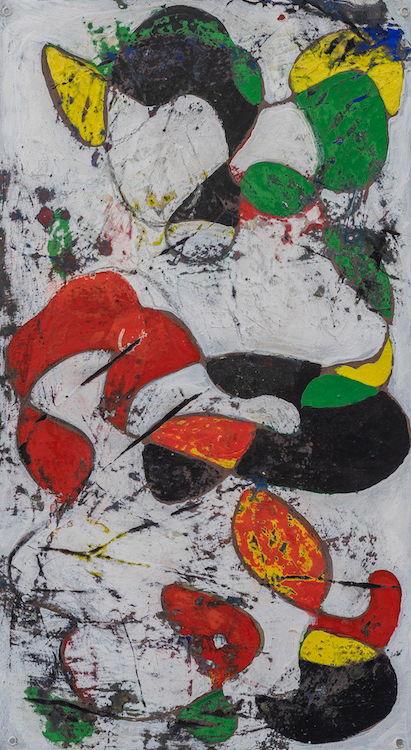
ALBERTO GARCÍA-ALVAREZ A-71 1994
Mixed media on aluminium, 805 x 525 mm.
Maintaining a daily practice over 25 years requires plenty of surfaces on which to paint, and García-Alvarez has proved adaptable. In his gallery office, Tim Melville has lined the walls with paintings for me to peruse. Despite their minimal frames and clean, careful matting, many look salvaged, dredged out of ruins. I think of warehouses and building refuse, feel the ebbs and flows of destruction and refurbishment. There are works on paper (including the spidery, black-and-white 1991-54), on canvas, board, wood, and my favourite, sheets of aluminium. A-157 (1994) is one such work, although the metal is the utilitarian brown of paper, the kind used to wrap packages. Purple paint has been scumbled and slashed upwards. Both metal and paint are completely matte, rendering the surface soft, at odds with the painted edge that appears to be a thin, savage blade. Meanwhile, A-71, a mixed media on aluminium from the same year, recalls García-Alvarez’s stained-glass creation at St Louis Bertrand Church. There is a casual, childlike sloppiness to the painting, with its looping, leaden doodle lines and glowing primary colours contained within. But then, it also looks as though it has been left in the den of a wild animal, scratched by a lion claw, sat on with immense weight.
The booklet accompanying the exhibition Labyrinth begins with a letter from García-Alvarez. His letter opens with the phrase, 'let me explain', and I want to reply, 'no explanation necessary', because to explain the work is to cut the feeling of it. But García-Alvarez knows this; it is why he offers a quote from Dante’s Inferno, included in Italian, 'Lasciate ogni speranze voi ch’entrate'. The English: ‘Abandon all hope, ye who enter’.
To give García-Alvarez’s work your time is to enter his personal labyrinth. As I look, I try to string the works into something coherent, but they resist. In the same way the success of a labyrinth hinges on a lack of rationality, García-Alvarez’s work is captivating for the way it is many seemingly conflicting things at once.
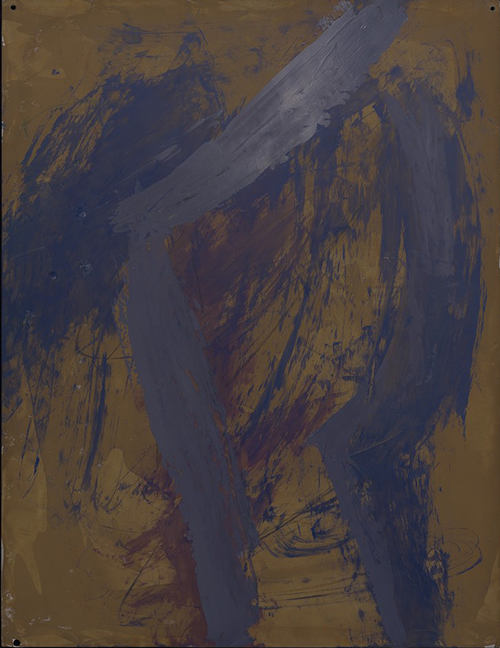
ALBERTO GARCÍA-ALVAREZ A-157 1994
Mixed media on aluminium, 430 x 345 mm.
In his conversation with Leonhard Emmerling, García-Alvarez explains that, ‘in Spain we say: Todas las cosas buenas son pecado o engordan―all good things are sin or make you fat.’ He is responding to a specific query as to why some of his paintings have triangles cut out of them. When the painting is good, he posits, something must be done to destroy it. He explains, ‘in a way I want to destroy the exuberance and freedom of the strokes made . . . I probably destroy the passion of nature by a controlled action’.(5)
Probably. It is not a conscious act; even García-Alvarez cannot fully explain his process. I am reminded of that axiom, coined by the notable paediatrician Donald Winnicott: ‘What is good is always being destroyed’. Unable to find the context for the original quote, I imagine that Winnicott, an expert in developmental psychology, is referring to the notion that life is a series of devastations children not only develop in spite of, but because of. Looking at García-Alvarez’s work, I cannot help but wilfully misremember the quote and think to myself, ‘it is good because it has been destroyed’. Which is ultimately the same thing, isn’t it?
1. Alberto García-Alvarez, quoted in Andrew Bogle, ‘Alberto Garcia-Alvarez: Illusionism and Abstraction’, Art New Zealand 35, Winter 1985, p. 34.
2. Ibid
3. Ibid.
4. Alberto García-Alvarez talks with Leonhard Emmerling. Exhibition catalogue for Alberto García-Alvarez at ST PAUL St, Auckland, 16 July–7 August 2009.
5. Ibid.