
Film Review
Geoff Dixon: Portraits of Us
directed by Glenis Giles & Clare O’Leary
Gogo Media, Wellington 2022
DON ABBOTT
Geoff Dixon is a Bluff-born artist who has made his home in Cairns, Australia. Now in his sixties, he has been exhibiting in New Zealand, with Wellington’s Bowen Galleries since the mid-1980s. Glenis Giles and Clare O’Leary’s Portraits of Us, screening at International Film Festivals around the country, is a feature-length documentary that profiles Dixon, delivering a fascinating portrait of his art and life.
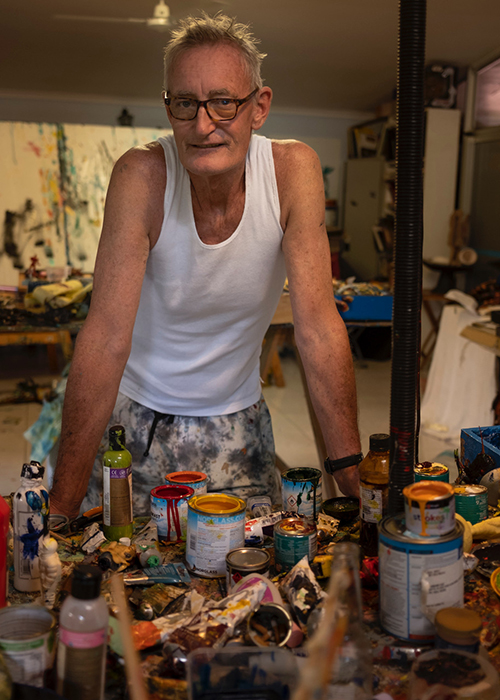
Geoff Dixon in his Cairns studio, 2021
(Photograph: Michael Marzik)
The film spends a lot of time in Dixon’s studio, listening to him talk while he readies canvases in preparation for an exhibition. He is a natural at talking about his art: techniques, materials, themes. He describes a canvas as he applies a white compound containing marble dust as ‘an environment, one that defines where everything else goes’. Watching him in this setting, even though he says he does not like people seeing his half-finished work, is the visual equivalent of eavesdropping, a mix of intimacy and subterfuge. The camera roves around the studio in the way that a nature documentary surveys a landscape, with a mix of reverence, scientific interest and curiosity. By the end of the film the studio feels remarkably comfortable and comforting, its quirks—dinosaurs, plastic toys, paint tubes, wine boxes— recognisable, meaningful and familiar.
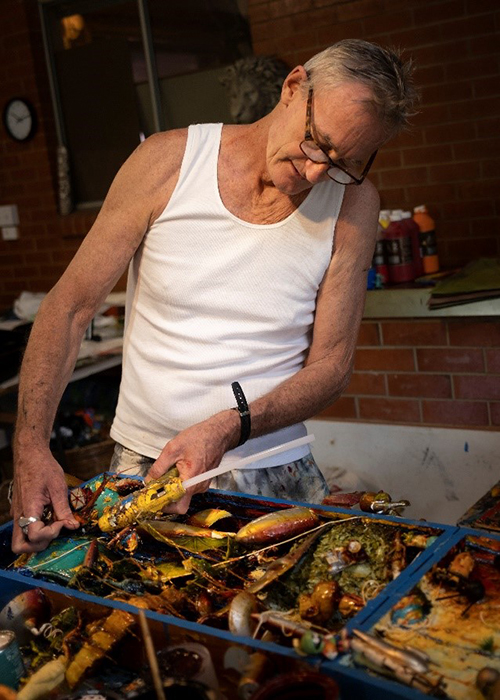
Geoff Dixon in his Cairns studio, 2021
(Photograph: Michael Marzik)
The film is a portrait of the artist as a participant in two important and formative relationships. The first is with his friend and fellow émigré Euan Macleod, who in the film is visiting from Sydney, and with whom he attended Christchurch Technical Institute in 1974–75. They were enrolled in the graphic design programme, and their teachers included Barry Cleavin and Michael Reed. To this day they are grateful for the education they received. It is rare to witness a lifelong friendship such as theirs on screen, played out in a series of lively interviews, its rewards evident in the casual, relaxed and forgiving humour that exists between the two men.
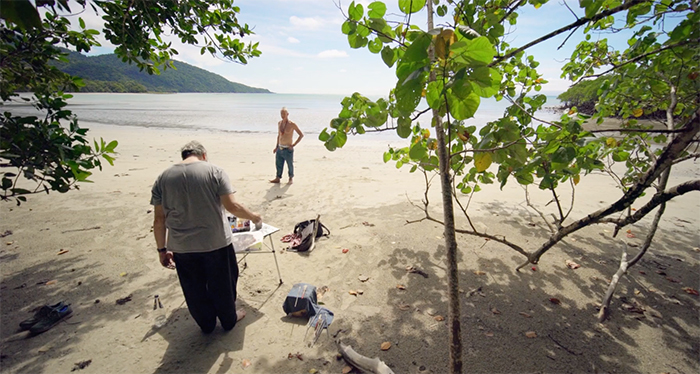
Euan Macleod paints Geoff Dixon at the beach, in a still from Portraits of Us
Dixon has modelled for Macleod’s paintings for decades—if you know Macleod’s work you will recognise Dixon’s pose and lanky frame. Macleod’s painterly eye admires Dixon’s ‘perfect bone structure, almost Egon Schiele, and massive [pauses] . . . nose’.
The other relationship on screen is that between Dixon and fellow artist Arone Meekes. Meekes is Aboriginal with tribal links in Far North Queensland. The two relate how they met, fell in love and established a life together, one that has lasted 21 years. Once again it is rare to see a long-term gay male relationship on screen, discussed and expressed in such an ordinary way that it becomes extraordinary.
Dixon’s paintings fall on the extraordinary side of things and so the camera spends time cruising their surfaces, which allows an appreciation of their detail. They are textured to such an extent they could be called contoured, with lines, gouges and counterpoint that add layers to each painting.
Dixon has several themes that he has rather obsessively explored throughout his career. Most of his works include birds, mainly endangered species. He celebrates the natural world, and warns against extinction and the destruction of our planet. ‘What are we doing to our natural world and when are we going to wake up?’ he pleads to the camera. He references technology by the inclusion of spaceships and UFOs, and creates psychological landscapes by painting these things together, with little regard for rules of perspective and scale. ‘Everything affects everything else,’ he says in the film, and it is an apt description for the internal workings of each of his canvases.
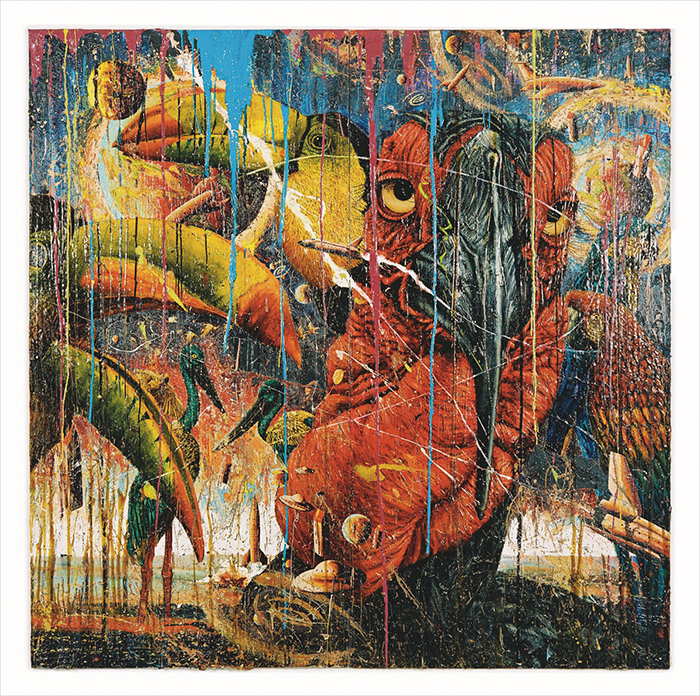
GEOFF DIXON Space/Rain Forest 2005
Acrylic & oil glazes on board, 2400 x 2400 mm.
(Photograph: Stephen A’Court)
These works are reminiscent of Bosch, or of the energy of the best of medieval marginalia, the juicy bits on the side that cut to the truth of the text they surround. The time Dixon has spent in the tropics is evident in his use of vivid colour, and there is a strong sense of scientific obsession, and a long-held love and respect for the environment.
The scientific bent in his artwork is the result of brushes with two important scientists: at the age of 12 Dixon’s tonsils were removed by Dr Geoffrey Orbell, the man who rediscovered the takahē in Fiordland. And after art school he was employed by Canterbury Museum, and spent two years drawing the genitals of the caddisfly for Alec McFarlane, who would eventually write and publish a paper on the subject.
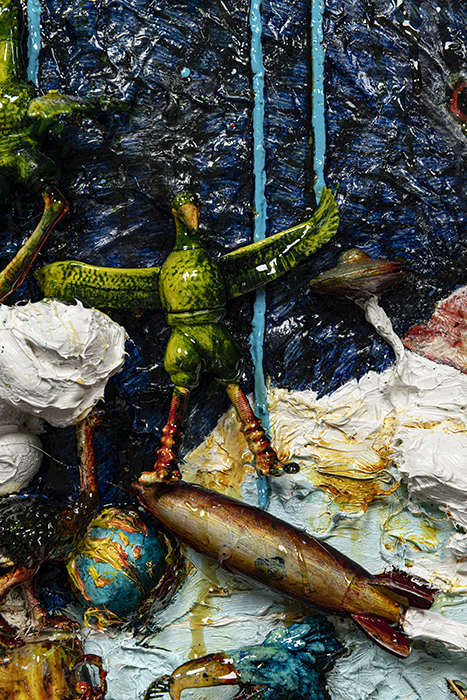
GEOFF DIXON Detail from To the Moon and Stars and Back 2022
After 70 minutes of such stories, insight and mirth, Dixon is a familiar and immensely likeable person— playful, adventurous and almost fearless in his approach to his art and life. It is remarkable the extent to which the audience empathises with the artist, sharing his emotions and experiences.
It seems the directors of Portraits of Us have worked to make themselves almost invisible, creating a seemingly direct connection between the film’s subjects and viewers. Every now and then a question is asked from off-camera, and you are reminded that this is a mediated artform. Interviewees in the film are given space and time to talk, and the research behind this project is impressive. The original music is by Plan 9, and is a major feature of the film. Wordless singing by Janet Roddick provides a human contrast to the drone sounds that supply a suitable sonic background; a bowed saw evokes birdsong; a simple two-chord mantra (played on a small double-strung Thai guitar, Mahalo ukulele guitar and Chromoharp) subtly underlines strong emotions.
Geoff Dixon is a complex man with a straight-up demeanour, captured here with sensitivity and deftness. Portraits of Us is a supremely rewarding documentary.