
All That Glitters
The Complexity of Cardboard in the Work of Monique Lacey
AMY STEWART
Perhaps what one wants to say is formed in childhood and the rest of one’s life is spent trying to say it.
Barbara Hepworth
Monique Lacey’s earliest memory is from kindergarten; in it she is fashioning a handbag out of a cardboard box. Fast-forward a few decades and she is an established painter beginning her Master’s degree, and has just been challenged to produce 20 objects in three days. The exercise is designed to expedite the path to her ‘one good idea’, the idea that will, supposedly, unlock her practice. That was a few years ago now but some of the objects she made are still in her studio and—spoiler alert—not one of them was a painting.
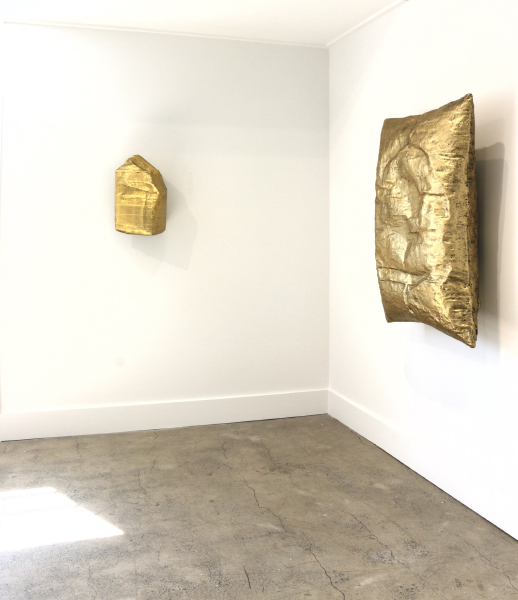
Monique Lacey’s Bipartiss Solucius at Scott Lawrie Gallery, October 2020, with from left, The Emperor’s New Clothes & Full of Hot Air (both 2020)
Under the immense pressure imposed by the spectre of her first-ever crit, instead of reaching for paintbrushes and canvas, she reached for cable ties, paper stock and wood frames. The habitually prolific Lacey admits to being nearly in tears when she reached 18 objects but persevered and made 21, all of which she calls ‘wall objects’—in other words, sculptures. The assessors were delighted and left Lacey alone, surrounded by her creations, to continue the series. ‘I sat back, and I thought, “What just happened?”’ Lacey laughs, ‘I’m a painter, not a sculptor.’
Lacey herself was more perplexed than anyone at what had just transpired. ‘I phoned up my supervisor and said, “I need a meeting.” I wrapped up a couple of paintings and went there and I said, “Look, there’s been a mistake. I’m really sorry. I don’t know where that came from, but I’m actually a painter. See? Here are my paintings.”’ But they didn’t want to see Lacey’s paintings, they said. They knew she could paint. What she was making now was something different, something altogether more interesting.
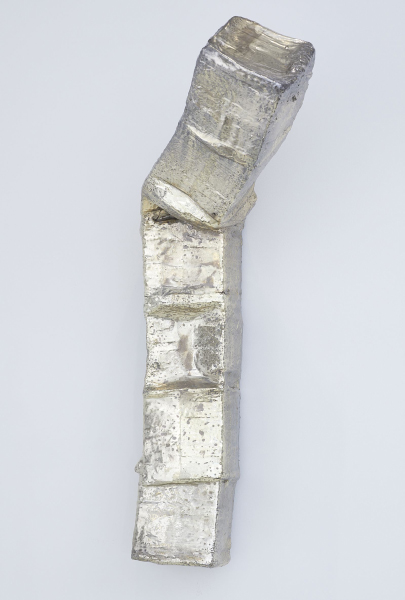
MONIQUE LACEY Monkey Business 2020
Cardboard, plaster, paint & resin, 430 x 1150 x 490 mm.
As it turns out, Lacey is a natural sculptor. With an acute sensitivity to even the smallest inflection of weight and light, it is hard to imagine her doing anything else. She is drawn to commercial materials that have no intrinsic value by their potential for deception, a nod to arte povera and a result of her working method, which is at once prolific and extremely selective. ‘It’s a numbers game in a way. I always have ten things on the go, because then I don’t need to worry if number seven doesn’t work out, because then I’ll turn to number six and number eight.’
To hear Lacey describe cardboard boxes is like listening to Canova describe the subtleties of Carrara marble. She is intimately familiar with the different weights, the different textures, how age alters them, the way certain sizes will yield to her body when she precisely but brutally crushes them. In addition to the episode in kindergarten, Lacey adds that ‘in a previous life’ she ran a shop where she was surrounded by boxes, forever breaking them down, stacking them, folding them. ‘There is such variation in cardboard—you have no idea.’ Recycled cardboard won’t do either; Lacey pushes her boxes very exactly to their limit, and she has to know what they have already been through to predict what sort of force they can withstand.
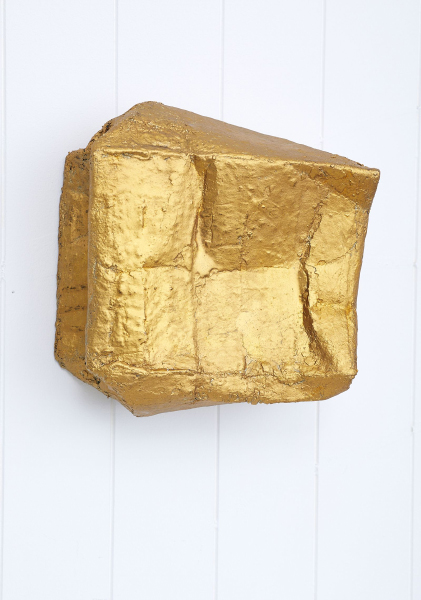
MONIQUE LACEY Fake News 2020
Cardboard, plaster, paint, resin & bronze pulver, 250 x 230 x 140 mm.
It has not always been the humble cardboard box, and they have not always been coated in resin, plaster and pigment (the very particular bronze tone in works such as Fake News is bronze pulver, which is used to brand the ends of cigarettes—another delightful high-low moment). Fresh off her 20-object challenge, Lacey prowled the aisles of Mitre 10 on the hunt for materials until she settled on wool sacks—aesthetically interesting, endlessly malleable. There was only one problem: ‘Horrific to deal with! They make a terrible mess.’ A corner of her studio is currently haunted by an enormous, neon pink tinsel pom-pom, another adventure that she enjoyed but ultimately abandoned. She has even tried having her forms cast in traditional materials like bronze and while it looked good, she does not relish the process. She is a maker, she says, and she does not like outsourcing.
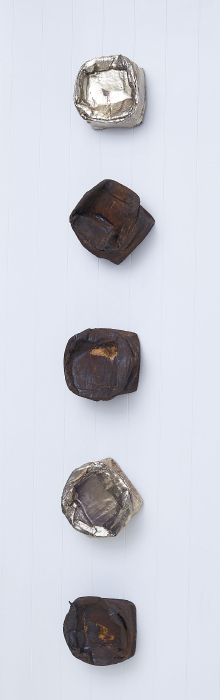
MONIQUE LACEY Herd Mentality 2020
Cardboard, resin, plaster & paint, each piece 220 x 220 x 130 mm.
Lacey’s most recent show at Scott Lawrie Gallery, Bipartiss Solucius, was not planned to coincide with such a fever-pitch moment in the American election cycle, but its timing was another unexpected gift delivered by The Year 2020. As it happened, Bipartiss Solucius closed one week before the American polls did, after millions of Americans, including this author, had already cast early votes, and before the agonising week-long election that caused many—including this author—to fret much and sleep little.
The name of the show sounds technical but is nonsense, and as such is much more than just a clever name. It is an exact transcription of one of Donald Trump’s slurred statements uttered during a rally, where it matters little what he says—the adoration of his followers is without limit; the crowds froth uncritically.
The experience of stepping into the gallery to drink in Bipartiss Solucius sits in stark contrast to the hysteria of those televised rallies. Lacey’s sculptures have a wonderful balance of bulk and levity, at once appearing inflated (Full of Hot Air, a gilded, human-torso-sized pillow, alludes to this) but also like they are made of stone. Some have surfaces that reflect light and others, like House of Cards, absorb it. Some, like Monkey Business, seem to lean towards you as if asking your opinion, and Lacey herself describes her objects as ‘kind’. The artist says she is ‘fascinated’ by the process of elevating and transforming common materials to make them seem valuable when they are not, a statement that forms a tidy parallel with a certain bronzed demagogue.
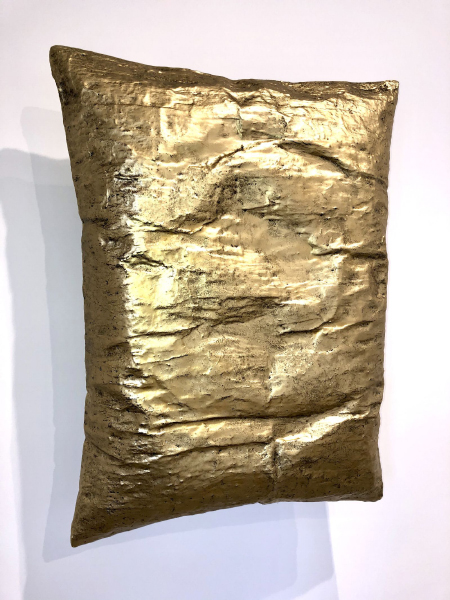
MONIQUE LACEY Full of Hot Air 2020
In 2019, before the world’s nations closed their doors to each other, Lacey undertook a residency in Texas. In that peculiarly American way, the TV was left on in the studio constantly, all day, and was tuned exclusively to CNN. The CNN news cycle was dominated by Trump, and so his garbled catchphrases and wild intonation seeped into Lacey’s subconscious, an unwanted backing track to the work she was trying to produce. In that way, the show is not really about Trump—it just happened while he was also happening. And so there is a sense that, like ancient gneiss, these objects have always existed and the Trumpian titles of Bipartiss Solucius denote what happened around them while they were just being. Like soil samples, the state of the atmosphere influences their composition and they end up telling the story of what the world was doing when they came to exist.
For much of the international population and also for many in the US, this is an accurate metaphor for the Trump presidency. It happened around them but not to them. It provided dinner-party fodder and Saturday Night Live punchlines, but if you are not a person of colour, Muslim, queer, or a member of any of the other myriad marginalised groups whose lives were endangered by his flippancy, he continued to be a comic-book figure, a joke, something happening in the background. For so many, he was tragically very real, as were the consequences of the policies enacted on the back of late-night, poorly articulated tweets.
For a very long time Lacey resisted titles, leaving most of her early works open-ended and without them. But for work that is initially so hard to pin down, titles afford the viewer a welcome foothold and, importantly, inject some of Lacey’s wry, perceptive humour. ‘I’m not a person who is,’ she pauses, ‘overly serious.’ Lacey believes that humour and making fun are effective means to affect people’s worldview. ‘There is value in that proposition, rather than being very blunt about it. I find the gentle poke very effective.’
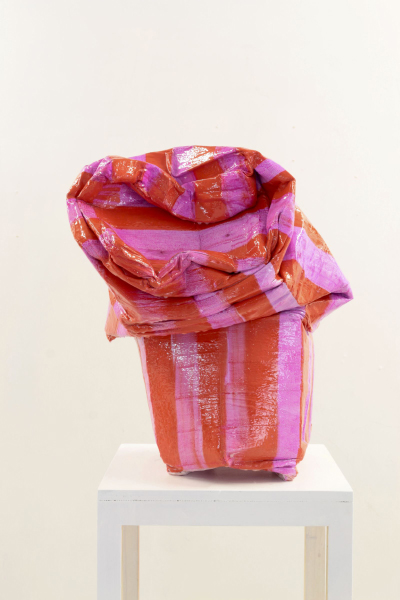
MONIQUE LACEY Pillar 2020
The titles are a dependable guide into and through Lacey’s oeuvre. The Emperor’s New Clothes gleams in brassy gold. Pillar of Society looks decidedly unreliable, like a pre-formed concrete parking-lot column that has been compromised and is on the brink of collapse. The Oranges of Investigation is not orange but a stark black, mesmerising in its depth and with a faint glitter. Herd Mentality very satisfyingly resembles metal that has been punched, squarely and hard. It channels the singular force of the piece that started it all for Lacey—an untitled cardboard piece that was subjected to a singular stomp in a fit of creative-block rage. She had tried unsuccessfully to crush it kindly, but the cardboard had hardened with age and would not yield, so she put her boot through it. And so that ‘one good idea’ is forever petrified in that singular, gestural moment.
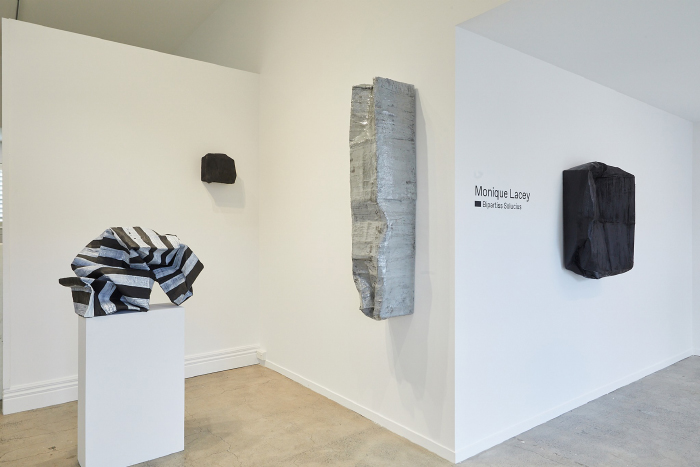
Monique Lacey’s Bipartiss Solucius at Scott Lawrie Gallery, October 2020, with from left, It’s Like Pushing Shit Uphill, House of Cards, Pillar of Society & The Oranges of Investigation (all 2020)
Lacey’s art is ultimately about artifice. It is about two-facedness and trickery. That must not be confused with glibness, however, and the sardonic bent of the titles here belie a heartfelt critique. ‘It’s about trying to make the works look like something when they are really nothing—they’re full of hot air.’ And while the work is not about Trump per se, the man himself is a good poster boy for what Lacey describes as the innate ‘deceit’ in her practice, the sort of King Midas sleight-of-hand necessary to turn cardboard into gold.
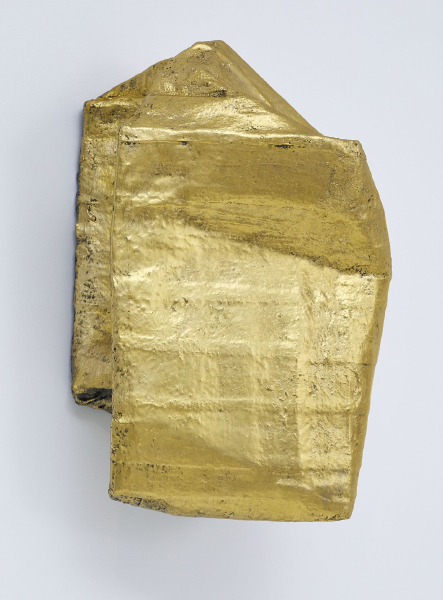
MONIQUE LACEY The Emperor’s New Clothes 2020
Lacey sculpts by crushing the cardboard with her body and, given the show’s reference material, a more cathartic process is scarcely imaginable. This process looks destructive when it is in fact producing and shaping; for a woman operating within the canon of male-dominated minimalism and abstract expressionism, it feels like a cool drink of water. Once they are crushed, the boxes are coated in plaster, resin, paint, wax, ‘whatever the surface needs’. When asked how she knows when a sculpture is finished, she quotes American painter Brice Marden: ‘He said “when the work can breathe on its own”, which is such a good explanation. I relate to that. When the work breathes on its own for me it sits right on the edge between liveliness and lifelessness.’ She demonstrates with a work-in-progress hanging on the studio wall, which, to the untrained eye, looks like it could be made of solid chalk. But when she lifts it off the wall it flops like papier-mâché and is soft like skin. It is ready to be resined, she says, but she had been watching it for a while, just sitting there on the wall, to see what it would do.
‘The thing with art is it’s all decisions. How big, how small, where do you crush it, what colour—they’re all decisions. And sometimes they’re really hard to get to the bottom of.’ Her discerning eye is what allows her to scan an object’s surface and, in a moment, calculate its mass, its effect on the viewer, and decide whether it needs a swift left hook or another sprinkling of metallic pigment. Does she wish she could use colour like, say, Franz West? She answers with her characteristic incisive clarity: ‘It’s a bit like clothes shopping,’ she says. ‘You may want what that person is wearing, but it may not work on you. But you can admire it.’ Metallics, deep, rich blacks with the faintest glimmer of glitter, are what feels right.
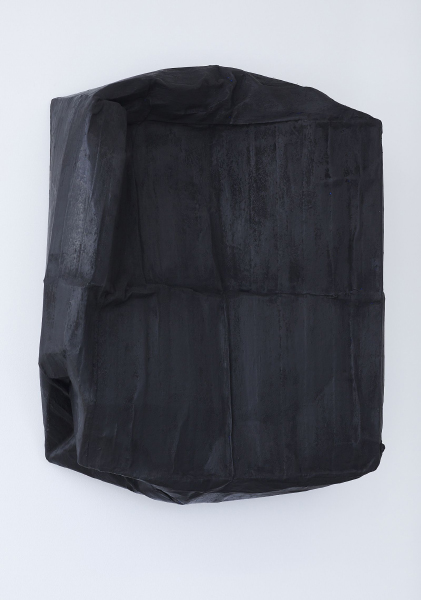
MONIQUE LACEY The Oranges of Investigation 2020
She looks over at a monumental arched sculpture standing on a plinth, reaching over itself and balancing God knows how. ‘It can’t stay like it is. It needs to be finished. I’ve been looking at that for the last four months.’ In the meantime, a show in Houston has gone the way of so many plans, namely postponed indefinitely until some bright, post-Covid future arrives. An upcoming show in Melbourne looks more promising and there will be another show at Scott Lawrie Gallery in the autumn. After rattling off this list she pauses and points to a small but weighty piece on the wall: ‘That work is called We’ll all just have to suck it up.’