
Paintings Talk
Shona Rapira Davies on her Recent Work
WILLIAM DART
Back in the 1980s, Shona Rapira Davies announced herself with work that bristled with the energies of burgeoning Maori consciousness and the women’s art movement. The portrayal of the life-size victim in her 1987 Govett-Brewster installation, Ma te wahine ka tupu ai te hanga ne, te tangata, ma te whenua kawhai opanga ai/Woman found raped, wrapped in a threadbare cloak was stark and confrontational.(1)
It was a stand that is also reflected in Rapira Davies’ iconic Nga Morehu (The Survivors), a group of life-sized terracotta Maori women on an uncompleted flax mat, singing a waiata. Talking to Jim and Mary Barr several years later, she admitted to the influence of Rodin,(2) but there were also echoes of Picasso in the forms, and parallels, in this country, with the earth goddesses of Bronwynne Cornish.(3)
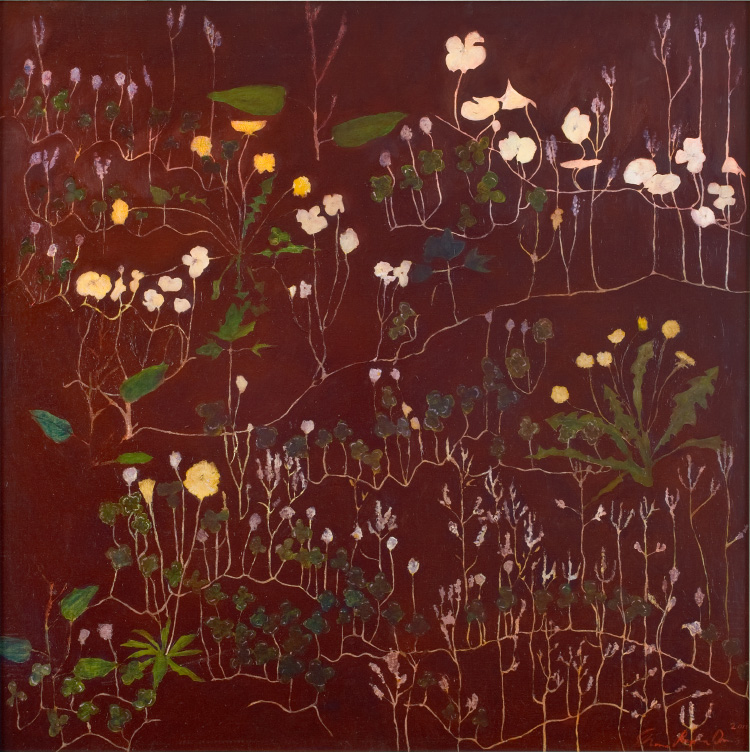
SHONA RAPIRA DAVIES Ka pinea koe a ahau Kit e pine o te aroha. Ke te price a kore nei E waikura eOil on canvas, 1360 x 1360 mm. (Victoria University of Wellington Collection)
Rapira Davies was a survivor herself. Two years studying sculpture at Otago Polytechnic in 1980-81, as a solo mother of two young children, had been a ‘major cultural shock, like going into another country’ for this woman of Ngati Wai descent.
In Dunedin, she experienced what she now describes as ‘not exactly racism, but more of a casual unknowing. It was a kind of blindness,’ she tells me. ‘Maori were talked of in the past tense, like those people over there who had died.’
Yet for all the political implications of Nga Morehu, there was also the technical struggle in creating the work. ‘A huge step,’ she sighs. ‘Laborious!’ follows, with one of her characteristic darting, suppressed shouts.
‘Geoff Wilson had helped me build a special kiln; it was two metres high, a huge, chunky thing. I was working at the extremes of ceramic art.’
The crucial waiata text on the women’s bodies was added in the middle of the night.
‘Everybody in the gallery had gone home and I started writing it,’ Rapira Davies remembers. ‘I came back the next day and I got these horrified looks. If they had been there they might have stopped me from doing it. It wouldn’t be what it is. Women dressed in black are just the stereotype of Maori women; when you put that stuff on top, that takes it to another level.’
Rapira Davies has moved on. ‘I’m stepping away from the whole ceramic thing,’ she stresses. ‘I’m not a craftsman. I’m more interested in what's happening inside.’
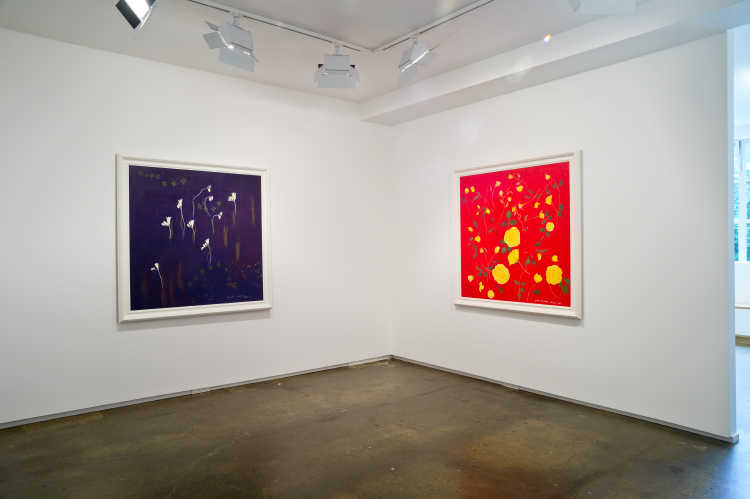
Shona Rapira Davies' Nana he horihori Katoa at Bowen Galleries, February 2013, with One last time Alecia Jean (left) and 40 Roses for Wendy (right)(Photograph: Stephen A'Court)
There have been decades of controversial public art, from her 1988-92 installation at Wellington's Te Aro Park, the subject of Pamela Meekings-Stewart’s television documentary A Cat Among the Pigeons,(4) to the various highly politicized statements of the 90s, including her 1998 Immigrant exhibition at Wellington’s Bowen Galleries.
Rapira-Davies has now turned to the more traditional medium of paint, with a series of four imposing images of flowers, capitalizing on the painterly skills identified by Luit Bieringa when he included three of her large oil paintings in his 1986 Content/Context exhibition at the then National Art Gallery.
There are practical issues that fuelled the shift from sculpture to painting; foremost among them, the latter is less expensive and she feels that she now has ‘far more facility in handling the materials.’
As an aside, Rapira Davies marvels at the ease with which Ralph Hotere would take to stainless steel with a grinder, ‘like a great ballet dancer doing an arabesque’―a flowing gesture that can be sensed on the scattered blooms of the new paintings.
Yet these works may not have eventuated in this form. The oils have their origin in a sculptural proposal put forward to Creative New Zealand in 2009. The overall title was going be ‘The Fugitive Scent of a Mouse in the Cupboard’, projected by the artist to be ‘a series of wall and floor mounted three-dimensional art works in mixed media’; works based around ‘the curious way memories of events shape future endeavour’.(5)
The drawings for this proposal map out processes to be explored. 40 Roses for Wendy is laid out in a sweeping semicircle; the flowers would include stems, fixed to the wall, one broken.
Each work comes with its own story, as wryly ironic as anything Maupassant might have penned. 40 Roses concerns her late brother Gavin, whose wife, Wendy, teased him by sending herself yellow roses each birthday, supposedly from a French lover. He then encouraged her to lead the man on, for pecuniary reward. However, when their own marriage broke up and his wife left him, he found out, via Visa statements, that she been sending herself the flowers all along.
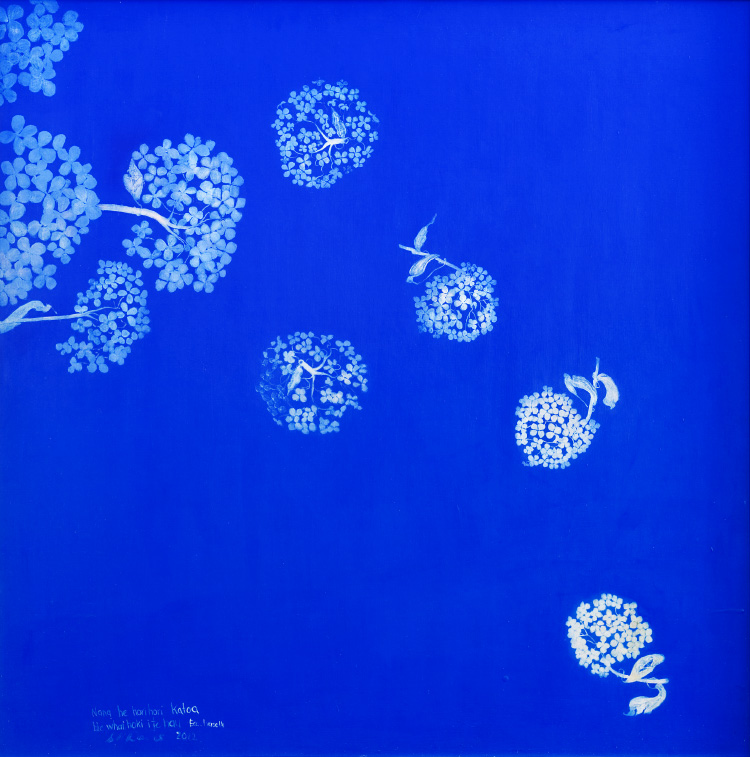
SHONA RAPIRA DAVIES Nana he horihori Katoa, He wahi hoki i te hau / Behold, all is vanity and a striving after wind: Ecclesiastes Ch 1 v 14 2012Oil on canvas, 1385 x 1385 mm.
More practically, the painting was inspired by a move to Miramar North, to an older established house surrounded by hundreds of roses.
‘My gardens have always been wild but this new one was formal, all set out in rectangles and straight up and down,’ she laughs. In her painting, the blooms have been ‘thrown into an abyss, but the abyss is red. It’s unrequited love; luscious but still.’
Another painting, Nana he horihori Katoa, He wahi hoki i te hau / Behold, all is vanity and a striving after wind Ecclesiastes Ch 1 v 14 comes from memories of her maternal grandmother. The full story, submitted to Creative New Zealand, catches the woman, a ‘solid matriarchal figure I clung to. I called her Mum, but my Grandmother was a racist bigot.’
‘The title’s from Ecclesiastes,' she muses. ‘All is Vanity―all the old lady’s bigotry has gone now.’
The blue startles, a hue bordering on Yves Klein, but the artist points out that her inspiration was the brilliant lapis-lazuli shading that surrounded a Renaissance Virgin and Child that she remembers seeing.
‘I used cobalt blue which is very expensive,’ she whispers conspiratorially to me. ‘There are 15 layers, very thinly painting because if you use it too thickly, its dries and cracks.’
The very processes of putting down paint have become more assured with experience. ‘I know the road from my head to my hand now,’ she explains. ‘I know the way to do things and how to shorten the time frame so I can get to the end.’
The completion of a work holds its own terrors. She jests about how her family and her dealer wrest works off her before she is tempted to add more layering, more details. ’The final state of an artwork is a horrible place,’ she grimaces. ’There’s such a terrible anxiety as you get towards the end of it.’
There is no escaping a pervading sadness that hangs over the new paintings. She talks of family members who have died, many from her own generation. ‘It makes you think about things,’ she reflects. ‘Death, sickness and mental illness make you a different person.
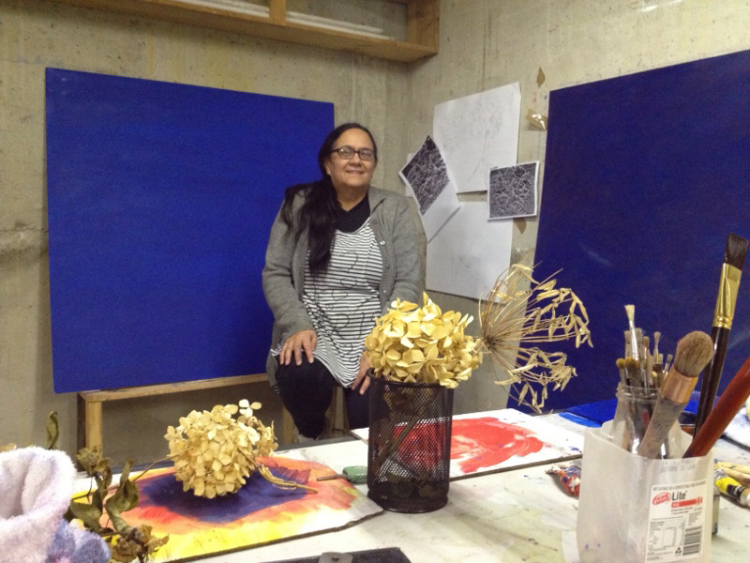
Shona Rapira Davies in her Wellington studio, 2012
‘You don’t take such a long time to get to where you want to go. I might have spent five years thinking about something but, with paint, it will take me two or three weeks to do. I like that intensity.’
The death of her brother, Peter, inspired the first of the four paintings, Ka pinea koe a ahau Kit e pine o te aroha. Ke te price a kore nei E waikura.
The title alludes to a ‘waiata that is always sung at a tangi,’ Rapira Davies explains. ‘The Te Arawa women created it for the troops coming home from World War I and it’s turned out to be a family lament.’ The image features daisies and convolvulus spaced over the flat surface of a dry brown summer earth.
The original scenario for the work was set against a poignant leave-taking between a man and his Australian widow who had not conversed for 30 years because ‘they had a falling out many years ago, and all of a sudden it was too late to talk.
He looked so handsome, young and debonair and as if asleep when she first glimpsed him over the edge of the open casket. When the tangi was all over she sat in her funeral blacks on a chair with a view out the door toward the creek. The sun showers played softly over the late summer grasses, brown and reedy and thin from the lack of water. There had been no rain for weeks. She could hear voices of other family members in the background calling out and whistling to the prize pig dog to summon him home. ‘Hell’s bloody bells he’s bringing home a woolly pig for sure.’ Someone had let him off his chain. His name was Zeus. (6)
If the signing-off of a work is something to be feared, then so too are its first moments.
‘In front of me is a big white canvas and I know that I will need to fight all the demons in my head,’ she tells me with vehemence. Ka pinea koe is the result of such soul searching―Rapira Davies estimates that the painting consists of ‘ten works on top of one another’.
She now looks back with a mixture of nostalgia and respect to her days at art school. She admits that she was often ‘quite cavalier about experimentation for its own sake’ during her career and also, for a decade she did not create much that was ’substantial’, but she now feels grounded.
’I always wanted to work in a classical style,’ is the surprising explanation, dismissing the appeal of an expressionistic approach ‘because I can’t control the paint enough for me to do that.’
Rapira Davies has rediscovered perspective, which allows her to make the flat painting surface compensate for the three-dimensional possibilities that sculpture offers. In the case of Nana he horihori Katoa, He wahi hoki i te hau. Ecclesiastes Ch 1 v 14, ‘the whole arc of flowers is basically death. You’re looking at it from below so that the arc retreats and disappears.’
Exploring the act of painting as she would fashion a sculptural object, the picture plane is all-important, and classical techniques assist in realizing its full potential.
Yet, we round off our meeting looking at wider issues than brushes, palette and canvas. Rapira Davies warns me, with a quiet smile, that her political fervour has not dimmed at all.
When we talk of Maori art, she singles out Robyn Kahukiwa as a major force, a woman who ‘comes into the room like a ship in full sail and one who set the course of the battle with Maori art.’
There is a brief aside on the tyranny of the male Maori artists who ‘talk about themselves and Picasso in the same breath. Hello?’
Ralph Hotere, however, was not of that ilk and she now understands why he did not worry about the people around him constantly mispronouncing his name.
‘He was from the old school of Maoridom,’ she explains. ‘You treated strangers with courtesy; you didn’t allude to mistakes and you never made them feel mamae.’
Like Hotere, she thinks of herself as a Maori who paints rather than a Maori painter. ‘When I was quite radical, Ralph told me to leave the activists their own glory. You’ve got other weapons and you should use them. Stand up and use your art!’
1. See Cheryll Sotheran, ‘Shona Rapira Davies at the Govett-Brewster’, Art New Zealand 45, Summer 1987/88, pp. 45-47. 2. ‘Move on, move away: Shona Rapira Davies with Jim Barr and Mary Barr’, in Shona Rapira Davies, Bowen Galleries, Wellington 1994, pp. 5-6. 3. See Elizabeth Eastmond, ‘Bronwynne Cornish’s Dedicated to the Kindness of Mothers’, Art New Zealand 30, Autumn 1984, pp. 16-17. 4. The film can be seen at http://www.nzonscreen.com/title/a-cat-among-the-pigeons-1992. 5. Shona Rapira Davies, Proposal notes for ’The Fugitive Scent of a Mouse in the Cupboard’, 2009, collection of the artist. 6. Ibid.