
Art Places
The New York Scene 2
WYSTAN CURNOW
This sound which has woken me is the sizzling of bacon and the slice's tapping on the skillet's edge. Nose, amazed, is up and about in a trice: sniff, sniff-sniff. O nose, I am so sorry; sleep and steam heating have confused us all. Pipes, applying themselves to this cold, hiss and clank. Eleven above zero, reckons WRVR, right after Mose Allison's 'Your mind is on vacation, but your mouth is working overtime' - salivation on faith. I settle for coffee. I have heard the soft thump of the percolator and smelt the sweet dark smell of Bustelo. That and a hot bath has me pumping. On the street in minutes, then. Making my break for the subway. Going out, honey? She the same, neatly dressed, woman on the corner as yesterday said quietly, How about some sex, baby? You got bacon? What did I have on yesterday?
I get out at 34th and Avenue of the Americas. Gimbels, Macys, Korvettes, etc. What I want is a pair of bed-sheets with SLEEP written all over them. Today is November 26, day after Thanksgiving and a Friday. Already the sidewalks are swarming with Xmas shoppers shopping, hustlers hustling. Sundry Santa Clauses (with bells), lady Sallies (with microphones), Black entrepreneurs (with shell games), street musicians (saxophones, violins, trumpets) and hawkers of cut-price accessories. Fire breaks out somewhere. So add: 15 fire engines, plus cop cars, road blocks, hoses, smoke, water, and flames from the roof of a small (5 storey) building on 34th street. It being Friday I'm back down on West Broadway around five. Friday's Opening day in SoHO, the streets are full of art people making their way from one new show to another, gathering in small groups, being pleased to see one another. It is a friendly time and place then. Galleries themselves are often over-crowded, the art largely overlooked. At the John Weber Invitational - a sort of New Faces, 1977 - a woman trips and falls on to a piece of sculpture and smashes it. The gallery goes dead quiet. All eyes are on her. Which is the more shattered, the art or the woman? Which will be picked up first? How long was it before someone went to her and said, for something to say: How did it happen?
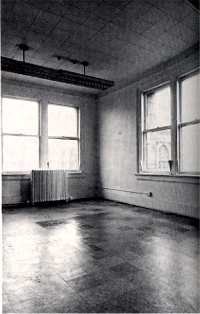
BILLY APPLE
9 x 9, A Subtraction
Fine Arts Building, New York, 1976
Saturday is the day the art-going public goes to the art places. Openings are for art people and take place Fridays. In Auckland it's Mondays. Otherwise, there's not much difference. Same people: artists and friends, critics and friends, buyers and friends. As here, most are on mailing lists which, like openings themselves, are part of the art community's communications system. There, of course, this is far larger, and far more complex. After several months frequent opening-going I'm still the voyeur. I meet famous people. Dorothea Rockburne, David Hockney, who have you? Did you know Hockney holidayed here in April of '77? He hired a car in Auckland. Was with this nice boy, Geoffrey, and the woman said: Do you both drive? To which David gaily retorted: Why, do your cars have two steering wheels? That cracks him up, really does. Nothing comes of such meetings. Not that I push it. Never much of a front man for myself, I do get the who-am-I anyway feeling at times. At best a sort of foreign agent from where did you say? Didn't Meredith Monk say she'd like to visit New Zealand - and then stand me up? For that I'm saying no more about Meredith Monk. Oh, really? In New York we take the rough with the rough.
Okay. But I do have this problem: six months - no more no less-in the Big Apple: what to do with it? I'm not just visiting, thanks, I'm on Study leave, here to work, you know, as art person, on the spot. like McCloud. Well, the Literary Editor of The Nation is an old friend. She knows my prose. After lunch at Sweet Basil - Mike Nock's got a gig there - we browse new books on her shelves. New Zealand on $10 a Day (we think not), Norman Mailer on Henry Miller, Genius and Lust (I think so)... So, books to review. I do write a little fiction, give readings even. I think to try reviewing an exhibition or two. But how to do that not knowing last year's, and the year before that's work? Except from reviews, half-forgotten and now, reminded as I am most of them are best forgotten? Just go to shows why don't you? During the week. And keep up your journal. There's everything in New York to do. Make a start.
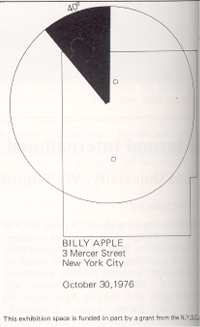
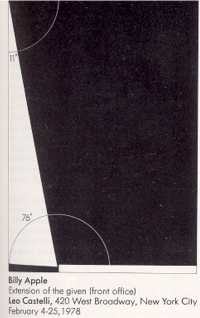
Stocked as it is with sharp memories of his New Zealand shows, I've got a good mind to see about Billy Apple though. He's taken over a loft just south of Canal Street from Geoff Hendrick who does assemblage of a sort I don't go for. In fact, it's still half full of his stuff which Billy is busy 'subtracting' into smaller and smaller areas. Painting (white) and cleaning as he goes. Seems to have become something of a cheese freak; my local formaggeria's got nothing so exotic as sheep cheese, Alaskan reindeer, something about Mexican mother's milk. But, as always, he's utterly pre-occupied with his work. Context-sensitive as he is, how's he adjusted back to the alternative art space scene? Two shows harked back to New Zealand work. One took place in November (1976) at Stefan Eins' 3 Mercer Street.(1) This storefront gallery space is disfigured by a vertical eye-beam to which is attached a heavy arm extending back over a makeshift partition into the rear where Stefan lives. Pivoted top and bottom, the eyebeam, or rather the arm, may be made (with effort) to describe an arc limited on the right side by a pipe and on the left by the end of the side wall. Using standard gray floor paint Billy covered a wedge of floor which corresponded to that traversed by the arm's swing (see illustration). What's thus marked out for 'removal' is not a volume left over but one that obtrudes from another area. Put otherwise, it is the partition which should go, for it prevents the completion of the wedge. The beam is a reminder of the building's previous life as an engineering shop; the painted wedge showed how it compromised the integrity of both gallery and total store space. The work was an exemplary instance of an improvising art making itself at home in an improvised art space. More impressive as such than Diagonal Subtraction (Sanding) (1974), which was prompted by the same eye-beam, it's success owes much to the floor-painting work done at the Auckland City Gallery the year before.(2)
9 x 9 took place at the Fine Arts Building. and some time before I got to New York. 81 floor tiles 9 inches square were waxed and polished for 81 minutes, starting from three in the afternoon. The show closed the same day. The format was familiar but not the time factor. An exhibition conceived as a lightning raid on art space? The Dunedin fiasco is back of this.
Also the sense of art in Soho as an all but private activity in makeshift art spaces. Where to now? For a time, art work is reduced to getting hold of building plans and the checking of measurements. This is desperate endgaming, this putative breaking and entering: and I am uneasy. Options running out too fast? He's scouting out 'conceptualist' territory, but has he the head for it? -/+ 38 opens in December at 112 Greene Street. Billy plots while Jerry Vis carries out a repair job on the floor. Unhappily, there's disagreement between the artists and the gallery which leaves the repair work and its exhibition less than half done. Meantime, there is enthusiasm for Brian Doherty's essay Inside the White Cube, part 3:
For better or worse it (the gallery space) is the single major convention through which aft is passed. What keeps it stable is the lack of alternatives. A rich constellation of projects comments on matters of location, not so much suggesting alternatives as enlisting the gallery space as a unit of discourse. .. The gallery space is all we've got and most aft needs it. Each side of the white cube question has two, four, six sides.
(Artforum, November '76)
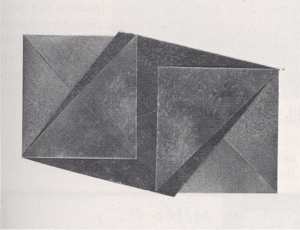
DOROTHEA ROCKBURNE
Copak # 6 1976
Kraft paper, varnish, blue pencil, board
John Weber Gallery, New York
So the talk turns to spaces ancillary to the 'white cube' but rich in contextual cues - none more so that those at Leo Castelli's where Extension of the Given (Stairway Entrance) took place last May, and Extension of the Given (Front Office) last February. Without having seen either, I'd say they were the culmination of his post-New Zealand work. And, as statements of the politics of the found art space, quite superior to those of Hans Haacke and Daniel Buren, whose shows I did see.
Other New Zealanders come and go. I hear of visits with Clement Greenberg and Jules Olitski, from Rick Killeen over soup at OJs. With Speedy West, inventor of the pedal steel guitar, from Bryan Dew, ex-Auckland Welfare State Realist of the '60s now film-maker, documenter of the Olde West. Adolph Hofner, of the (sextagenarian) Syncopators, asks after the incredible one-arm fiddler he knew in Auckland in the '40s. With Vito Acconci, from Bruce Barber, at Magoos over Eggs Benedictine. On the wall of Magoo's loo:
When Truth goes from art it will be gone forever. - R. Farina.
When R. Farina goes from art he will be gone forever.
This, then, is another Soho art bar. Bruce is an Auckland performance artist currently Commonwealth Scholar at the Nova Scotia School of Art and Design, Halifax. He is on city section at the School's loft. Whittier's Soliloquies, first performed at Adelaide's Jam Factory the year before, get their second airing, in New York, at the Franklin Furnace. Bruce and Pauline Barber read, Wystan whittles. There, in the audience, is Ian Hunter, from the National Gallery, Wellington.
I call up Lucy Lippard. She could fit me in - for drinks, before dinner, Thursday next. I'll have the scotch. Cool it Wystan, Thursday's over a week away. Lucy's not inhospitable: she's one of the world's few full-time art critics. Her normal speed is flat-stick. Her two most recent books - Eva Hesse, and From the Center - are due out any day, as is the first issue of Heresies, a heavy feminist art journal she shares in editing. I'd announced myself on the intercom, the service elevator had creaked and rocked me up to the loft. What would you like to drink? The phone rings. Between calls we recall her visit here in '74. She's been using slides, taken then, in lectures. Who's done what since then? We talk fiction, which she does summers. What have I been to? Oh, dance (Rudy Perez) art (Claes Oldenberg, Robert Morris, Italo Scanga) movies (Stand Brakhage), music (Michael Snow, Don Cherry, Phil Glass), performance (Martha Wilson). These are early days, yet it occurs to me whatever the art, two kinds of work predominate: those of mixed means, which end up a collage of metaphors, and those of single means, which add up to a non-metaphorical complex. The phone rings. Charles is organising dinner - beef casserole, smelling good. I'm welcome to share, and do. Charles Simmonds builds miniature clay villages for 'little people' on ledges, sidewalks, in gutters of New York's slumlands. Has been doing so for seven years.. I came across one on the roof of PSI. He's got a committee meeting on the East Side, Lucy a lecture to attend at A.I.R., the women's gallery nearby.
These New Zealand contacts take care of my immediate problems. Billy gets me a Soho loft to share with Dieter Froese and Kay Hinds. Bruce and Ian get me lectures, as visiting art critic in Halifax and Cleveland. Lucy gets me a library in Soho, normally restricted to artists, to work in. look at me! I'm an art person, free-lance, on the spot, with goods to deliver. I'd pictured worse: lonely insomniac with piles holed up in some East Village flophouse, window-shopping by day, by night cramming The New York Times, High Times, Time, The New Yorker, New York Magazine, The New York Arts Journal, The Nation, American Poetry Review, Art in America, Arts, Artforum, Art-rite, Art News, The Soho Weekly News, The Village Voice, Andy Warhol's Interview, Screw, Playboy, Hustler, Tracks, Fox, Unmuzzled Ox . . .
Turns out Dieter, Kay and I get along OK. They're my age; he's some kind of Marxist, refugee anyway from Germany's student 'uprisings' of the '60s" She's from Tennessee, and part-time postcard salesgirl at the Guggenheim. Now I think, nostalgia is it? There's a little Annie Hall to Kay. Jacki Apple's a friend of theirs - Jacki I'd met briefly here in '75; there she proves a great chaperone, quite serious about making a native of me. She, Dieter, and their friends are Soho for me. I go to shows, performances, parties with them and not in six months do I met a single living Photo*Realist. Mostly in their 30s, all are more or less established on the alternative art space scene but none has, like they say, a reputation. All are poor, but full-time, artists. They get by on the odd grant, and odd jobs. Dieter, for instance, is a dab hand with an air brush and does piece work for the rag trade. Their work involves performance, audio or video tape, and temporary installations, either separately or in combination.
This loft I live in is Dieter's studio. What I know of his work comes from living with it. Not that I've much choice. His medium is video, the TV is on till three in the morning most nights and my privacy is a cotton curtain. But I am curious. Video art dates from the early '70s and is unknown in New Zealand. One reason being cost. Poor as he is, Dieter has, to my eyes, a lot of hardware: portapack camera and deck, three receivers (one colour, two black and white), and four monitors. But here the gear's cheaper. And Canal Street, Manhattan's discount strip, is but blocks away. Want electronic parts? Integrated circuitry? Try The City Dump on Canal, they've a wall of wire baskets full of it.
Dieter's a scavenger, and mechanically adept. A couple of weeks get spent building a switching mechanism for moving a video image along a row of four monitors in ten seconds. Then we three set to and compose 'video-poems' so we can see it through its paces. Dieter, oddly, is no movie-goer. And his taste in TV is lousy. I cannot understand why he spends hours watching re-runs of '50s sitcoms. Until, that is, I realise, it's the highly conventionalised routines which fascinate. Dieter's work concerns communication; he uses video to get full coverage, to get body as well as verbal language. He is interested in clichés and ritual. Like Vito Acconci, and his friend Bill Beirne, Dieter has absorbed Erving Goffman (The Presentation of Self in Everyday Life, etc) but his main man is Ray Birdwhistell (Kinesics and Context: Essays on Body-Motion Communication, 1971) Several of his pieces are called 're-stages' and they go like this: I'm parcelling up books to post home and saying to Dieter I'll be flying home on my birthday and how it'll be a close thing, I could lose it down the date-line and so. He's shooting and talking. Later we watch about 15 minutes of this and select a 30 second sequence which he plays back and back to me until I've got the 'script' of it. He shoots me learning my part-lines, gestures, posture, till I'm 'word' perfect and more, in fact, bored with it, varying it a bit this way and that. Later, this is run down the row of monitors. What became of me I've no idea. I left before the piece took a final shape. Most of the time we don't know what we are doing. Video gives an access otherwise very hard to come by. Added to that the 're-stage' dramatizes the discovery, begins to complicate the epistemology of it.
My curiosity about video dates from Some Recent American Art (Auckland 1974) which had 12 tapes by 9 artists and only 9 paintings by 3 artists. The contrast meant something. Well, what's become of painting? Dorothea Rockburne's drawings 'which made themselves' were, in her case, what painting came down to: just as Mel Bochner's pebble pieces were, in his, all that sculpture amounted to. Both have become in the interim painters: but of a sort which changes your idea of what paintings might be. Of course, New York, was, as before, full of painting, of good sometimes great examples of what paintings have been. I was not slow to go to exhibitions with new work from de Kooning, Noland, Kelly, Warhol, Johns. Bochner, who paints directly on to the gallery wall, did not show while I was there, but Rockburne did, and her's was as pleasing an exhibition as any I saw. There were 5 paintings and 12 drawings - actually Kraft paper constructions which were studies for the paintings (see illustration, above). Starting with 2 identical squares, and the rectangles which are' their golden sections, she folds and cuts them according to certain rules of symmetry. These too are drawings which make themselves; each is shaped by its own history. The paintings are the same but larger and made of a heavy linen treated with Gesso. Also - and this is an important departure - they're painted, coloured. For example, the two (sort of) squares of Copak #6 become in Doscourse red and green,(3) while the central parallelogram is blue, except for one of the thin wedges which is brown. The idea is not to decorate, but to pick out in distinct and distinctive hues the final folds and cuts: 'I look at the shapes until I see them in colour'. On the other hand, the colour is more than functional - there are too many possibilities - and it marks the end of one process and the beginning of another so that a new chapter has been added to the history of each work. like the use of the golden section, the colours allude to Italian Renaissance painting but in terms of feeling rather than idea. The gain in presence is great.
The allusions are, in fact, to the works of Agostinodi Duccio. Writing this piece I add to - it's the point of doing it - an image of New York as where the pursuit of the new is at its most hectic. What's forgotten is that we here are in a sense more subject to the anxieties of that pursuit than New Yorkers. The past is laid on, in magnificent museums, and Europe's not far. To an extent that might surprise artists here, New York artists are art historians. The Sceoe's not got one speed, fast: but many. I was interested in how, in Memling's Madonnas... but Robert Morris did that in the late '60s. . . Soho's finished, PS1 just another institution. . . Getting to New York to get up to date can feel like getting into history from a place oddly oblivious to it.
1. See The New York Art Scene 1977, Art Places, Art New Zealand 7. For a far fuller account see the two spec issues of Art in America (July/August, September/ October, 1977) devoted to the New York scene.
2. For a discussion of this and other New Zealand works see my Billy Apple in New Zealand, Gallery Quarterly 61, Auckland City Art Gallery.
3. Artforum (January 77) has a colour reproduction of this work.