
Not a Bunch of Carmelite Monks
In this interview the playwright BRIAN McNEILL talks with RAYMOND HAWTHORNE, founder and artistic director of Auckland's second professional theatre group, Theatre Corporate
Hawthorne and I are about the same age. We both went to England around the same time. He did all the right things, like going to RADA and then into rep. Mind you, by the late 'fifties and early 'sixties, RADA was considered a trifle passé by most theatre pundits. This was the age of student revolution and the working-class hero and most aspiring actors were trying to get into the more rugged environs of 'Central' or 'The Actor's Studio' or otherwise just bluffing their way straight into rep. Not that any of this really matters - where you go or anything - it's what's inside that counts. What Hawthorne did bring back to New Zealand was a professional gloss and a sense of urgency about his craft that was much needed. All saints however have their foibles - they can afford to! Yet I have noticed a few disturbing things lately about Theatre Corporate and hoped that by having this chat we could resolve - or at least bring to the boil - some of these issues.
B.M.: You call yourselves Theatre Corporate. You used to be called Theatre Co-op. Corporate usually means the forming of one body by many individuals, whereas we tend to think of a co-operative as a community project where all the profits are shared equally.R.H.: Well, we wanted to be Theatre Co-op but we also wanted to be an incorporated society. We have to be an incorporated society, and the government or whoever decides these things wouldn't let us call ourselves Co-op.
B.M.: But when you first started off the profits were on an equal share basis?
R.H.: Well, we didn't pay - no one got paid. Everything we earned went back into classes and paying tutors and subsidising our production work. It wasn't until Story Theatre came into being, nine months after our inception, when money started to come in to the actors and then everyone got paid a weekly salary.
B.M.: Now with more money coming in you've obviously got a different structure.
R.H.: Mmm, yes. We're meeting Equity rates on all companies now, yes. It's breaking the bank like mad of course, but it's got to be. Otherwise don't function! If you can't afford to pay them, don't function. There are now eight permanent members in the Resident Company, six permanent members in the Theatre in Education, and six permanents in Story Theatre. Twenty actors in all plus a staff of about sixteen.
B.M.: That's a lot.
R.H.: Yes, thirty-six hungry mouths to feed.
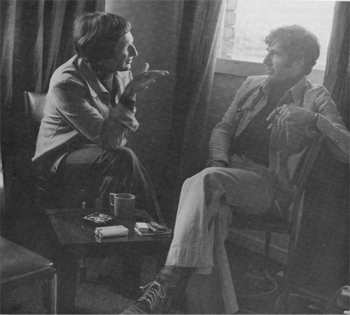
Brian McNeill talking to
Raymond Hawthorne (left)
R.H.: (emphatically): Rubbish! (pause) That's rubbish!
B.M.: But you are a member of the Association of Community Theatres (ACT) and yet you seem to be isolated from what they're doing. Do you think there's a lack of liaison between theatres in this country?
R.H.: I think there's a certain communication between certain theatres. Centrepoint and our company have a very strong liaison. They're the only theatre in this country we feel we can communicate with.
But as Hawthorne went on to say this might be because there's a rapport - an empathy if you like - between the two directors. Many of the actors working at Centrepoint (Palmerston North) he finds similar to his own and this means as he puts it: 'Tackling their jobs with sincerity, no bullshit, lack of ego, and being concerned about their theatre which is what actors should be'. I said that maybe one of the reasons he's had this criticism levelled at him was because he'd hesitated for so long about bringing in outside actors and directors - that no one has had a chance to get in and find out exactly what's been going on. Naturally enough he disagreed with me here and I will admit that the company is at last beginning to open its doors a little. Outside actors are being brought in: Roy Patrick, an experienced New Zealand director now resident in Britain was back over here last year for a six month stint with the Resident Company. Generally though, Hawthorne is wary about employing outsiders. He's been badly burnt in the past through using directors who 'had no idea about what they were doing' and refuses to expose his still fledgling company to this sort of gross incompetence in the future.
R.H.: My greatest liaison was with Tony Richardson [ex-Mercury director]. We understood exactly what each of us was trying to do. We both looked at how long it would take to train an actor and we decided it needed six years before an actor could stand up there and really, really deliver the goods. Well, most of my actors are in their fourth year. . .
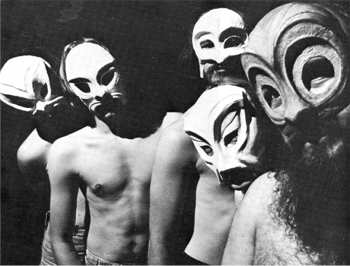
Theatre Corporate's production of
From the Four Winds;
masks by Peter Bartlett
I know that Hawthorne's own feelings towards life greatly influence his work so I expected (rightly enough) my next comment to bring him out in a rash of smiles and firm speaking. I quoted Bruce Mason's belief, and incidentally my own, that theatre in essence should be a 'celebration of life.'
R.H.: Yes, I agree. Totally! A celebration of life, and a worship of life too. One likes to think that one worships in one's work. I like to think that everything we do here is positive. And this, he went on to say, very much influenced his choice of actor - who gets into the company and who doesn't. He looks for quality of person as much as quality of talent. Being into drugs for instance, this he won't tolerate. There was a short pause here while we both did a bit of nodding. It appeared however that my monastic dig had not been entirely forgotten. R.H.: But being monastic! You see that really alarms me. I'd love to know who made that statement. I think the last thing we are is monastic. The audiences who come here feel an openness of feeling, we're not at all self-congratulatory. We're dedicated but that's different. I then mentioned a quote of his in the Listener apropos of New Zealand writing: 'Anyway New Zealanders don't want to see themselves on stage.' He denied that this remark was intended for publication. He didn't know he was being interviewed at the time, that it was simply a remark made in passing! I believed him but only just: probably because I personally tend to get wildly incoherent wherever the subject of New Zealand plays is broached, believing that many directors in this country are too frightened to risk themselves on untried material. I have to admit that when I first read the Listener article I was outraged that anyone in Hawthorne's position could publicly make such a damning and untrue statement. He only had to look at two recent and highly successful New Zealand plays, both dealing with contemporary matters: Roger Hall's Glide Time and Joe Musaphia's Mothers and Fathers to see that this fatuous remark of his didn't hold water. In both these plays, and there have been others, the audience enjoyed immensely seeing themselves portrayed on stage. Hawthorne agreed with all of this; but he then made a very strange remark:
R.H.: I don't think they recognise the fact that it's them.
B.M.: What? That it's 'them' being portrayed?
R.H.: They sit and laugh at it but I don't think for one moment they think it relates to them. I mean, I would have loved to do Glide Time but I couldn't cast it. I would love to do more New Zealand plays I'm going to try to do more - but I can't afford. . .
B.M.:To take the risk! (becoming excited) But surely by, taking the risk and doing more indigenous work there'll come a time when recognition must dawn. And recognition will only dawn if you see yourself repeated time and time again. That's what's happened in Austral. .
R.H.: I still don't think New Zealand has much character. I mean it's easy to write about an English situation because everyone's a total individual in England aren't they. They're all eccentrics, they're ill strange, they're all weird, they've all got some sort of zing in them you can respond to, whereas you can meet seventy-five New Zealanders a day who ire as dull as bloody ditchwater. Nice. Lovely people - but dull!
B.M.: But this is part of our job isn't it? To reflect society? So shouldn't we be showing this? Not in a dull way, not in the sense that people are going to get up and go home.
R.H.: That's right! Well, give me a play that does that and I'll do it.
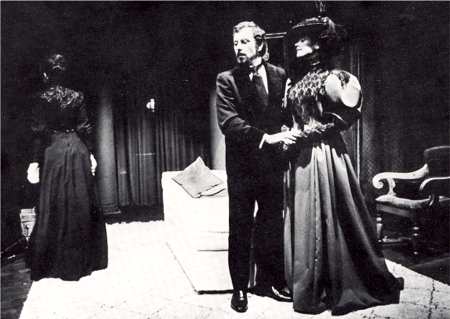
Theatre Corporate's production of
Ibsen's Hedda Gabbler,
directed by Roy Patrick
B.M.: We already have one drama school in this country - at Wellington. How do you see yourselves in relation to this school, as a rival or what? I mean, I think this country is only big enough to support one drama school.
R.H.: I agree, but we're not supported as a school. We're not set up as a school. We're self-supportive. It's something I've chosen to do.
Hawthorne refused to discuss this matter any further. Naturally enough for he is also on the Board of Studies at the drama school and must tread carefully. He did say that there was $100,000 a year at present being spent on drama school students. $100,000 of Arts Council money and just twenty students in training! I felt there was a lot more he could have said on the subject.
R.H.: I mean, what is the training of an actor? To bring out their individuality, isn't it. To find out what their nature is and then to extend it. We're a load of funny creeps if you look at us separately in Theatre Corporate but when we are collective we take on great beauty, we then work together as an ensemble and his surely is the art of the actor, to be a vessel, isn't it? Isn't it?
I could only agree. And that's why I love the man so much in spite of his. . .!
Much of Hawthorne's success in creating his theatre complex has been due to the people he's aligned himself with. The administration is efficiently and imaginatively handled by Alan Freeman. There is a close alliance between them both. This sort of administrative and artistic blending is still a rare thing in this country and could well serve as an example to other similar bodies.
We went on to talk about financing. The Arts Council does what it can of course but I suggested that he might begin to look further afield for auxiliary support and he agreed. He said he'd like Industry to express more interest - that there should be a link between Industry and the arts in New Zealand and that he'd like to see Government help make this possible. I suggested that Television should be putting money back into the theatre and related arts, that it was about time they began to show some responsibility in this direction. This, apparently, has now begun to happen. South Pacific Television has recently allocated three $500 dollar bursaries for 1978-79 to go towards the training and support of three Theatre Corporate drama students. Finally I asked whether he would like to see theatres in New Zealand run on the same lines as public libraries and municipal art galleries; supported by local government and offering a virtually free service to the public.
R.H.: Wonderful. Yes, but how wonderful.
B.M.: It'll be a long while before anything like that begins to happen.
R.H.: I'll say! Unless a miracle occurs..
I then spoke with two acting members of Theatre Corporate: Timothy Bartlett and Linda Cartwright. Both expressed an abiding sense of loyalty towards the company and to Raymond; and a sense of dedication to their craft as actors. I asked them if they felt at all isolated from what was happening outside of Corporate. It's common knowledge that Hawthorne works most of his company to death and I wondered if this was altogether a good thing. They both agreed to the occasional sense of isolation but felt that the demands of the job allowed them little option. They are obviously kept very much in line by Raymond although they've both discovered at a remarkably early age that a performer's greatest satisfaction is to give himself over entirely to the play and the director and allow himself to become part of the greater whole - a single pulsation, if you like, within the creative structure.
I almost had the feeling that if the Devil, in the guise of a Hollywood producer, happened to phone them up tomorrow with offers of instant fame, they'd turn him down; and if this is so, then Theatre Corporate is to be congratulated for doing more than just turning out good actors.
Brian McNeill worked in Britain and Australia before returning to New Zealand at the end of '72. He started off as an actor; moved into production; and ended up mainly as a writer. He is the author of one of this country's most successful stage plays: The Two Tigers, now published by Price Milburn (he worked with Hawthorne on the first production of this play). In 1977 Theatre Corporate mounted a full-scale revival of The Two Tigers with Hawthorne directing. McNeill is currently working on an epic dramatisation of Captain Cook's third and final voyage of exploration. The play has been commissioned by Auckland's Mercury Theatre to coincide with the bicentenary of Cook's death in 1979.