
The Rationale of a Private Collector
HUGH FOSTER
Warwick Brown's early interest in painting was stimulated by his father, who took an interest in modern art, and was himself a talented weekend 'sketcher'. Mr Brown had many numbers of The Studio as well as books on individual artists that his son remembers reading as a teenager. Warwick Brown remembers reproductions of the works of Grahame Sutherland, Paul Nash, Edward Burra and Felix Kelly (the 'English Surrealists'). He was an ardent fan of Edward Wadsworth and Henry Moore finding an excitement in these artists' works that was lacking in the conventional landscapes commonly admired at the time. He thought then that it would be interesting to study at Elam School of Art in Auckland: but his parents stressed that there was no material future in becoming an artist (this was in 1957). Instead he took up law; and the creativity thus suppressed was later to find an expression in his art collecting.
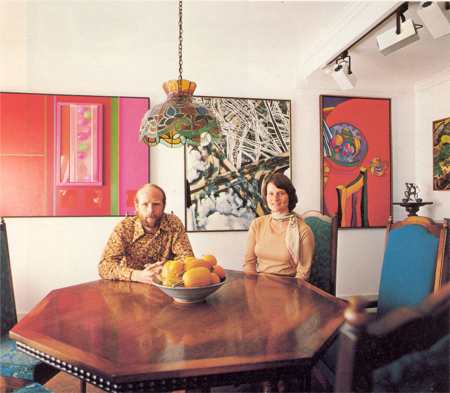
Warwick and Kitty Brown,
with paintings by Don Driver,
Robert Ellis and David Armitage
In 1959, on a visit to England with his father, he saw modern paintings in the original for the first time. It was at the Tate Gallery in London; and, as with many other New Zealanders, he was astounded by the scale, the vibrancy and texture of paintings experienced in all their actuality. His interest developed throughout the early 'sixties. But this was a period in Auckland when there did not seem to be much happening in the exhibition of contemporary New Zealand painters. The Auckland City Art Gallery was the most active art centre. He remembers touring exhibitions, including those initiated by The British Arts Council - and most notably the Henry Moore exhibition, which caused a furore in Auckland.
By the mid-sixties, Warwick Brown became aware of the fact that 'modern art' was being produced in New Zealand in quantity, and of some quality. His first purchase, a small oil on paper from the Strata series by John Papas, gave him such intense pleasure that he went back and bought two more.
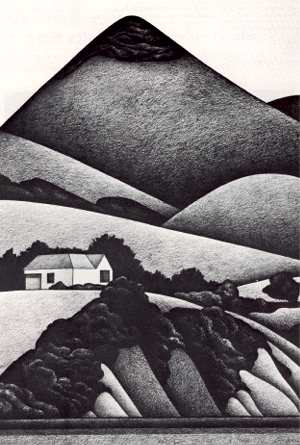
ROBIN WHITE
Harbour Cone 1972
pencil, 440 x 300 mm.
It was about this time that the mature work of a new wave of younger New Zealand painters who had begun to paint in the early 'sixties broke upon the scene. Warwick Brown went to all the fortnightly dealer gallery shows. He realised that he had somehow missed the rise of such talents as Hanly, Binney, Ellis, Armitage and Trusttum. Their best work was already a bit too expensive for him - but only just! It was a source of both temptation and frustration. He turned instead to prints and drawings, and found that these were the source of a quieter pleasure. He bought whenever he could not because the walls needed clothing, but because living with paintings was so much better than a brief look at a gallery.
As his collection became established he found that all the works grew to enhance one another. The more that were added {he better they all seemed. Fortunately, his wife Kitty shared his enthusiasm, and they both seemed to like the same works. He felt he was lucky to have a wife who was prepared to see paintings dominating both the house and the family budget.
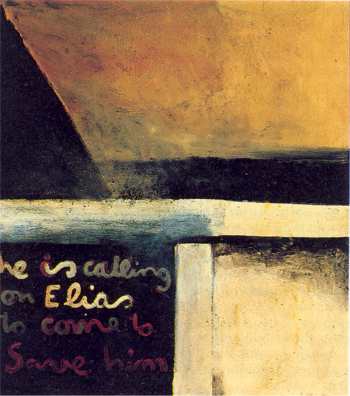
COLIN McCAHON
He is calling on Elias. . . 1959
solpah on harboard, 750 x 650 mm.
In the early 'seventies, Warwick Brown thinks he was still unconsciously measuring New Zealand painting by what he knew of contemporary art overseas. He had come to feel that all the painters whose work he knew were understandable by this measure except McCahon. As he says: 'I could not relate McCahon's paintings to anything I knew of; and 1 sought to explain him to myself on the basis that he obviously did not know how to paint. I thought he had no colour sense, no technique, and no finesse. There was a directness about his scrawled words and unframed bits of daubed hessian that was affronting. But later McCahon was to have the last word, and teach me what painting was really all about.'
In talking to others who appreciated McCahon's work and knew the artist, he eventually picked up what seemed to him to be 'keys' to unlock these paintings.
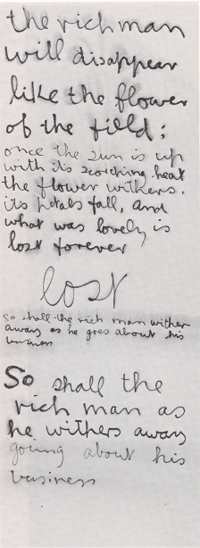
COLIN McCAHON
Practical Religion series 1969
chalk on wallpaper, 1330 x 550 mm.
'Standing one day looking at the ethereal blue and white McCahon in Kim Wright's collection, with its simple message, I suddenly saw the light. McCahon's work was 'different' and strange because it was truly original and therefore incomparable. Here was the essence of a man speaking through an assembly of images and techniques that owed nothing to anyone else. I realised that all the negative impressions this artist's paintings had made on me sprang from the fact that his commitment to the act of painting was far greater than mine in experiencing the finished work.
'I now believe that a good painting is a sort of battery. It should keep on giving out energy to anyone who is properly connected up to it. The output depends upon the amount of energy that the artist has put into the work. There has to be talent too, of course; or else the energy is lost and not stored. But a talented artist who doesn't expend energy in the creative process will produce a superficial painting. Even Picasso, in his late work, demonstrates it. It is this energy output that makes collecting paintings so rewarding. Every time I look at one of the paintings in our collection I get a charge. And if I am feeling world-weary, a session with these paintings makes me feel rejuvenated and truly alive.
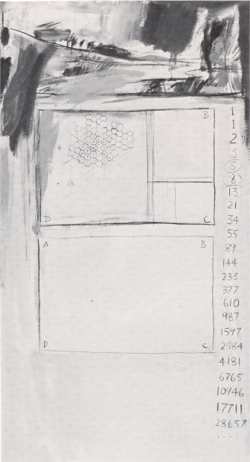
PETER JAMES SMITH
Fibonacci Numbers series 1977
crayon and acrylic on canvas, 1330 x 730 mm.
'I learned from McCahon that sometimes one has to struggle with a painting to make the connection through to the artist's original feeling. The harder the struggle, the more long-lasting will be the effect if you make a break-through. The 'energy' seems to have run out on one or two of our paintings. They have become merely decorative or even dead. But the McCahons keep on beaming out a message of strength, sincerity, truth and timelessness.'
Looking at modern painting in New Zealand has become for Warwick and Kitty Brown an adventure, a voyage of discovery, as well as an absorbing and rewarding hobby. They feel that to collect paintings is to establish an almost mystical rapport with individual artists (often people they have never met) and to preserve that relationship, letting it mature and grow over a period of years.
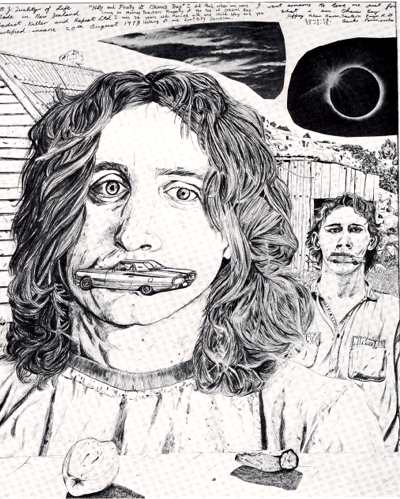
JEFFREY HARRIS
Nutty and Fruity at Okains Bay 1973
pencil and collage, 335 x 270 mm.
Warwick Brown finds it refreshing that, because the modern movement in New Zealand is still in an early stage of major development, there are not yet any real schools or trends. He feels that our young artists are prepared to do their own thing and take a risk on it. He considers that the best work being done here is as good and valid as that from overseas - which he suspects is often judged more from fashion than intrinsic merit. Our local artists deserve support, he stresses; and it is fortunate that good painting here is still within the means of the average person.