
Slap-Happy
New Work by Ken Robinson
CHAD TAYLOR
I first met Ken Robinson in the early '80s when he was an art teacher at AIT. He lectured students at length about the value of formal observation and careful life-drawing line, form, tone, the rendition of spatial relationships; and from these unblinking values we inferred a career as a photo-realist at best. It was a happy paradox when his work turned out to be entirely abstract: huge canvases bouncing out of the frame (Installation), illusionistic op-art spaces (Sway) and lurid modernist palettes. The purples practically seethed. Robinson's own art student days were in 1960s London, and there have been flashbacks of Op, Pop and Modernism in his work since.
For his latest exhibition, the man-high canvases have been replaced by small, brightly coloured pieces. ‘I had a drawing show and people said, I'd buy your work if it was smaller!' he chuckles. 'Because really, these are working drawings. There's something going on here that's different from the formal paintings that I've been doing in the past.'
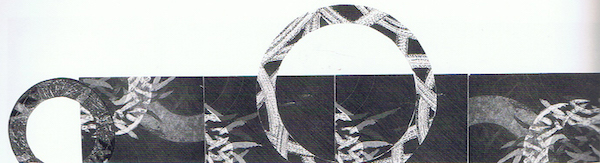
KEN ROBINSONUntitled Working Drawing 1998 Collage on paper, 600 x 45 mm.
In the 1980s, Robinson's Drop series was highly formalised. The emotional colours of works like Drop and Purewa Haze are restrained by a cool net, a comprehensive frame that folds them back on themselves, always preventing the composition from breaking away.
'You do that sort of stuff and explore it but it's only part of your nature. One day you realise there's another part—the slap-happy side. All of a sudden I realised that if I had a piece of paper like this (he snatches a section of paint-spattered undersheet)—it could be part of a painting. It's like an etching. But it takes you nearly 20 years to get there. So these works are small paintings. And I like doing them—I like the freedom.'
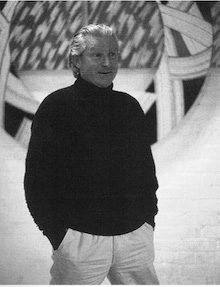
Ken Robinson, photographed by Eve de Castro-Robinson, Auckland 1997
The 'freedom' in these tiny, semi-precious drawings comes from their collaging of found and random markings. Overlapping circles mimic the arm's sweep and the brush-stroke, the montaged gestures of '90s pieces like Global Dance and Rojo Redondo.
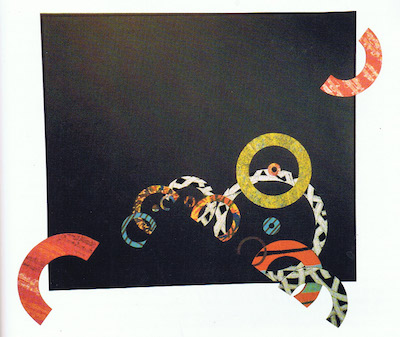
KEN ROBINSON Tumbling Strains 1998 Acrylic & aluminium on wood, 1300 x 1200 mm.
'[Those works] were crude, gestural painting. I'd gone that formal way and then slowly I put the circles back in, putting that spontaneity in . . . The circles started off as monoprints—pure gestures.' Tumbling Strains, a much larger work, rolls and sprawls with the same freedom as the working drawings—but on heavy wood and canvas.
'The problem now is how to make a painting out of collages. A lot of painters stick pieces on but I find the separate pieces have to be flush with the surface, sunk into the gestures of the paint. 'The tumbling strains actually tumble out of the picture. Its making reference to the outside of the painting. I've allowed the circles to tumble off the edge and reorient themselves again. 'Circles have no orientation. A lot of artists don't like them. It's a bit like using grids: if you can't work out the painting, you grid it.' He shakes his head. 'How many painters have done that?' 'For convenience,' Robinson says, Tumbling Strains is named after the musical score screened onto the piece, but his other works are mostly unnamed. 'I normally don't think about titles, but people like them . . . I'm even starting to do something representational with the music screened on. Screen-printing something figurative into the paintings!' he laughs. 'It's taken me years to get around to it.' Another composition takes place against oil-on-water marbling, photographed and screen-printed as a background. The graphic technique belies a printmaker's approach: capturing accidents and repeating them as motifs and devices. The idea is 'to collage spontaneity' as Robinson puts it: 'I liked the spontaneity of [the marbling], but only if it's organised. I don't allow the gesture to be the painting. It's important to do more. You've got to capture and use it. You build up intuitive awareness to capture the accident. Intelligent behaviour is not how cleverly you organise things, it's the apprehension of the facts themselves. The sensuous apprehension. Not appreciation— that's a learned response, like politeness and manners. No: it's a case of developing the sensuality to apprehend the things that are floating around. 'I spent a week sitting down just cutting out circles—and I cut every one out of an old painting. I cut the circle out, so part of the new painting is the old one, mixing with the new direction all the time. I'm recycling! I'm out of that war generation where everyone recycles. Maybe I'm doing that . . . I mean, what am I going to do with the old works otherwise? I've got a little bit of all the things from the past in here.' As surfaces, patterns and colours accreted on the new pieces, so have the experiences behind them. 'That's a woodblock,' he recalls, holding up another monoprint, 'when the press was screwed down too tight. I was printing it and talking to somebody, talking about the way you capture accidents—and as I was talking it was happening. And now it's in the work.'
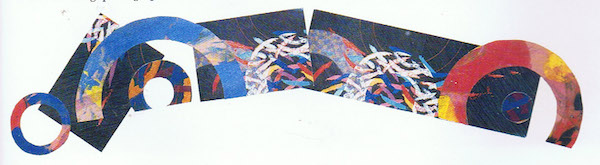
KEN ROBINSON Untitled working drawing 1998 Collage on paper, 600 x 45 mm.
Discussing untitled abstract art, you fast run out of adjectives; writing about it is sheer folly. T.J. McNamara, in the New Zealand Herald, has variously described Robinson's work as 'big-scale', 'rectangular' and 'big'; Suzi Melhop in the Christchurch Star found it 'slightly foreign'; and Roy Dunningham, reviewing the NZPPA show in Hastings, in 1977, declared it 'somewhat equivalent to a loud blast of Led Zeppelin on a good stereo set' (or, presumably, any equivalent '70s hard-rock combo). Thus the mainstream approach to abstraction is to either list its components (dot, line, square) or to describe them as an analogy—as if the painting is a scribbled shorthand for greater knowledge, like a GP's handwriting. As Robinson describes his work, he persistently refers to 'narrative': the works as a series of events and reactions, innovations and responses, histories captured in the paint and the surfaces it clings to. He points to an older work on the studio wall: 'See that? I started with a square, then by gesture of colour alone, knocked the square out. Then I started to realise as I put more colour in, nobody would know there was a square behind it—so I began leaving the works unfinished, allowing the underlying structure to come into its own. I left the cross-hatching in Tumbling Strains half undone so you can see the story of the painting.'
Ironically at the age of 57, Robinson's art is approaching a style that could, with an eye on the market, be nudged into a trademark. But that probably won't happen. His working process is to construct and corrupt, removing the work (and himself) from any literal or art-historical context. Although the work might be about time passing, he doesn't want to be trapped in any time frame.
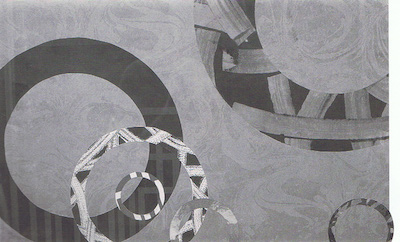
KEN ROBINSON Swirl 1998 Collage, marbling, screenprint on paper, 570 x 730 mm.
'In the Pop art days a lot of people jumped on the bandwagon and then disappeared completely because they had nothing to say. Postmodernism has put a whole lot of people in the same position.' In fact, it's almost as if he doesn't want the work to be finished, but to continue, hovering, at the moment of inception: 'The days of directing students into a situation which they might not like—but in which they might learn something—we just don't do that anymore, which is a shame. Tutors try and make life drawing functional . . . why bother? Something happens when you're drawing—time goes by and you're in tune with the marks you're making: do that. There's something in drawing where there's a timelessness: you're in tune with the paper and the pencil and the room, and it all comes together in a holistic something or other . . . and that's the magic.'