
Towards a Promised Land
JOHN CASELBERG
It is not the tongue but our very lives that sing the new song.
ST. AUGUSTINE(1)
A week camping alone on Stewart Island in the spring of 1948 and several weeks at Bluff preceded my first seeing paintings by Colin McCahon.
The Stewart Island bush had rung with the wing-beats of tuis and with tui song. From high rocks near the harbour, I had watched dolphins approaching ecstatically, slicing the waves like black swords, grazing the underwater rocks and parting their tresses of kelp before wheeling, plunging and vanishing mermaid-marvellous back into the alluring sea. 'You're the first tourist of the season', the island's mayor and its baker had said, before the three of us set out in the latter's launch to the upper reaches of Paterson Inlet; from where, having run out of petrol, we limped home the next day using a sheet for our sail, so that they missed their two days' fishing and I a possible trip to the west coast of the island.
I had been writing a first long - unsuccessful - story, about a shell-shocked American ex-soldier (he had come often to our house in Nelson when I was a boy), who, recovering his memory one brilliant morning, suddenly sees the New Zealand hills and sky and vegetation and the sunlit Maitai river here for the first time, with astonished eyes, like a reborn child. Later, while the story was being typed, I worked on the wharves at Bluff, walking each still-winterish morning across gleaming railway lines to the ships that connected our isolated plot of earth with the vast world beyond; hurrying always it seemed through gale-shouting silver-incandescent clouds of locomotive steam and smoke that raced away northward.
Sometimes I climbed the small hill behind Bluff, where gorse in bloom poured its dark yellow flames fuming into a cobalt sky. Here, and after hitch-hiking through the spring-green lush Southland plains' farmlands on my own way north - beginning a journey that would take me to what seemed then the Mecca of civilisation: London; whence those ships had departed and to which by oceanic routes they kept us bound as if by unseperable unbilical cords - I wrote lines that became:
No end
To the rolling plain:
The white sky.
No end
To the long black line
Of thundering mountains.
And,
Like the land -
The soil and the ice
And the barbed gorse -
No end
To the sound of the sea on the shore
Thundering in the heart like the heart's core.(2)
Reaching Dunedin again, I stayed in the city apartment which was housing, miraculously, behind its grey back-street facade, like an Italian Byzantine shrine, flaring yellow, green, blue, earth-red and lamb-white pictures painted by Colin McCahon. They had just been shown at an exhibition in the Dunedin Public Library organised by Rodney Kennedy.
I did not see the paintings at first. Then, after' a week or so of living and sleeping among them - and, later, when hitch-hiking on through north Otago's arching hills and across flat Canterbury, where thin grass blades had begun piercing the gleaming spring-black soil - at night I dreamed of those pictures' strange new symbols and of their extraordinarily-new fiery colours. In Christchurch, James K. Baxter took me one morning to meet their painter. In his studio workshop at Doris and Dermott Holland's, he paused, looked up from his work - making jewellery or preparing paintings and, after a handshake greeting, asked, perhaps unconsciously describing himself: 'Who are you? A poet or prophet or what?'
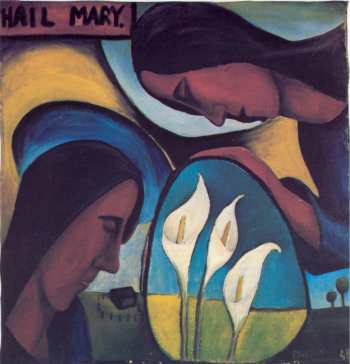
COLIN McCAHON
Hail Mary 1948
oil on canvas
(Collection of the Artist)
Eighteen months later, towards the close of a northern spring, after walking and hitch-hiking through the stupendous mountains of central Switzerland, I arrived in Zurich with photographs of two McCahon paintings - the Hail Mary and The Blessed Virgin Compared . . . The friendly, experienced art dealer to whom I showed these photographs, pointed out that, before he could sell in Europe, a New Zealand painter must win a reputation in London first.
In the summer of 1951, having returned to New Zealand, while working for the 'State Hydro' Department at lake Sylvester, on the beech-fringed mountains of Western Nelson that terminate the Tasman massif before it tumbles into Golden Bay, I read a magazine article on teacher-training.
As a result, perhaps under the influence of that beech-resin-heady alpine air, I enrolled at Teachers' College and spent 1952 and 1953 in Christchurch. There gradually I became better acquainted with Colin McCahon, with his wife, Anne and their children, and with his painting. I came to enjoy his and Anne's hospitality in their Barber Street house; which he has described as situated:
by the Linwood railway station. A place almost without night and day as the super floodlights of the railway goods-yards kept us always in perpetual light. The trunks of the trees were black with soot. We eventually had a small but lovely garden. To the right a pickle factory; behind a grinding ice-sugar plant. Twenty-two rail tracks to the left. A lovely view of the Port Hills and industry from the front room and across the road an embryo female bagpipe-player learning hard.(3)
It was also not too far away to bike to from the farmlet where my dog and I boarded among the cemeteries and sewage ponds, the lupins and pine woods of Bromley.
As the months passed, he included me in various activities. I cycled with him on some Saturday mornings to assist his professional gardening, he invariably having pointed out to me, on the way, some visual splendours in the architecture which I would never have noticed otherwise; accompanied him to meetings of the-Philosophical Society, dominated by his friends Arthur Prior and Ron O'Reilly, and to the Theatre Arts Guild, for which he designed and stage-managed a production of Peer Gynt in 1953; co-operated in publishing a broadsheet, Issue, and in trying to stage an arrangement of Job; relaxed, over beer, as on the night beside the river when we debated the merits of Beethoven and his favourite, Bach; waited for him, as on the evening when he arrived home very late for his meal after work because 'I have been sitting on a park bench trying to think what is wrong with my painting'; saw the triptych On Building Bridges emerge from an entirely different landscape and sun's-orb dominated painting (he had visited Australia the year before); and attended the 1952 Group Show, where he exhibited On Building Bridges, now owned by the Auckland City Art Gallery; There is Only One Direction; and the last of his Crucifixion series.
These three pictures, like those shown at the same exhibition by Rita Angus and M.T. Woollaston, received scant or scathing attention from reviewers and from the public. Similarly, the Crucifixion gained no place when it was entered for a religious art competition a few years later. Such dismissal of new art is the rule. Since Giotto's time, the work of major European painters has been ignored or derided by their contemporaries. Proust explains why this happens, when he writes, of encountering a new work: 'The beauties one discovers at once are those also of which one most soon grows tired'; because 'they are less different from what one already knows' whereas more profound elements seem at first 'too new and strange to offer anything but confusion to our mind. . .' He continues: The time, moreover, that a person requires . . .to penetrate a work of any depth is merely an epitome, a symbol, one might say, of the years, the centuries even that must elapse before the public, can begin to cherish a masterpiece that is really new. (4)
The second part of this essay aims to help viewers see more clearly four early paintings by Colin McCahon.
II
The Indian art historian, A.K. Coomaraswamy wrote:
Let us tell them [the public] what these works of art are about and not merely tell them things about these works of art. Let us tell them the painful truth, that most of these works of art are about God, whom we never mention in polite society.(5)
Colin McCahon's paintings map a relationship between man and his God. The first three illustrated here depict chronologically the story of Jesus. This preoccupation is not unique, for in a group of poems written twenty years earlier, R.A.K. Mason also portrayed a New Zealand Christ set in the local landscape, although most of this poetry was not known until Mason's Collected Poems was published in 1962. The fourth work discussed, combines a personal statement with Old and New Testament references. In choosing these subjects, the painter may be seeking to remind us, with Thomas Traherne, that:
The WORLD is unknown, till the Value and Glory of it is seen... It is indeed the beautifull Frontispiece of Eternite the temple of God, the Palace of his children;
where, sang Traherne:
The Laws of God. .. command you to love all Angels and Men. (6)
The Hail Mary painting was shown in the Dunedin Public Library exhibition of September, 1948. In the exhibition's catalogue, Charles Brasch wrote that the:
Hail Mary is a vision of exquisite and tender beauty, and seems to express that miraculous annunciation with great vividness and truth. (7)
The picture celebrates the announcement made by the angel Gabriel to Mary:
Hail, thou that art highly favoured, the Lord is with thee. . . And behold, thou shalt conceive in thy womb, and bring forth a son, and shall call his name JESUS. . .. The Holy Ghost shall come upon thee, and the power of the Most High shall overshadow thee: wherefore also that which is to be born shall be called holy, the Son of God. (8)
The painting depicts the heads of Gabriel and Mary, both with brick-red sun-darkened faces; Mary's surrounded by an aureole of azure-blue. The bending Gabriel touches a womb shape which is quickened with three stark white lilies, flowers that are both sexually and spiritually emblematic, symbolising here the Christian Trinity mentioned by Gabriel: God the Father, the Son, and the Holy Ghost. Below, among brilliant yellows and greens, a fenced building indicates man's work on earth.
The purity of this picture reflects an Immaculate Conception by which Mary would give birth to those virtues which if any can - surely must redeem western civilisation, although they may be only rarely realized yet: of the brotherhood of mankind; of living humbly rather than in luxury; of non-retaliation to violence, even verbal; of 'loving kindness fully blown'(9); of serving and suffering for others instead of for ourselves.
Also painted in 1948, The Blessed Virgin Compared to a jug of pure water and the infant Jesus to a lamp, portrays the childhood of Christ. The boy stands upright, his head, placed in front of Mary's womb and under the maternal bulges of her breasts, gazing out upon the world intently. The jug and the lamp are emblazoned beautifully above the figures. A dark shape occupies the lower right corner. On the left hangs the bold inscription. Otherwise, the picture emits a blaze of white light. It 'owes its being', the artist has said, 'both to the painter Grunewald and to that cruel and beautiful film, Open City. (10)
This film was made by Rossellini a few weeks after the German forces had left Rome. Rossellini himself wrote that:
In Rome Open City... all the acts of heroism and human kindness obviously spring from faith, and the brutalities of war from cynicism and absence of moral code.(11)
Like the painting itself, the heroine of the film is an apotheosis of such faith. She was played by Anna Magnani, who 'powerful, passionate, coarse, struck an earthy blow at the conventional film-star concept.' (12) Her strength is realized in the watching figure of Mary. By being compared 'to a jug of pure water', Mary becomes a symbol of absolution as well as of compassion; reminding us of Keats' lines extolling:
The moving waters at their priest-like task
Of pure ablution round earth's human shores.(13)
The comparison of the child Christ to a lamp is more usual, for, as Zachariah prophesied:
Thou, child, shall be called the prophet of the Highest. . . to give light to them that sit in darkness and in the shadow of death, to guide our feet in the way of peace. (14)
The painter's own compassion for men, women and children emerging from the holocaust of war can be expressed, perhaps, by this account from Jeremy Taylor:
St. Lewis, the King, having sent Ivo, Bishop of Chartres on an embassy, the bishop met a woman on the way, grave, sad, fantastic, and melancholy" with fire in one hand and water in the other. He asked what those symbols meant, She answered, 'My purpose is with fire to burn Paradise, and with my water to quench the flames of hell, that men may serve God without the incentives of hope and fear, and purely for the love of God. (15)
By this painting, we are adjured to serve others for themselves, without too much hope, fear, ambition or pride for what is particularly our own.
The 1952 Crucifixion is the culminant work of a series which, in the tradition of north-European art, had been characterised by portrayals of harshness, torment and fervour. This painting, however, is more reticent. There is no sign of the anguish typical of that Germanic Crucifixion before which Dostoevsky had his Myshkin say 'that picture might make some people lose their faith'. (16) Tortured thieves, mocking soldiers, the bereaved, thorns or bleeding nail wounds do not appear. Christ is shown in dignity, with outraised arms, on a cross which is carefully and strongly constructed. The landscape under him is calm. The cloud of darkness approaches or recedes unobtrusively on the left side of the painting.
In the lower right corner, a blood-red roof symbolises human building; man's activity. Above this; over the hills' dark horizon - stained only faintly with an echoing flush of red - the light of a new day, dawning now for all mankind, waxes ineffably; recalling the question with which the painter concluded his 1972 Survey catalogue notes: 'Do you believe in the sunrise? (17)
This Crucifixion is exquisitely painted, vindicating Keats' 'Beauty is truth, truth beauty'. (18) The inscription 'INRI', standing for 'Jesus of Nazareth, King of the Jews', has been delicately and subtly coloured. The white cloth hanging from Jesus' loins is folded as limpidly and sensuously as the robe draping Mary's elbow in The Blessed Virgin compared . . . It shows physical procreativity transmuted into spiritual generation. Behind Christ's figure, the 'green hill', from a Nelson or north-Otago landscape, rises, heaped up as if it were a yellow-green wave breaking, out of which not salt spray but the firm, ochre-stained sun-burned indissoluble body of Jesus like a crocus springs, unfolding immortal petals, spreading goodness' and sympathy's arms wing-like over the land; declaring indeed 'I am the way. . .' The painting is less a crucifixion than an ascension, in which the risen Christ embodies the psalmist's lines:
If I take the wings of the morning,
And dwell in the uttermost parts of the sea;
Even there shall thy hand lead me,
And thy right hand shall hold me.(19)
The grieving and loving features of this Christ are companions for all people. In 1975 Colin McCahon's Religious Works exhibition was shown in the Dunedin Public Art Gallery. Looking at some of these pictures after a lapse of years, several of us were astonished by their colours' mosaic-like radiance, which seemed to have grown brighter with the passing of time. One painting I had not seen before is entitled The Promised Land. It depicts a visionary face, perhaps the bearer of a prophetic voice, watching or speaking out of the skies; a singlet-clad workman; and two Nelson landscapes, the smaller of which, inset, is surmounted by the waterjug and a candle in a candlestick as a lamp. The Promised Land was painted in February and completed in August, 1948. The artist has described it as:
a dream painting of my life in Nelson - places I loved, me, my hut and water and light and below Farewell Spit, the end and beginning of it all. (20)
The viewer of this inset landscape gazes out - from the South Island's northernmost hills behind Farewell Spit, across the sickle of that 20-mile long arc of sand sheltering Golden Bay and Nelson haven itself - directly north. Somewhere beyond its clouded horizon lies the clear white cone of Taranaki - Te Whiti's sacred mountain - the Manukau harbour, Titirangi, Auckland city and Muriwai beach. The painter's progress after mid-1953 into those localities is a story of further explorations in artistic and religious faith.
Written sometime after Jesus' death, the anonymous A Letter to Hebrews says:
By faith Abraham obeyed the call to go out to a land destined for himself and his heirs, and left home without knowing where he was to go. By faith he settled as an alien in the land promised him. . . For he was looking forward to the city with firm foundations, whose architect and builder is God.(21)
Through their going out and seeking that spiritual 'promised land', Abraham and his heirs created the vast wealth of rhapsodic Hebrew literature. Something of how Colin McCahon has continued his particular search and his lyrical picture-making is told elsewhere in this number of Art New Zealand. If we would join him by understanding the paintings he has produced on that journey, we will need to follow Bernard Berenson's advice for studying a work of art; that is:
We must look and look and look 'till we live the painting and for a fleeting moment become identified with it;
remembering also Berenson's accompanying dictum, that:
No artifact is a work of art if it does not help to humanise us.(22)
In this way, as the painter intends, becoming more humanised ourselves by the pictures we study, our lives may add their new songs to those already bell-like summoning us towards another 'promised land'.
Acknowledgements: I am grateful to Rodney Kennedy, whose faith and foresight enabled Dunedin people to see McCahon paintings in 1948. Also, I am indebted to my wife for many suggestions incorporated in this essay; and to Gordon H. Brown and Ross Fraser for asking me to write it. Dunedin - Nelson: August - September 1977.
1. 'St Augustine, Enarratio in Ps. XXXII' quoted in A.K. Coomaraswamy, Christian and Oriental Philosophy of Art, New York 1956, p 36.
2. John Caselberg, The Sound of the Morning, Christchurch 1954, p 27.
3. Colin McCahon, Colin McCahon: A survey Exhibition, Auckland 1972, p 20.
4. Marcel Proust, Remembrance of Things Past, London 1949, vol 3, P 146.
5. A.K. Coomaraswamy, op. cit., p 20.
6. Thomas Traherne, Poems, Centuries and Three Thanksgivings, London 1966, p 172-3.
7. Charles Brasch, quoted in Colin McCahon: Religious' Works..., Palmerston North 1975, p 8.
8. The Gospel According to Luke, 1:28-36 (Revised Version).
9. Thomas Hardy, the Collected Poems..., London 1952, p 306.
10. Colin McCahon, ... A Survey Exhibition, 'P 20.
11. Quoted in Roger Manvell, Films and the Second World War, New York and London 1974, p 225.
12. Oxford Companion to Film, London 1976, p 439.
13. John Keats, Last Sonnet.
14. The Gospel According to Luke, 1: 76-79 (Authorised Version).
15. Jeremy Taylor Works, iv. 477. Eden's ed.', quoted in The Confessions of St. Augustine, Edinburgh 1874, p 348.
16. Fyodor Dostoevsky, The Idiot, London 1946, p 212.
17. Colin McCahon,...A Survey Exhibition, p 72.
18. John Keats, Ode to a Grecian Urn.
19. Psalm 139:8-9 (Revised Version.
20. Colin McCahon,...'Religious' Works, P 49.
21. A Letter to Hebrews, 11:8-10 (New English Bible).
22. Bernard Berenson, The Italian Painters of the Renaissance, London 1959, xiii.