
Colin McCahon as a Teacher
CLAUDIA EYLEY
In November 1976 I visited the Urewera National Park Headquarters where the Colin McCahon Urewera mural hangs. McCahon had been one of my painting lecturers at the Elam School of Fine Arts and seeing the mural reminded me that twelve years had passed since I, as an art student, first had close contact with him.
I had gone to the Ureweras and East Cape on an annual holiday tour with my family. We had ventured out from Rotorua by car passing on to Murupara on a broad expanse of highway through the Kaingaroa pine forests. Then the climb began up into the Urewera Mountains. The whole atmosphere was unique, the bush was dense and thick, the road rough and difficult. I peered with interest at signs relating to historic Maori sites and recalled snippets of half forgotten information, Te Tini-o Toi, Te Kooti, Rua, a land rich in history and legend.
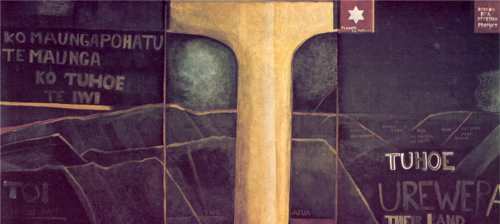
COLIN McCAHON
Urewera Mural 1975
acrylic on canvas
(Urewera National Park Board)
We had climbed to the Taupeupe Summit at 3,015 feet, and after three hours travel we came upon Lake Waikaremoana. The 'Lake' was an inland sea. Waves crashed on the shore, the rain was falling, and the mist hung heavily on the mountains. The lake seemed huge with massive cliffs on one side and high waterfalls. Minutes later we came upon the National Park Headquarters, a newly-opened architect-designed building. We stumbled out of our vehicle hoping for information on camping facilities and walking tracks.
The reception area is placed high in the building, using a series of ramps and platforms, thus elevating the visitor from ground level up to mid-tree height. Curious, we entered the reception area and beyond it was McCahon's Urewera mural. Nothing could have taken me more by surprise. I had seen some preliminary works in Rotorua at the South Pacific Arts Festival in 1976 and knew the work was destined for a site on the Ureweras. But to come face to face with a fine finished work in this remote place was very exciting.
In this one painting McCahon had revealed the essence of the rugged, tough, yet beautiful land. With a rich, dark ground he had worked the land forms that reached away from this place as a series of ridges into the far distance. He pays tribute to the TUHOE, THEIR LAND. McCahon recalls the ancestry and legend in words, the spirit of which is expressed in his version of this poem:
The Stone Mountain and the South Wind.
Hear me! O South Wind:
The Stone Mountain is the mountain.
Come - prepare food for our illustrious men:
the time has come for food and games.
Hear me! Tuhoe are the people and Rua is
their Prophet.
See the stirring of the Lake.
The actual words composed on the painting are: KOMAUNGAPOHATU TEMAUNGAKO WAIKARE TE MOANA KO TUHOE TE IWI TOI. These words, in large capitals, are placed on the left of a large cream Tau cross in the centre of the painting. On the right, in the ridges, is painted:
Our landed inheritance comes
from Toi our prestige
from Tuhoe
or Potiki Mana.
or HAPE
From the right-hand arm of the cross McCahon uses Te Kooti's six-pointed star, and further to the right, in the top corner, are the words 'Kenana Rua', the Prophet Rua, for Rua claimed the same spiritual ancestry as Te Kooti. In the lower half of this panel, in large capitals, is:
TUHOE, UREWERA, THEIR LAND.
The artist's signature is inscribed, 'Signed Colin McCahon, March-July 1975', and under the signature, 'At the boundary can I forebear from turning back my head'.
The whole effect was thrilling for me, so rich, so full of quality. While viewing the triptych, I found myself recalling the time I was a student under Colin McCahon at the Elam School of Fine Arts from 1965 to 1969.
McCahon had an informal approach to lecturing, although he was a very energetic and busy person. During his Elam hours this energy was directed almost entirely at us, his students. When he spoke to a group during a 'crit session' he held our absorbed attention while speaking in simple terms of very basic concepts. He was able to give these concepts the quality of universality. For instance, in a first year class, he would place a match box on a table in the studio and describe the match box, not as an object, but in terms of planes, horizontals, verticals and angles. He would explain how the upper surface related to the surface of the table, the sides to the vertical legs of the table, and on to the floor surfaces, to the walls and the total surroundings. For many students this was the first time that abstract ideas about form and the relationship of planes had been rendered in such a concrete and immediate way. We were given a way of seeing with new perception a world one had taken for granted up till then. For this reason McCahon probably had greater impact on his students at the 'freshman' stage. McCahon's authority was greatly respected by the students as he was a painter who spoke directly from his own vision and experience.
McCahon set many exercises for his students. He made use of traditional forms such as still life, painting from the human figure and some landscape. One memorable painting exercise was a still life study of two white eggs, on a white saucer, on a white piece of paper - to be investigated for a period of one week. McCahon looked on with an impish grin. When the week was up a clear bottle was added. As can be imagined, we made a very careful study of form during that fortnight, for it taught us how to look carefully. Often there were references to Cezanne and FraAngelico; to their use of form and space within a picture area.
McCahon gave ready support to individuals and genuine effort. Each student was encouraged to develop their own natural style. When he found a student struggling with a painting he would pick out the most successful section - even if it were the size of a postage stamp - and encourage the painter to bring the rest of the work up to that standard. He was encouraging in spite of the fact that, as he believed, out of every ten years of lecturing only three artists might emerge who would continue to work in a committed and innovative way. We were once asked to question ourselves as to why we were at Art School; what were our aims; and how valuably were we using our time there? Such prodding forced one to search both heart and mind, and this was often reinforced with references to separating the sheep from the goats.
Another phrase McCahon used that sticks after a decade is: 'To paint is to contrast'. Other sayings were: 'A curve contrasts with a straight line', or: 'Black contrasts with white'. We students saw such concepts illustrated in McCahon's own work, especially in his Waterfall paintings which were contemporary with this time.
I recognized such elements in the Urewera work. The huge, almost T-shaped shaft of light, with its two curves in the inside cross, is reminiscent of two waterfalls. Here also is the contrast of light against dark, and the hard-edged lettering against the organic hill shapes remain constant reminders of the basic elements that run through all of McCahon's work.