
Book review
MIRROR OF THE INVISIBLE WORLD: Tales From the Khamseh of Nizami
published by The Metropolitan Museum of Art, 1975 (117 pages, $15.00 US)
Reviewed by MAURINE ROTHSCHILD
This splendid volume is a new presentation of three of the famous stories of Nizami's Khamseh or 'Quintet' written during the last thirty years of the twelfth century. 'The beauty of the Khamseh of Nizami is unsurpassed in Persian literature' writes Priscilla Soucek of the Department of the History of Art of the University of Michigan, in her perceptive introduction. 'Sensuous, dramatic, gracious and refined, these epic poems display Nizami's genius for linguistic invention and psychological characterization - a talent imitated by hundreds of poets since his time, but never equaled.'
During the last quarter of the twelfth century Persian culture flourished even though political power diffused. Princedoms vied for the services of Persian poets. Though little is known of his personal life, Nizami lived in Ganjeh, a Caucasian outpost town, a major centre of cultural activity. During the Seljug period 'it boasted at least seven important poets', but Nizami was unique. He was a true Renaissance man, even a social reformer. 'He was democratic, delineating simple people with as much insight as heroes.' Especially in the treatment of women he broke with the custom of his times. Regarded by others as chattels, or, at the most, decorative objects, his women were strong, subtle and virtuous but often with sharp, educated intellects. His passion for justice was fierce. Kings must only rule wisely; they must create governments under which people can flourish spiritually as well as materially. He was a humanist and a romantic, and though his Islamic moralism frequently surfaces, it is of this world. Virtue wins out but life has a firm foundation in material and erotic pleasures.
The tales chosen in this edition are sensitively adapted into English by Peter Chelkowski of New York University. He has provided in addition an introduction and commentary on each with its historical background and with insight into the rich imagination of this twelfth century poet.
Khosrow and Shirin is the first of Nizami's romantic epics, a story of the love of the last Sassanian monarch for his mistress, Shirin. It is a romance of great dramatic intensity as well as a powerful commentary on human behaviour. It has been described by the great Persian authority, Dastgerdi, as 'the best historical fable of love and chastity, the treasure of eloquence, counsel and wisdom' and has also been described as one of the great masterpieces not only in the Azarbaijani but in world literature.
Layla and Majnum is one of the most popular romances in the Islamic world, for centuries a theme of love sonnets and songs. Even at its most blissful, the poet reminds us that 'love is accompanied by pain which separation intensifies' When Layla defers to the will of her family and marries another, she will not share his bed. And finally, dying, she asks to be dressed as a bride to join her beloved Majnum in pure ecstasy.
The Seven Princesses is the fourth and most intricate poem of Nizami. It is not a tragedy 'but a bedazzling exploration of the pleasures of love.' Though Nizami is always moral, it is regarded as one of the most intensely erotic poems of Persian literature, full of Islamic cosmology, for Nizami was much interested in astronomy. The major motif is the number seven, always prominent among the peoples of the East. Seven is called the first perfect number and casts its magic spell throughout the tale. The story is made up of those told by the seven princesses to enchant the ruler Bahram Cur. Each princess has been installed in 'her own paradisical pavilion in a specially built seven-domed palace near his own.' Bahram passes from one princess to another on succeeding days of the week, loving each and enthralled by their tales.
The publication of this book coincided with the opening of the new Islamic galleries at the Metropolitan Museum of Art. The manuscript copy is part of the Museum's collection.
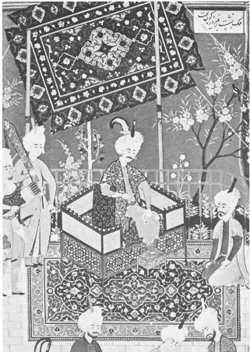
Each of the stories translated is illustrated by illuminated panels, wonderfully reproduced in this volume, luxurious in brilliant colour and gold, with the delicacy and precision that are the tradition of Persian miniature painting. The book is a visual delight, each illustration worthy of framing. The basic element of the decoration is an arabesque scroll embellished with multicolour blossoms. Backgrounds are blue, white and gold; robes and palace decoration are brilliant hues. Yet with all of its architectural decorativeness, one has a deep feeling of court life in the days of Persian artistic supremacy. Detail is accurately recorded, and subtly beautiful. Composition is organized and has a quality of unity and focus perceived in Western Europe years later by artists such as Cezanne. One's eye travels where the artist wishes, and rests on quiet and composed beauty. The balanced use of colour, the tradition of architectural patterns makes human figures at first seem contrived, but as the viewer enters each pavilion of the Seven Princesses, he finds the naturalness and the spontaneity that was part of the dynamic life of Persia.
The Khamseh is truly a splendid example of the art of the Persian book and the heights it achieved under royal patronage. It is a joy to read and to peruse.