
Closing Focus
Ten Takes on Mark Braunias
JUSTIN PATON
1. Flashback
Peering, staring, scrutineering: the act of looking in all its aspects is at the heart of all painting, and that act has formed the moral hub of his art for at least a decade now. He is, as we know, a painter of the teeming human world, a voracious scanner of the social scene, an artist whose drawings and paintings are populated by a rich and shifting human cast: boxers, soldiers, debutantes, tourists, rugby players, war brides, plunket nurses, marching girls. No surprise, then, that many viewers thought they had him classified and filed under the 'human interest' heading. No longer.
2. Closing Focus
Talk process to Mark Braunias and certain words recur. He speaks of 'forging' an image, pulling or wrestling it up out of the canvas, grappling it into being. His paintings, true to that urge, are worked and reworked, toiled over, scraped out, hewn. This process has always obsessed him, but of late it has yielded an unforeseeable and dynamic trajectory. As Braunias burrowed deeper and deeper into his obsession with the act of looking, the images of sight that served as props in earlier works—the cameras toted by his boorish tourists, the range-finders and rifles and gas-masks hefted by his young Anzacs—began to crossfertilise and divide and mutate, like cultures on the breed in a petri dish, supplanting the humans whose tools they once were, sprouting into strange and edgy new lives of their own. Before, his paintings looked out at the world through a wide-angle lens, and we looked on. Now, the paintings peer troublesomely back at us, scrutinising the scrutineers, turning viewer to voyeur. Braunias is closing focus, and we're in his sights.
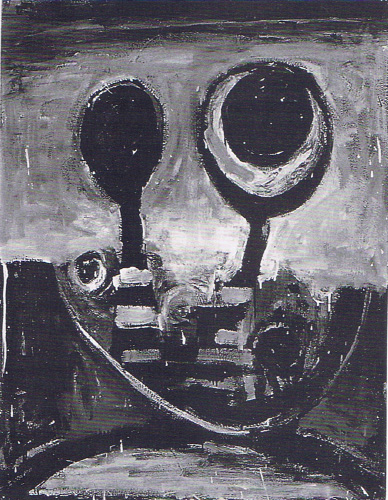
MARK BRAUNIAS
View Finders 1994
Enamel on paper, 1500 x 1200 mm.
3. Black Eyes
The eyes have it. Big, black, unblinking, they stare broodily out into the gallery space, eyeing you up and staring you down—at once ugly and benign, strange and sad. Close cousins to the huge hairy eyeballs in Philip Guston and Robert Crumb, they're struck onto canvas and paper in gutsy swipes of oil or enamel, and they crane upwards through the churning paint like periscopes. The eye is the psychic heart of the face, and it is the antenna with which a painter reads the world. Thus do these images press on your mind as an oddly tender portrait of the Painter as a tragi-comic anachronism, peering out with hope and apprehension at a world that has no need for his art: a naked eye stranded in an alien landscape, good for nothing but looking. 'Only an eye', as Braunias has scribbled in one of his workbooks, 'but my God, what an eye!'
4. Snapshots
They bristle with scopes, these paintings. Stand in their midst and you're crisscrossed by sightlines, loomed at by lenses. Your gaze ricochets back from all sides. No escape. Braunias, here, is looking at looking, bending the gaze back at himself, holding up a mirror to his own roving eye. His theme is the moral ambiguity of vision, the dangers of peering into other people's lives. And his protagonists are people who have become the lenses they look through, versions of that brand of twentieth-century voyeur described by Susan Sontag as the ‘hunter-with-a-camera’. The photographer shoots and the gunman shoots, but both acts are predatory, and it's just that dilemma—the bedrock paradox of an art of social observation—that Braunias fronts up to when he welds eye and camera and gun. Does the painter have us in his sights? Do we have him in ours? Is this a lens we stare into? A mirror? Or a barrel?
5. Machine Dreams
The pages of Braunias' recent notebooks return us to the ardently Utopian science of the '50s. He's entranced by the imagery of that bland and paranoid era—Russian cosmonauts, dogs in space, shiny-new satellites, with the cold war humming edgily in the background—and they form the sources for a recent series in which Braunias' manic optics take on a space-age spin. Some recent titles: Headcase, Redhead, Atom Ant. In these works Braunias reissues, in a radically new form, the old sci-fi trope of the individual tangled within technologies bigger and more powerful than their architects, thus taking up and recasting a tradition that runs from H.G. Wells to Blade Runner. Braunias relishes the purchase of one such work by the National Bank, where it will doubtless hang in some high-security executive office: an image of surveillance under surveillance.
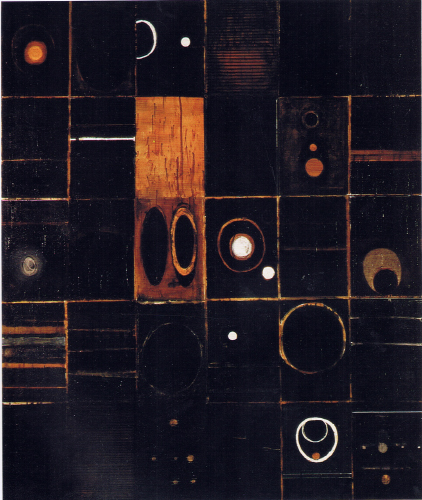
MARK BRAUNIAS
Optic 1994
Mixed media on canvas, 1830 x 1520 mm.
6. Weird Science
You have to be a fan of the hokey noirishness of sci-fi movies and comics to tune in to Braunias' recent work. Rogue circuitries, mutant gadgetries, electronic grotesques, sinister shutterbugs: the hybrid organisms in Braunias' new paintings might have been retrieved from an early episode of Doctor Who and rewired by a '90s Dr Frankenstein. Innocents abroad in a post-human world, E.T.s with no home, these creatures inhabit some dank cranny below the Information Superhighway. Look at the beetlish robot-critter that emerges from a tangle of conduits, cogs and cams in Shadow Zone: Gyro Gearloose crossbred with H.R. Giger.
7. The Fistic Arts
It's not all sci-fi and cyclops in the world of his art, though. Elsewhere, the people-paintings go on. The latest are suffused with Braunias' passion for boxing —its seedy glamour, its B-movie pathos. In a corner of his big, shambling studio are stacked old, yellowed copies of the boxing magazine The Ring, circa 1950. Flicking through them, you recognise the source for the pale, sad, black-singleted pugs in Braunias's paintings. These images—full of high stark contrasts and vicious flurries of oil or charcoal—give us the ring as primal arena, a cage of rope and canvas, the high theatre of the lowbrows. And though Braunias might disown such a reading (‘I'm not making any grand statement about painting’) it’s not a stretch to see these paintings as a wry homage and elegy to old macho brands of painting. The artist as contender; the studio as ring;- and the paintings as two-fisted attack.
8. Low Blows
Braunias throws low blows to high culture. This is an artist who roves further left of field than the art world —a Southpaw, so to speak. When I quiz him as to what’s hot on Auckland’s gallery-circuit, Braunias sends me strolling to 50 High St. An art emporium, surely? Nope. It’s a shop-front full of pulpy space operas from the ’20s and 30s (Fantastic Mysteries, Astonishing Stories, Weird Tales) whose elegantly lurid cover-art Braunias swoons for.
Likewise, early MAD magazine is Braunias’ bible; and Bill Elder, its greatest pen-man, is God. No hostage of the white cube, Braunias makes regular dispatches to the wider world. Quick on the draw, he has published deft, dark and barbed cartoons in Prague’s news magazines, appeared in local pavement ‘zines, and his love of the ragged garage-grade product —xeroxed, unkempt, vernacular — pours from the pages of his workbooks, A4 volumes packed with oblique and quirky sightings.
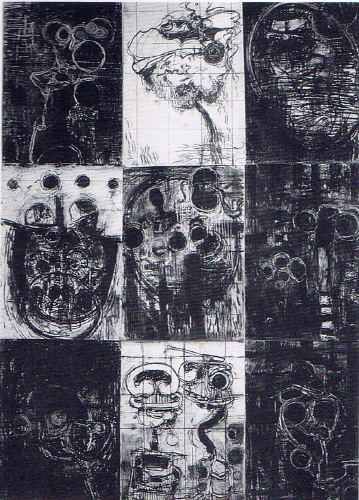
MARK BRAUNIAS
Gash Stock 1994
Conté & primal on paper, 3240 x 2250 mm.
9. Strip Shows
The A4 page is Braunias’ natural habitat (his brush delivers body blows, but his nib feints), and in his most spectacular works he assembles up to 150 such pages into huge grids, riffing his way restlessly, rhythmically across their surface in twink and ink and shellac, coaxing up fragments of figures from the inky surface. Such works resemble story-boards or comic-strips, except that the plot’s scrambled and the humour’s pitch-black. Of late this filmic format has surfaced on Braunias’ canvases as a tarry vestige of the Modernist grid. They’re action-packed, these works, dense with invention. Shellac bleeds down the grid. Novas pulse and dilate. Windows and grilles open into it. Wiry lines leap across the cells, like electricity between cathodes. And over such cells are fastened acetates, like x-rays on a lightbox, yielding double exposures.
10. Fade
Questions, not answers. Action, not stasis. Grit, not polish. That’s what this artist has to offer. No market-friendly re-issue of signature works, his recent art yields a tougher pleasure. Burrs and all, it puts us eye-to-eye with a sinewy, undoctrinaire and unruly visual intelligence: mind open, eyes wide, on his toes, in touch with doubt. Which is the only place, really, for a painter to be. Keep an eye out for Braunias.