
The frame is the dictator
GRAHAME SYDNEY
I agree with the notion that there isn't much feeling of belonging in New Zealand - not yet. I feel I belong but maybe that's just my generation. I think the generation of painters before mine kept a very close eye on what was being done elsewhere. When you're not completely housed in your own little province, being supported by the people who buy your work as a painter, it's inevitable that you feel you don't belong. And so a lot of our painters went overseas and stayed there. Only in the last decade has there been an emergence of a local legend in the painting world - of people who stayed here, who made it work here. My generation - the ones around the age twenty-five to thirty-five - are the first group to feel that their support in the long term will be here, that they can justifiably use nothing but New Zealand imagery with confidence, and can be supported by New Zealanders.
I don't label myself a landscape painter in particular - I don't think of myself as anything but a painter. The landscape artist works with any object that crops up in the landscape, not simply panoramas and vistas of hills and plains. If old buildings are an interesting feature of a particular environment and they come well within the landscape balance, then I'm a landscape painter because of that.
GRAHAME SYDNEY
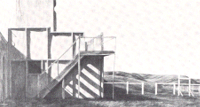
Jockey Club
egg tempera, 814 x 432 mm.
(collection of the Auckland City Art Gallery)
I certainly don't come into the school who say that nature is the ultimate artist, that our job is to pick out pieces, draw frames around them, and reproduce them as faithfully as possible: though most people who see my work think that is what I do. I have a great love and respect for things as they naturally occur and especially for what nature has done to them - like buildings that develop a sort of warping rhythm of their own. I love that and I tend to use it a lot. But to think in terms of using it simply as a framer is nonsense. I can't bear the thought that painters simply go out and reproduce what they're looking at. That's far too facile. The thing that's more vital to a realist painter is to make the picture work within the frame and what I do is entirely my affair, nothing to do with nature at all once I get into the studio.
I never paint outside, apart from the odd watercolour. I do all pencil studies outside, and that's when it all happens. That's when you become an artist and not a reproducer. The frame is the dictator not the appearance of nature. It's what you do with the spaces inside the frame; that's the key. The longer I paint, the more I'm in control of what's happening within the frame. I used to be more loyal to the visual truth than I am now - when it comes to the real subject, I abuse its reality.
My first one-man show in Dunedin sold out and I thought I was on top of the world, that there would be doors opening all round. But I just didn't have the cash to be able to paint. My approach is slow and my technique is slow. I'm so slow that I need money for a year to get an exhibition together so that I don't have to sell the things as I do them to keep going. I got to Europe with a couple of thousand dollars which was gone in three months: but I went to as many galleries as I could, as often as I could. Instead of painting I went the photographic way. I've got thirty rolls of film still undeveloped and another forty or so that I had developed. I evolved this rather odd notion of going round the galleries making notes on paintings. I came to realize that it's all possible. There's not a thing in those paintings that you can't learn.

Grahame Sydney
photograph by Tom Turner
I've only been in the Clutha valley for about eight months: but most painters, I suspect, would feel the same way as I do about the Clutha Valley proposal. Possibly I fall into the group that feels most from the heart about it - how wrong it is, what a foolish act it is! It's patently clear why serious artists should want the land preserved - because it's something they have a great love for, more than they can really tell. It's not just because they use it when they paint, they paint it because they feel for it so strongly, and the paintings are the expression of that. I expect that nobody likes seeing it defaced or abused, and especially they don't like seeing it lost forever, behind a bloody awful dam!
I think the kilowatt dimension of the argument is going to be the shortest-lived element of the whole thing. The basis for our annoyance is in several things. It's a marvellous, unique bit of landscape which I want my children to see and know like I do. It's bad enough to look across to the hills of Bendigo and see pylons and shiny damn wires right across the range, the whole length of it. There will be pylons everywhere taking the power away up to the North Island. I hate it being touched. I'm such an arch-conservative conservator when it comes to land that I just don't like it being defaced in any way.