
Book review
JUAN GRIS by Juan Antonio Gaya-Nuno (translated from the Spanish by Kenneth Lyons)
published by Secker and Warburg, London 1975 (267 pages, $40.60)
Reviewed by GORDON BROWN
In approaching Juan Gris' achievement the author touches on the parallel relationship that has unjustly allowed Picasso's fame to overshadow that of Gris, as Velezquez dominated over Zurbaran. Such a comparison is not surprising from a noted Spanish historian who in the process of dealing with Gris reveals facts about his early life hardly mentioned by previous authors.
Today we see Gris as one of the pioneers of Cubism along with Picasso and Braque. But as Gaya-Nuno explains, Gris, being younger than the other leading Cubists, was just sufficiently out of step as not to command the same respect from those who had been the original supporters and theorists of the movement. When he lived, this mattered dearly to Gris, but as time advances such facts diminish in importance, while the appreciation of the artist's work slowly increases until now he is treasured among the Cubists.
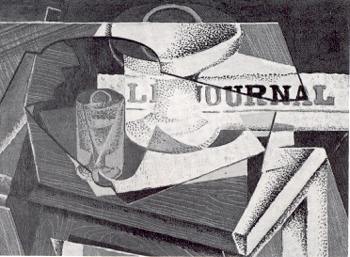
JUAN GRIS
Fruit Bowl, Book and Newspaper 1916
oil on canvas, 33 x 46cm.
Gaya-Nuno analyses the reasons for this early neglect, for which he sees the artist's own personality as partly to blame. He quotes Gris' letter of December 1915 to Kahnweiler: 'How I wish I had the facile coquetry of the unfinished. But unfortunately painting must be done as it is. I have a spirit that is too precise to let me stain a blue or twist a straight line'. The author comments that the artist's shyness and premeditated carefulness 'prevented him from understanding that a great artist has to let everything in him be discovered, even the weaknesses'.
Although highly informative, the text is not particularly long and is easily read within several hours. The author is scholarly without being ponderous, and while it displays some exuberance, his style allows for easy reading. The text's seriousness is on occasions lifted with humorous touches, as when the author relates how Gris' future dealer, Kahnweiler, called the full-blooded Spaniard a Creole type - a racial fantasy which the equally proud Spanish author sees fit to forgive considering the help Kahnweiler extended to Gris. There are also enthusiastic passages related to Gris' work, as in the penetrating description of the artist's use of black in a chessboard depicted in a 1915 painting.
The book itself is well illustrated, and includes a good number of colour plates. The reproduction of magazine illustrations from Gris' early years can be welcomed. The bibliography is full and the index reasonable.
The one fault I found when reading the text was the absence of a simple marginal reference to the illustrations referred to in the text. Because of the book's layout, the relevant illustrations are not always easily or quickly found.
It is a virtue of Gaya-Nuno's book that he reminds us of the greatness of Gris's paintings at their best during the troubled years of the First World War when the artist was proving himself to be the purest practitioner of all the Cubists. Without doubt this monograph can be regarded as a standard work on Juan Gris: a book easily read and understood.