
Regionalism and Identity
Paintings by Mark Braunias
WILLIAM McALOON
When Mark Braunias exhibited his All Black paintings at Christchurch's Jonathan Jensen Gallery in 1989, a notice advertising the event appeared in the sporting fixtures column of the local paper. When further works were shown at Wellington's Last Decade in the following year, a former All Black, Jock Hobbs, dropped in for a look. He found the figures 'heroic, pensive and thoughtful . . . they'd hardly be thinking about the next Woody Allen joke.'
Wit is crucial to Braunias's painting. Irony is used as a means of confusing and disrupting the codes of a national identity, particularly the construction of masculinity in that most powerful of institutions, the game of Rugby. Braunias's intention, he has written, is to depict 'aspects of regionalism . . . myths, role model types and attitudes (predominantly male) which I find peculiar to this country.'
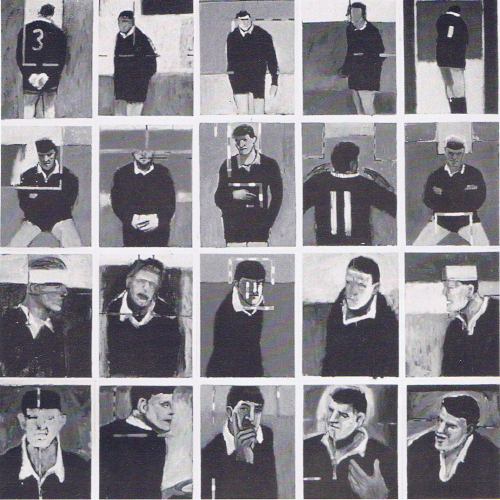
The Emblems of Identity exhibition featured paintings of All Blacks in variously heroic or anonymous poses. The collective mentality, the system, is shown in the monumental Black Order (1989-90), where vestiges of individual identity are lost. The players are types, stern and foreboding, entrapped and ordered by pictorial construction lines and layers. Some make eye contact with the viewer - the cultured gallery-goer - and look on mockingly, or with genuine wonder.
MARK BRAUNIAS
Black Order 1989-90
Oil on paper, 2600 x 2500 mm.
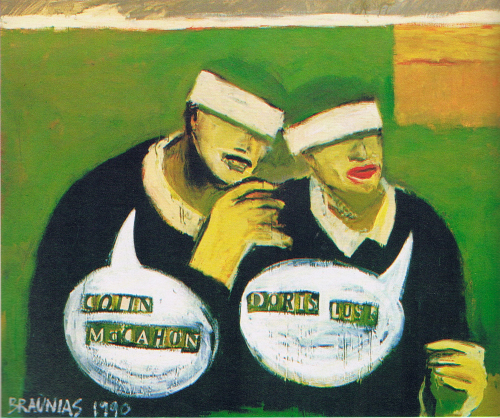
Other works broaden the field, indicating that it is not just 'The Game' that is in question, but the general machinations of a social structure, and the place art has in that structure. Knowing About Art I (1988-89) puts the viewer in the judgement seat before a Daumier-like jury of All Blacks, with masked or blank faces. Black Isolation (1988-89) and Lock (1989) put us face-to-knees and face-to-facelessness with a couple of black uniformed monoliths. We are also notified of the fact that the sporting and the artistic pursuit are related by a shared concern for figures in fields. Knowing About Art II (1990) shows a dialogue between two blindfolded black-shirted players, one outrageously made up. We are left to referee the competition, the match between the All Blacks and Art, Colin and Doris, the masculine and the feminine.
MARK BRAUNIAS
Knowing About Art II 1989-90
Oil & newsprint on canvas, 1200 x 1800 mm
The regional concerns that are apparent in these works are shared by a number of other contemporary artists, and recently a dialogue has opened up between artists and the historical style, capital 'R' Regionalism. Recent work by Ian Scott, for example, attempts to analyse the position of McCahon in our consciousness, by filling rooms with Warhol-type wallpaper portraits of the artist. Dick Frizzell has made numerous journeys down forgotten Regional byways recently, and Michael Stevenson earnestly lives and paints the religious experience of life in the provinces.
Earlier work by Braunias was more specifically art historical in its investigation of regionalism. One painting entitled Foreign Intervention (1988) for example, depicts a meeting between the Madonna of the Annunciation and Donald Duck on a modernist colourfield, in turn suspended over a McCahon landscape. Another charming image, My Parents Always Saw Themselves in This Picture (1988), adds a black-singleted, white Y-fronted man and plaid-skirted woman to Picasso's troupe of Saltimbanques. With this textual layering Braunias illustrated the contradictions of regionalist art.
The appropriation and rendering of signs from the artistic centres are necessary to establish a seemingly local identity here at the cultural and colonial periphery. In scavenging signs, our selection becomes arbitrary. McCahon, as allegorised in Foreign Intervention, would happily mix the Bible with comic books. Thus, a New Zealand Art is always to some degree appropriated and foreign. Nationalist mythology, however, has privileged some borrowed signs and marked them as local and natural to the point where that is exactly how they seem.
Layering signs of the local and the foreign, and the multiplicity of meanings this generates, have become less of a concern for Braunias in his more recent work, its outlook less international. Some motifs remain: meetings and conjunctions of figures, points of dialogue and the placement of figures in broadly Regionalist landscapes. A more general connection is retained to the cultural heroics of Regionalist identity. An example is the apparently unintentional similarity of Braunias's people to the staunch and robust figures of G. T. Moffitt. They are the broadly brushed populace of a landscape with too few lovers.
Braunias's figures, however, lack Moffitt’s heroism, looking either too self-conscious or parodic, or censored by the abstract blocks and lines that contest with them for control of the compositional space. Single figures, or meetings in diptychs and triptychs featured in his Christchurch exhibition late last year. Numerous bleak countenances were barely visible, eye contact was difficult. They were almost too ordinary. Humour broke through in some works, one with phallic toilet doodling entitled Dickhead, another with two figures called Jim and Mary locked together head-to-head—the title: Shared Vision.
A recurring motif is the sash of paint blindfolding the subjects, concealing their full identity, protecting them like suspects or victims. Other figures resolutely refuse to meet our gaze, with eyes downcast, or their whole bodies turned away. The loss of identity for these masked or retiring figures is reinforced by the inclusion of fragments from newspapers to spell out lost names.
MARK BRAUNIAS
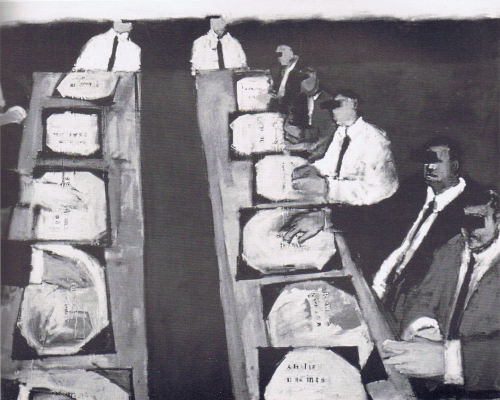
Hidden Identities 1990
Oil & newsprint on canvas, 2080 x 1600 mm
Mirror (1990) is a possible self-portrait, about the loss of self. A lump of pallid, dysfunctional flesh is masked from seeing itself, and lost in grim white space. In the aptly-titled Hidden Identities (1990), a conference table is occupied by nameless, faceless, corporate overlords, with badly stained blotters. The back-drop, once again, appears to be a McCahonian landscape, dark and austere, possibly a real painting in the picture’s boardroom. Mark Braunias continues to develop these twin concerns of individual and national identity, and the relationship between the two. Both are ongoing processes, never reaching a final and certain point. In both, art plays a crucial part, and this is investigated by Braunias from the standpoint of an ironic Regionalist style. His is an art about how we look at art, and how we look at ourselves.