
Exhibitions Christchurch
&:Ampersand Yuk King Tan Joanna Braithwaite
GINA IRISH
Time flies when you’re having fun: In 1992 the High Street Project was launched as an alternative venue for emerging and experimental artists. At a time when so many artist-run spaces dissolved, the Project survived numerous relocations and directorships. Now, 12 years on, the High Street Project, New Zealand’s longest running artist-run space, remains committed to edgy contemporary practice. &:Ampersand, the Project’s twelfth anniversary show, supported by Art & Industry’s SCAPE biennale, pays homage to the artists and coordinators who have secured the Project’s future.
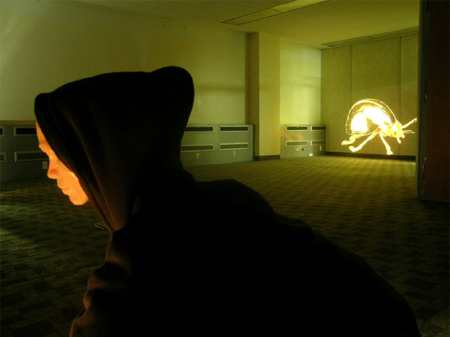
Sam Eng's He knew they could not see him so long as he kept focuson the light at &:Ampersand
On the second floor of the abandoned Ex-Government Life Tower building, located in Cathedral Square, installations by Dan Arps, Sam Eng, Sean Kerr, Saskia Leek, Violet Faigan, Francis and Alan Upritchard, Eddie Clemens, Grant Wylie, Zina Swanson, Joyce Campbell, Rae Culbert, Simon Lawrence, Robert Hood, Maria Walls and Amanda Newell, embody the Project’s ethos. All fifteen artists bore witness to the development of the space and represent significant milestones for the Project.
For many, &:Ampersand is a nostalgic homecoming. ‘Goods Delivery’ dockets replace exhibition labels and track the incoming works delivered or sent to the site by artists who no longer reside in Christchurch. Campbell, one of the first artists to exhibit with the Project and now based in Los Angeles, decorates a staid office wall with her microbiotic murals. Large black-and-white photographic prints of crystal formations and fungal blooms diminish anxieties surrounding infection and disease. Instead, Campbell unveils the chemistry of body, land and memory, to reveal alluring abstractions and patterns. The life that grows within the scientist’s slide or Petri dish is captured in an instant.
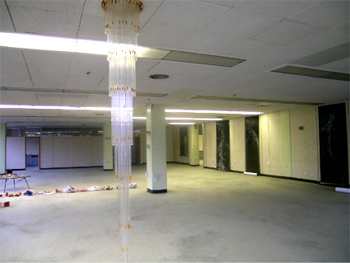
&:Ampersand, installation showing (foreground, anti clockwise) Zina Swanson's glass sculpture, Rae Culbert's installation Trash Bible Gun and Fundamental... Yeah Let's Get Fundamental, Joyce Campbell's photographic prints
Swanson, a more recent exhibitor with the Project, is suitably placed alongside Campbell. Elongated test tube vessels filled with water and stamens of oriental lilies, hang from the office ceiling. With the ever-changing temperature of the space, the stamens bob in the water, slowly floating up and down the tube. A large bulbous tube, running through the middle of the sculpture, contains lily pollen, painstakingly collected by Swanson during the creation of this fragile construction. The artist alludes to the magic of alchemy, the colour of the golden stamens deepening in their swollen liquid state.
Rae Culbert’s garbage installation, Trash Bible Gun and Fundamental Yeah… Let’s get Fundamental is a light-hearted critique of religion and addiction. Pages from the Bible are piled together alongside empty Tui and Canterbury Draught cans, burnt-out cigarette butts and banana skins. Rae’s installation is a tribute to the Project’s political voice, and is reinforced by Eddie Clemens: Triangle and Love Will Tear Us Apart presents the evils of mass production, consumerism and branding. Red supermarket bags printed with the words: ‘You bloody raped me and you think a trip to The Warehouse will make it better!’ immediately squash the concept of retail therapy.
The sultry sound of Marilyn Monroe singing ‘Happy Birthday Mr President’ can be heard from Maria Wall’s office where two DVD’s, one featuring blurry shots of ‘birthday’ artists, the other ‘writing’ the history of the Project, complete with Body Electrics’ 1980s soundtrack ‘I Could Be Happy’, are played over and over again—a never ending birthday toast. In the adjacent office, Hood recreates the great escape. The escapee AWOL office worker or an artist struck with stage fright—is long gone. Knotted white sheets trail out the office window down to the alley way below. A table, holding the sheets securely in place, is covered with chocolate M&M’s—an uncanny scene when you consider the link between Hood’s installation and the buildings previous ‘bean counting’ tenants—the IRD.
Down the hall, a computerised voice trapped in the radiator of Sean Kerr’s office, pleads ‘can you help me? I need someone to show me the things in life I cannot find’ Unsettling, yet oddly humorous, could this be the ghost of a blue collar worker? A framed picture of a cigarette packet alongside the artists’ sculpture of a bomb – fuse ready to light – contribute to Kerr’s scene of desperation.
The darkened room that is home to Sam Eng’s installation, He knew they could not see him so long as he kept focus on the light, delves into the mind of a delinquent. The eyes of Eng’s manikin— costumed in PJ’s and a hood—glow red. The demon child holds a magnifying glass to the light, spotting and destroying bugs that cross his path. A projection of a giant beetle faces the doorway—the one that got away.
Francis Upritchard, in collaboration with Alan Upritchard, the artist’s father, extends her study of collecting to explore concepts relating to authenticity. A hockey stick, battered and beaten, is transformed, re-presented as an ‘indigenous’ carving bearing crocodile teeth. The frame of a tennis racket undergoes similar treatment and is exhibited alongside ‘faux’ taonga copied and carved by the artist and her father. These sporting fixtures and blatant copies perpetrating as treasures, question the power we ascribe to artefacts and everyday objects.
Grant Wylie’s rooms lock the viewer out and invite the viewer in. Room one, with the sign ‘You Are Here’ on the door invites the visitor to walk around his concrete sculpture. In the adjacent room, identified by the sign ‘I Was Here’, concrete pavers are laid on the office floor, upon which two small architectural sculptures are placed. The tiles prevent the door from opening, blocking access to the room.
What would a birthday party be without sweets and cake? Gingerbread men and iced creatures—some purchased by Saskia Leek and Violet Faigan, others baked and decorated by the artists—crawl from the nooks and crannies of a white cardboard mountain. Based on the duos earlier exhibitions at the Project, the cardboard mountain is representative of ephemeral work the space has supported over the years. Likewise, the inclusion of digital work by Amanda Newell and Simon Lawrence was symbolic, for the Project has fostered new media and experimentation.
Dan Arps’ installation carries the presence of people who have once inhabited the IRD’s stationery room. An aerial sculpture of interconnected fluorescent lights dangles from the ceiling; the lower edge supported by a janitor’s mop. Beneath this unsteady construction, breakfast cereals, flouro plastic cups, a patterned rug and empty Mountain Dew bottles are scattered across the floor. The abandoned belongings and the continuous buzz of a radio set off frequency could easily pass as the remnants of a performance or party. It is here, that the &:Ampersand party draws to a close.
Little Wonder, Joanna Braithwaite’s recent series of paintings on show at the Brooke/Gifford Gallery unveils a circus of unusual creatures. Braithwaite’s interest in the relationship between the animal kingdom and mankind, in particular cloning, is taken one step further, the abnormalities more severe.
Twist of Fate III, a serpent with a swan’s head at either end of the body, and World without End, a two-headed chicken, fighting over the same worm, has a Dr Doolittle twist; for surely these mutant creatures are the product of fantasy, or could they one day be the result of science? Bird of Prey, a bird’s body and a cat’s head sits perched in a tree, undecided as to hunt or fly. Peanut, the miniature horse—a cute farm animal or just another genetic experiment? The genetic disasters Braithwaite imagines are disturbing, and while the animals appear animated and kooky, the pressing issue of genetic engineering dominates the series.
Little Wonder reminds the audience that we continually hold animals to ransom. Consider The Whistling Chihuahua, a painting of what may be regarded as the world’s most disliked and misunderstood dog. This seemingly quivering, nervous canine, wide eyed and caught in the spotlight, in role reversal the Chihuahua whistles for its owner, though one might assume that this unwanted pooch has been calling for quite sometime. Smaller paintings of canaries and canines dressed in tutus perform tricks for their audience, satisfying human desire to ‘tame’ or control nature.
The burnout remains of Yuk King Tan’s firework drawing, I am the light of the world, was exhibited at the Jonathan Smart Gallery in September. The blue and green firecracker drawing is a portrait of South Island Presbyterians, and an ambitious missionary, who after attempting to convert the Chinese goldminers who settled in Otago and Southland during the late 1800s and early 1900s, decided to travel to Canton to save a million sinners. The crusade was abandoned when conflict between the Chinese and the New Zealand Presbyterian Church dampened missionaries’ efforts. Footage documenting the burning of the firecracker drawing is played in reverse on a monitor positioned alongside the charred remains. Failed dreams are ablaze, as Tan remembers the goldminer’s determination to gain wealth in New Zealand and the missionaries attempt to convert the damned.
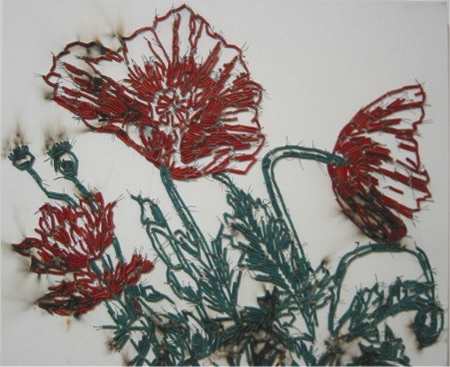
YUK KING TAN Poppy 2004 Red and green fireworks
Yuk King Tan’s DVD Center, documents Tan’s performance in a Shanghai park. Shot from an apartment building looking out toward the space, Tan stands in the middle of the park, suddenly drops to the ground and doesn’t move. Bystanders walk around her, many in a state of confusion, some offering help. The performance doesn’t last long as Tan leaves the area before the police, travelling by bicycle, arrive at the scene. Tan explores risk in a regimented society, after all the film is shot in China.
This critique of China’s culture and society revisits the past. Various flower drawings hang in the balance, awaiting a naked flame. The flowers: Iris, Rose, Sunflower, Carnation and Poppy are universal symbols of Revolution. Poppy, an image Tan has used previously, stands as a poignant reminder of the Opium Wars; the smoke stained canvas carries the shadows of China’s past. To watch the burning of a Tan drawing is a rare treat, a spectacle that literally sparks discussion.