
Book review
The Dance Photography Of Carl Van Vechten: Selected and with an Introduction by Paul Padgette
Published by Schirmer Books, New York 1981
Reviewed by WILLIAM DART
A copy of Nigger Heaven on the coffee table would be bound to raise a few eyebrows in these times: but then novels with titles like The Tattooed Countess and Spider Boy might also attract some curiosity. What these books have in common is that they were all written by the singular American litterateur, Carl Van Vechten (1880-1964).
Van Vechten had the kind of well-ordered career that academics dream of. He started as a journalist, writing on music and dance - many of his essays being published in his collections Red and Music, Popular and Unpopular. He found new fields to till in 1920 when he devoted himself to a quirky piece of feline scholarship entitled The Tiger in the House. From 1922 to 1930, he wrote novels which showed that Ronald Firbank could be as sound a model as Scott Fitzgerald in documentating the dizziness of the Jazz Age.
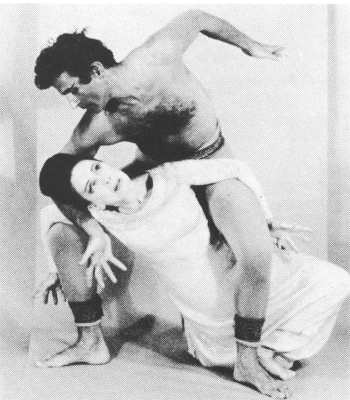
CARL VAN VECHTEN
Martha Graham and
Bertram Ross in
Clytemnestra 1961
Black-and-white photograph
For the rest of his life, Van Vechten dedicated himself to photography. What had once been an amusing pastime for a busy novelist now became a full-time, albeit dilettante, occupation. Van Vechten was proud of his amateurism for it gave him the artistic freedom to treat subjects of his own choice and then only release those photographs which pleased him as an artist. All this might not seem so exciting - save for the fact that his position in the world of theatre and dance gave him an unrivalled opportunity to capture subjects as diverse as Bill 'Bojangles' Robinson and Marc Chagall through his lens.
Schirmer's new publication offers a selection of over two hundred photographs, ranging from the 1933 portrait of Robinson to Van Vechten's work in the 'sixties, including the set of portraits of Martha Graham and Bertram Ross in Visionary Recital and Clytemnestra which date from 1961 - somewhat conceived close-ups of the dancers in sinuous and almost claustrophobic embrace. Many of the artists are photographed in what often seems a quaintly posed style, against the backdrop of a screen or curtain. One of Van Vechten's favourite backgrounds must have been the silver one which features in his 1936 portrait of Kaloah, an exotic dancer from Broadway's Cotton Club Parade, and is still being used in 1952 for his session with Ni-Gusti-Raka, a nine-years-old Balinese dancer.
The collection captures Van Vechten's prodigious energy in this field and it is indeed a revelation to learn that the Philadelphia Museum has no less than thirteen thousand Van Vechten photographs in its cotlection. It is a collection that ranges from his carefully documented account of Gertrude Stein and Alice B. Toklas's journey to Richmond, Virginia, in 1934, to the many portraits of black dancers and musicians: from various members of the American Negro Bal let in 1938, to that of a young Eartha Kitt from the Dunham Dancers fourteen years later in 1952.
Van Vechten's art transcends the obvious technical shortcomings of the photographs themselves.* They often exude a tremendous energy, catching the essential vitality of American Dance, whether it be in the casual antics of Frank 'Killer Joe' Piro and Shirley Booth dancing in Stage Door Canteen (1942), or in more formal portraits of dancers like Antony Tudor and Noel Laing.
Van Vechten's Prima Ballerina Assoluta was Alicia Markova.
In 1943 he wrote of this dancer: 'Markova, it is highly probable, is the greatest classical dancer of all time, not only greater than Pavlova (far, far greater), but greater than Taglioni. I know she is greater than Pavlova because I have seen Pavlova countless times. It is fairly simple to deduct she is greater than Taglioni because, even since Pavlova's time, technique has advanced so rapidly that dancers are required to do things now (with ease and to the manner born) that no dancer of 20 years ago would have attempted. Pavlova had an inner grace. a 'soul', a poetic approach, but she is excelled even in this department by the exquisite Alicia, who like Ariel, appears to be sexless.'
Markova is well represented in this collection. The photographs range from Bluebeard in 1940 to an informal portrait dating from 1963, the year before Van Vecten's death. Also seen are such eccentric touches as a portrait of the ballerina holding a lamb in 1940 and two close-ups of the dancers' hands in the following year. Curiously enough, the Indian dancer Ram Copal is similarly honoured with a photograph of his feet in 1938.
Historically, this book of photographs is invaluable for the way in which it catches the transitory talents of the artists and, when considered within Van Vechten's total output, reveals the richness and variety of expression that can be found in the work of one of the truly amazing figures of American literature.
*It should be noted, however that Henry McBride hailed Van Vechten as 'the Brozino of this camera period' in 1935.