
The Chelsea Project
SHERIDAN KEITH
A generous commission - five photographers in mid-career - and Auckland's Chelsea Sugar Refinery's Centenary form the boundaries for a fascinating exhibition of photographs.
It is one thing to follow a line of artistic inquiry, it is quite another to be given a subject on which to deliberate. Part of the enjoyment of this show lies in discovering how five individuals react to the same subject in five totally different ways; and in so doing it reinforces the concept of photography as an expressive art form, based on the verity of exactness, yet overlaid by subjective interpretation.
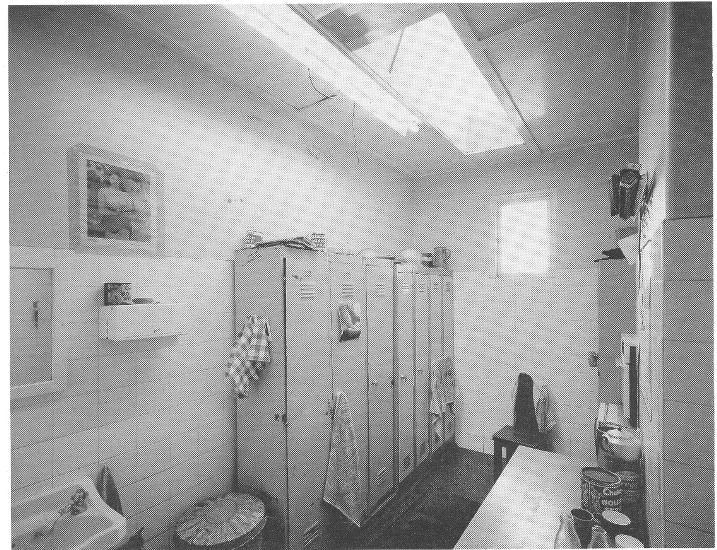
LAURENCE ABERHART Untitled 1984 black-and-white photograph
Gillian Chaplin has, in her characteristic way, turned the project to her own ends. Her fascination with materials in themselves, and with the mystery of identity, provide the basis for a masterly series of images in which a solitary, impassive female figure is juxtaposed alongside the strange entities of bulk, shape and form that inhabit the sugar refinery. We are taken on a mysterious journey, a few paces behind this woman. The drama is not of action, but of identity. There seems no relationship between the figure and her surroundings, except that, for the purposes of the photograph, they are together. Even when her hand is raised to touch the fabric (Char End III), she is doing so, not from her own curiosity, but as an extension of the photographer's.
This series of photographs, both posed and potent, invites us to feel with the eye. Chaplin has an exquisite sensitivity to the impulses of substance: for the fold, flow, pull, hang, glow of materials and matter. We pass shimmering mounds of sugar particles higher than our heads; touch drapes and hanging fabrics of unknown purpose; look through plastic sheeting, and into unfamiliar, swirling fluids. Each image evokes the allure of sensual stimulus and the wonder that this should be so.
Peter Peryer's work breaks into colour, in a major way, for the first time. There are two aspects to Peryer's photography: those intensely personal images with complex and enigmatic spiritual overtones; and other images where witty investigations into form relish repetition, resonance and echo. In the Chelsea Project Peryer pursues structure with the addition of colour. Even without the new element of colour these images are somewhat uncharacteristic of Peryer's work. While they continue his interest in form they are lacking in wit and for the most part are considerably busier than his usual serene and austere work. But the Peryer judgement of balance, always tightrope-sure, is as impeccable as ever.
Bruce Foster defines the Chelsea Sugar Refinery in terms of the people who work there, and their daily activities. His images are the most descriptive of the day-to-day working of the refinery. After first introducing us to his characters (Syrup House I) he whirls us through their routines - a quick mop-up, into the locker-room, and a cheery goodbye at the gates. In the middle of all this activity he pauses to give us a stunning image of empty golden syrup cans in symmetrical array, deliciously enjoined by a gloved human hand (Syrup House III). Foster makes considerable use of blurr to evoke movement and speed. His photographs portray the refinery as a clean and friendly place where work is part of human interaction' and warmth.
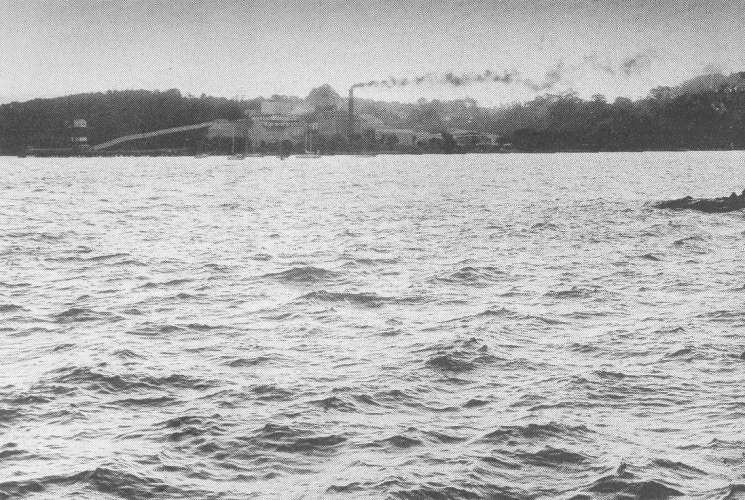
ANNE NOBLE Chelsea refinery 13 April 1984 1984 black-and-white photograph
Anne Noble's photographs, on the other hand, seem intent on portraying some sort of Victorian chamber of horrors where the workers vent their feelings by painting slogans on the walls. Her intense black-and-white images are evocative of the work-house and the prison ... a dark and sinister place. And yet in Chelsea Refinery 13 April 1984, Noble records, with a sense of loss, possibly the last puff of smoke from the chimney as the refinery changes over from oil to gas. Generally though, her images stress the ugly side of factory work, and the depressing nature of the environment.
Laurence Aberhart's group of photographs look at the work environment too, though the results are quite different. His black-and-white images are austere and finely-tuned excursions into the spaces and structures of the refinery, and convey a quality of stillness - as if by holding our breath we might just catch sight of the ghost in the machine. Aberhart delights in detail and in the most subtle gradations of whites, greys, blacks. Light floods in through skylights and from bulbs and fluorescent tubes. The factory seems poised, awaiting activity. Aberhart has also taken composite photographs of the exterior of the Refinery with its assemblage of assorted buildings and functional appendages. His images with their anachronistic feeling are perfectly in tune with the character of Chelsea.
This has been an interesting and revealing project. Would that there were more such enlightened companies!