
Exhibitions Wellington
SUSAN FOSTER
Chris Booth John Drawbridge Ans Westra
The use of traditional Maori crafts is an integral feature of Chris Booth's sculpture, Nga rimu o Puketi, commissioned by and recently exhibited at the National Art Gallery. The sculpture is larger than No Waitete nga kowhatu No Putakanui nga rakau No Whana-a-paki nga muka (Earth, Forest, Sky) (1982) owned and currently being exhibited at the Dowse Art Museum (reviewed in Art New Zealand 25) and more complex but with the same fine sense of balance and sheer beauty.
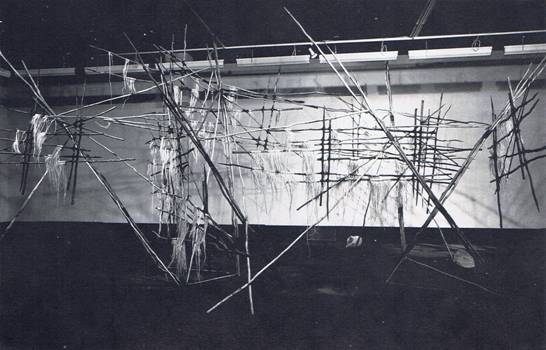
CHRIS BOOTH Nga Rimu o Puketi 1983/84 manuka, muka, boulders, linseed oil, fish net, twin and stockholm tar, 7800 x 6250 x 4900 mm.
Nga rimu o Puketi means rimu trees of the Puketi, Booth's home area. In the artist's words the sculpture is an attempt to `promote the guts of Northland... not only the Maori culture, and its history, Northland history but also our forests and our scrublands, that is, our indigenous eco-systems'. Booth is concerned at prevailing attitudes to the scrub land and second growth bush areas in the north, currently seen as uneconomic, and likely to be destroyed and replaced by pines, thus upsetting the whole ecosystem. The sculpture embodies the beauty he perceives in these areas. Manuka is chosen partly because it was the most frequently used timber by the pre-European Maori. The uprights are scrubbed clean to symbolise the trunks of the rimu tree, the struts are left scruffy and festooned with strands of muka (flax fibre), like fallen branches, vines and epiphytes. Although Booth learnt how to prepare muka from a Maori woman, the bulk of the muka in the work was prepared for him by the Outahi Crafts Group, a group of Maori women from the Ngawha Kaikohe area. In the lashing of struts to uprights Booth has again drawn on traditional Maori skills reinforcing the Maori ethos within this work.
A series of prints at the Galerie Legard completed in 1983 with the assistance of a QEII Arts Council grant reflects John Drawbridge's renewed concern with the representation of three-dimensional space two-dimensionally.
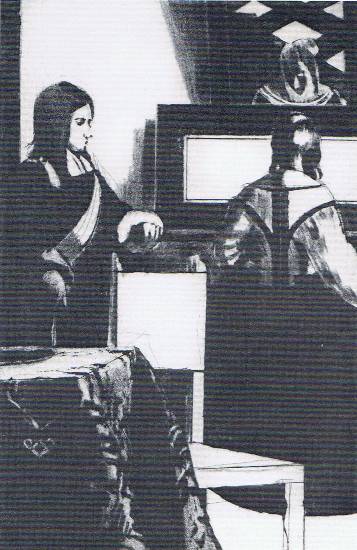
JOHN DRAWBRIDGE The Music Lesson (Vermeer) 1983 mezzotint
Don't be misled by the figurative aspects of Drawbridge's works. In referring to the elements that so often made up a painting by Vermeer, as for example The Music Lesson (Vermeer) Drawbridge is acknowledging way in which Vermeer arranged the squares and rectangles of tables, chairs, mirrors and virginals into a balanced and mathematically ordered, classical composition, as abstract in essence as to be later compared to Mondrian.
Reflecting Vermeer also is the sense of timelessness in many of these works. There is a stillness and serenity which is particularly refreshing. The soft velvety blacks achieved using the technique of mezzotint contribute to the beauty of these prints.
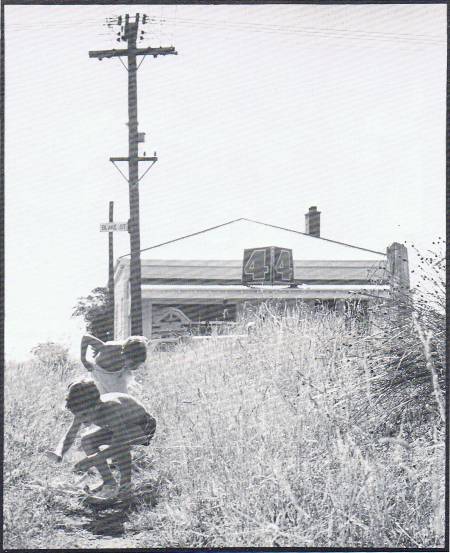
ANS WESTRA Boys Catching Crickets, Greymouth 1971 black-and-white photograph
Bill Main at Exposures Gallery is to be commended for his series of retrospective exhibitions of the work of Ans Westra. Because of the limited size of his gallery, Main has chosen to divide her work into four shows. The second of the series, Early 1970s was exhibited recently. In this group of images, showing aspects of everyday life—streets cenes, pubs, racecourses and rugby matches, festivals and funerals and A&P shows—Westra sums up so much that is undeniably New Zealand. Not being New Zealand born but emigrating to this country from Holland as a young adult has undoubtedly contributed to her objective vision in recording our culture. Boys catching crickets, Greymouth (1971) suggests the warmth of a New Zealand summer; hot sun, dry grass and carefree childhood days.