
Exhibitions Auckland
CHERYLL SOTHERAN
Mervyn Williams Juliet Batten Di Ffrench
It's a well-rehearsed notion, in New Zealand painting, that landscape is a dominant theme. There are other ways than description of approaching the landscape, and both Mervyn Williams and Juliet Batten, while using landscape as a starting point, seek in specific ways to transform it. What this transformation achieves, among other things, is a liberation from the identification of the local that characterises regional art, and a use of landscape to set up an arena for interaction between artist and viewer. Mervyn Williams's slot in local art is `abstract', a position acquired partly by association, as with the Seven Painters/The Eighties, with other non-figurative artists, and partly by his own description of his art: in the Seven Painters catalogue he aligns himself with the nonfigurative, calling his work `Pure Painting', and describes the works in the current show at New Vision Gallery as 'entirely abstract'.
While the artist's view of his alignment is clearly reliable, it hasn't appeared to everybody to be as exclusive as this: modifications in the direction of a more than ephemeral interest in the natural world, while not in any way making Williams a figurative painter, have long been recognised in his work.
Derek Schulz, in the Seven Painters catalogue saw `mythic associations' which related to or derived from `ritual.., the cycles of suns and seasons' and `colour and surface, the artist's love of natural form and texture', while Wystan Curnow, in Art New Zealand 28, thought that Williams was an artist who (with James Ross and Rick Killeen) most showed the proximity of realism.'
Williams's recent show places the artist's `entirely abstract' comment in its proper context: `Although entirely abstract, these paintings have their origins in an observation of nature—the dance of sunlight on rippling water or on sand patterns left by a receding tide', and, the artist adds, with a sort of reverence: `the miracle of perception'.
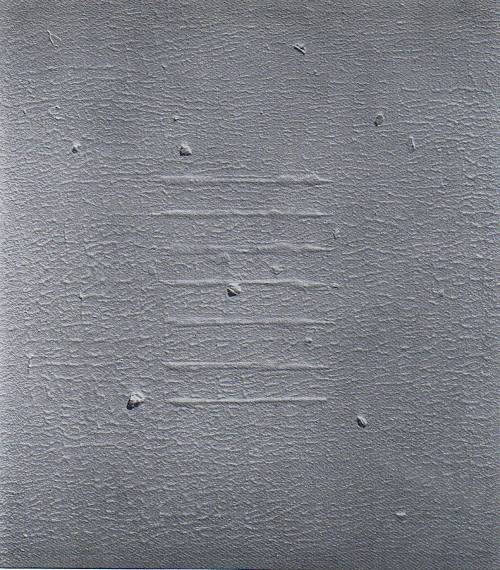
MERVYN WILLIAMS Dune 1982 acrylic on canvas, 650 x 470 mm.
This sort of celebration of the visual experience was not part of my interaction with the works, regrettably. Their interest lay more in that area of `pure painting', back with a more physical, less spiritual presence of the artist in the works. It does seem that the connections with the natural world which have been restricted in previous works largely to gesture, inflection, a progressive rejection of the rigid edge, the glossy surface in favour of the gritty, rough, spontaneous, have now become more clearly related to those natural surfaces and textures from which they derived.
The artist calls his work 'abstract', having in his mind his own intentions for the work. But he sets the viewer off on other interpretive paths, by remarking on, in both titles and appearances, the wordly connections of the images: paint which looks like sand in the work Dune, for example. Or, to use his own words again, works which haven't progressed far in visual terms from `the dance of sunlight on rippling water' or `the plumage of a bird'. I made a further connection, beyond the local natural world, to the aspirations and methods of the Impressionist artists: the ambition, revolutionary at the time, to simply render the real, seems related to Williams's 'miracle of perception'.
Williams, however, has the added self-imposed task to transform that reality in some way; to render it 'abstract'. It is in this context that I saw the horizontal ridges which proceed across these elaborately textured and layered surfaces, setting up a tension as they go. In a way they are signatures, declarations of the artist's presence; they are also formal in the presence of spontaneity, and place limits on an implied limitless surface. They can represent an order imposed on, or found in nature: a crucial distinction, and I favour the former as a description of Williams's approach.
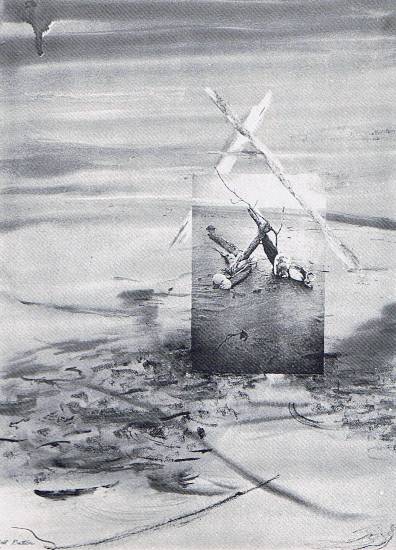
JULIET BATTEN Gateway 1983 watercolour pastel and colour Xerox
Juliet Batten's works are quite explicit in their use of the landscape to convey spiritual significance. Her comments refer to `an interaction between my own inner processes and those of nature' and then, catching the same event but not the same significances as Williams, describe the process: `sandforms are built silently, usually just after the tide has turned. As the tide approaches, the interaction takes place.'
Williams's interaction was a stylistic one: a certain reverence for natural cycles was present, but rendered with characteristic detachment. Juliet Batten on the other hand records a personal involvement with nature, pre-empting those natural cycles to figure forth rituals. The process does not involve replication/description, for its own sake: the artist uses sea coast changes to express aspects of her spiritual experience. She emphasises the progressive, time-related nature of the experience, both in the making of the works and in their implied qualities: `There are other forms. There are other moments at which to stop and make the offering. The rituals are ongoing.'
The works, seen as offerings, are both aspects of and records of the ritual. The media chosen are colour photocopies (from colour slides taken at the moment of experience), watercolour and oily pastel, used in collaged images relating directly to the artist female experience. The images use the vocabulary of female spirituality and creativity—goddess worship—as well as more generalised symbols: earth, fire, water—given a specific female reference by the context in which they are used.
The relationship between experience and recollection is imaged by the layering of the collage technique as well as the mixture of media: from the immediacy of the photocopy, a direct and relatively untouched image, to conscious manipulations and comments, verbal and pictorial, of the oil pastel, the atmospheric subtleties of watercolour setting the natural scene. The rituals, of which the art-making is one, possess and are possessed by the landscape; the impact of works is however greatest where most immediate, in the series of photocopy images of Fire Ritual.
Di Ffrench made a considerable impact in her visit to Auckland: a photography show at Real Pictures, slide talks and several performances of her Artist's Project work at the Auckland City Art Gallery: The Opinion. She dealt in this work with the theme of the public exchange of ideas, in a work that was as effective as a static installation as it was as a performance: this artist's attention to the assemblage of objects was characteristically meticulous, striking, provocative.

DI FFRENCH The Opinion 1984 performance work at the Auckland City Art Gallery
Various elements were manipulated to suggest that the exchange of ideas in this country is characterised by mechanical repetition, banality and an inability be original, being rather dependent on `overseas opinion'. The piece seemed to postulate a willingness on the part of the public' (the viewers) to be confused by smokescreens of untruth. It seemed at the time that either the work was imbued with a very deep cynicism indeed; or that a certain inconsistency, or reliance on stereotypes, rendered the work rather confusing, despite the artist's very explicit verbal gloss.
The sound of the sea (the 'other', in a sense the landscape reference in the work) and the billowing smoke which was produced in the latter part of the performance, together drowned-out/rendered-invisible the more apparently obnoxious elements of the political scenario (the looped film of a political rally, the mechanical mouth and newsprint stack representing aspects of `the power structure'), and could therefore be seen as performing a public service rather than adding to public obfuscation.
However, on reflection, it seemed that what at first were attempts to establish consistency may have been misguided endeavours to discover narrative/ parable in the work. In fact the sea (sound) and smoke (sight/smell) blanket did in fact envelop and overwhelm both instigator/ mechanic and audience/public together in an experience which may have imaged the need to suppress intellectualising about the work's `meaning'. On the other hand, it must be said that the artist, by adding such specific explanations to her work in the form of hand-outs, did lead the viewer towards such content considerations.
To return to the landscape theme, although without wishing to impose a simplistic nature/ culture dichotomy on the work, The Opinion acquired consistency if the artist was seen as identifying the ocean and smoke/mist as elemental, overwhelming the mechanical structures of opinion: a battle is fought between the political victims and the power structure, but both, ultimately are rendered invisible and ineffectual by the sea and its creeping, choking mists.