
Anxious Images
LEONARD BELL
Anxious Images was the third (after New Image and The Grid) in a series of exhibitions presented by the Auckland City Art Gallery that aims, according to the Director, 'to chart the passage of a number of key aspects of New Zealand art during the last decade or decade-and-a-half. In this instance the 'key aspect' was to quote the catalogue, 'the expression of powerful emotion: unease, anxiety, anger, fear and pain' in relation to matters ' social, political, moral, sexual, spiritual'.
Under this large umbrella were gathered works by ten artists, all well known: Philip Clairmont, Barry Cleavin, Jackie Fahey, Tony Fomison, Jeffrey Harris, Vivian Lynn, Alan Pearson, Peter Peryer, Sylvia Siddell and Michael Smither.
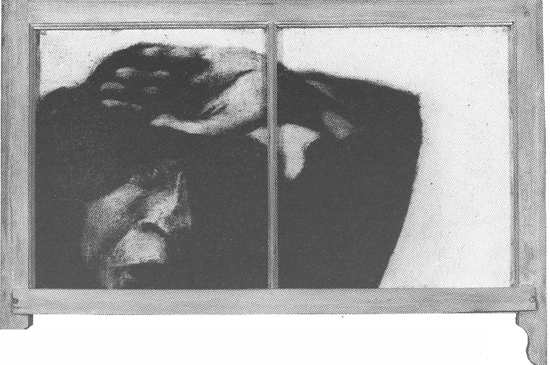
TONY FOMISON Self-Portrait 1977 oil on board, 415 x 750 mm. (Collection of the Auckland City Art Gallery)
That is a pretty mixed group, whose works are disparate in formal method and media, and widely differing, in some cases conflicting, in terms of the 'views of the world' they (the works) manifest. For instance, Clairmont's 'old' Expressionist paintings - gestural, rapidly, loosely, 'roughly' painted, the brushmarks asserted, and 'spontaneous'-looking - are poles apart from Peryer's spare, crisp, calculated, black-and-white photographic compositions - in style and quality of emotion and sensibility.
And what affinities or common interests do Pearson and Lynn have? - Pearson, another 'old' Expressionist, some of whose paintings 'embody' traditional New Zealand macho attitudinising and an animosity towards women; Lynn, whose images are sustained by a feminist critique of patriarchal values and power. 'Powerful emotion' regardless of ideological difference is hardly adequate as a common factor.
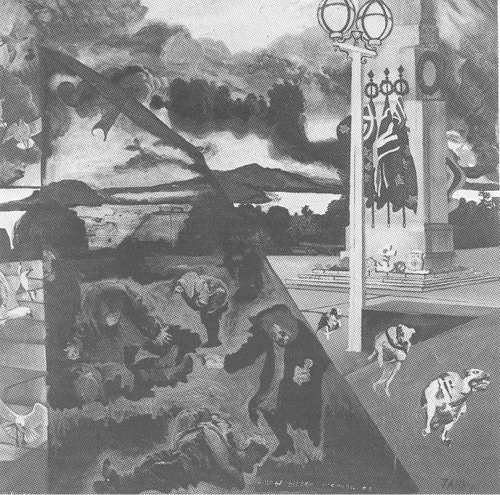
JACQUELINE FAHEY Hill of bitter memories 1981/82 oil on canvas, 1685 x 1678 mm.
Anxious Images seemed to hang on the premise that the expression of individual emotion is in itself of value, worthy. The catalogue classified the works as 'art for the world's sake, art for our sake', in contrast to the 'essentially trivialising notion of art for art's sake'. Now, while some of the artists shared common concerns and approaches to picture-making, this all-transcending construction imposed on the work simply did not hold together. Rather than a 'key aspect' or a 'current' of New Zealand art being demonstrated, one had ten mini-retrospectives, six or seven works apiece, some memorable, some not.
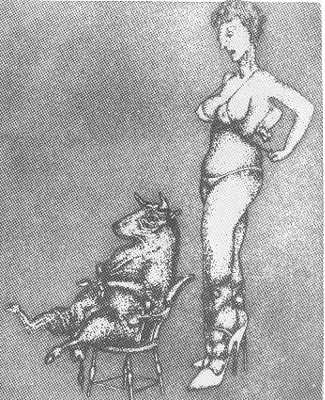
BARRY CLEAVIN A small bull being tormented etching and aquatint, 185 x 152 mm.
What then constituted 'emotion' in particular artists' works? And how were 'emotions' expressed? Perhaps oddly, given the exhibition's title, only a few of the images were really 'anxious', in the sense of evoking or generating feelings of distress, panic, fright.
Five of the six Clairmonts were his usual early twentieth century German Expressionist-inspired self-portraits, crucifixions, 'turbulent' domestic artefacts and settings. While these no doubt represented attempts to express very real anxieties, the dominating impression given by the works from 1971 to 1981 was of an artist - in terms of his paint-handling, composition, rendering of figures and objects, choice of colour effects - increasingly confined, perhaps frustrated by a formula, a set of formal conventions that is not necessarily 'emotion' - communicating in or by itself. There is, for instance, no absolute relationship between a brushstroke or a colour and a specific feeling-state, even if in certain social and cultural circumstances a particular quality of brushwork, a particular colour, have been used to denote 'emotion'. Perhaps that is why Clairmont's mixed-media collage, War Requiem Series IV, with its multiplicity of images and references, looked more contemporary - imaging fragmentation, dislocation, a complex of jarring relationships that, unlike his other works, has some affinity with recent developments in figurative art considered internationally.
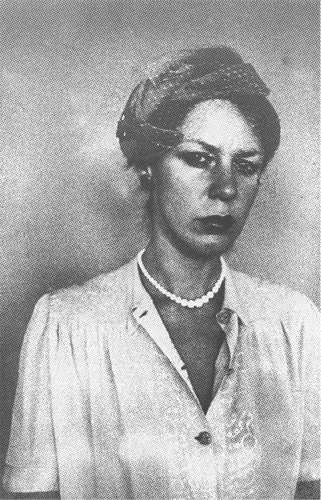
PETER PERYER Erika 1978 black-and-white photograph (Private Collection, Auckland)
Cleavin's usual method in his prints is a surrealist-in-origin juxtaposition or synthesis in the one image of 'incompatible' elements - elements that do not in the normal course of events go together - for example, Upon Reflection: an ugly animal skull or some monster head on the body of a naked female reclining on a bed, fondling a breast. Shock, social satire, a concern with the absurd and the enigmatic, the revelation of the unconscious (Next to Nothing: Nada a skeletal bull in an endless empty corridor) would seem to be Cleavin's purposes. Rather than images which express anxiety, pain, and so on, they more often reveal a delight, a pleasure in the grotesque and a bizarrely, misogynistically-tinged 'erotic'.
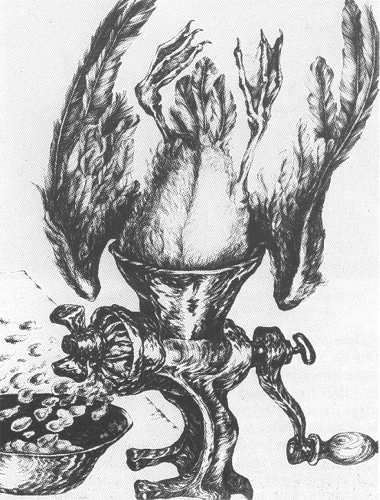
SYLVIA SIDDELL Cuisine Minceur 1979 pencil, 395 x 295 mm. (Private Collection, Auckland)
Fahey deals with the intersections of loss, memory, family, middle-class female experience, in images densely packed with information and narrative cues - whether observing the unities of time and place of conventional anecdotal painting, as in Birthday Party (1974) with its small girls and melancholic grandmother on either side of the picture space, the centre dominated by a 'tipped up' table and balloons (bubbles are a traditional sign of life's transience) - or whether in montage constructions like The Hill of Bitter Memories (1981-82), in which are elided the Museum War Memorial Cenotaph and surrounds, 'slavering' dogs of war, and a group of women grieving over male corpses (deriving from a photograph of a post-Battle of Stalingrad scene).
The Fomisons mainly featured hands, faces, dwarfed figures, fugitively emerging from darkness or dark against light - 'primitive', hypnagogic. Though they included a self-portrait, his works seem less concerned with the expression of individual feeling than with the emblematising of collective predicaments - particularly of the dispossessed, those outside mainstream bourgeois culture and society - for example, From a photo in P Sinclair's anti apartheid book, 'Black Soul'.
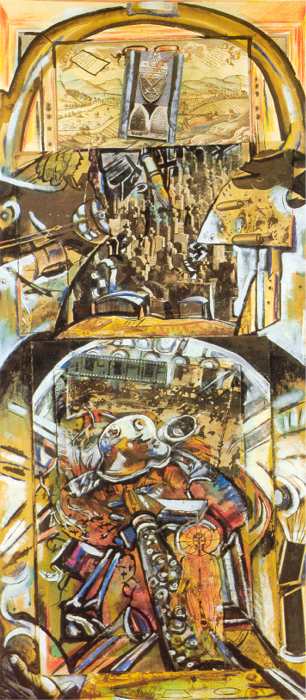
PHILIP CLAIRMONT War Requiem Series IV (Blitzkrieg) 1974 mixed media collage, 1090 x 477 mm. (sight)
Harris's paintings and drawings from an eleven year period showed the most stylistic change and development - shifting from an 'old' to a 'new' figurative Expressionism. His The Terror of Modern Life (1971) is 'closed' in meaning dependant on early twentieth century models. With that title, and nooses and scissors adjoining the heads and necks of figures, it is difficult to miss the message 'Emotion' is displayed on the sleeve. in contrast, Family (1981) is 'cooler', more detached, 'open' - literally, in that large areas of the canvas are bare, 'empty' or unfinished, and the figures incomplete - bodies, limbs merely outlined diagrammatically, only the heads 'filled in', rendered in any detail or colour. And it is 'open' in terms of its emotional load. Lines, shapes, colour areas scattered, 'random', running arbitrarily into one another, it images a world of shifting, unpredictable relationships, in which the self is seen to be an artificial construct, that can be constantly remade, not some sort of natural essence that can be 'expressed'.
The position from which Lynn operates has been noted. Her images of violence, bestiality, dehumanisation, the stuff of nightmare, are rendered with an almost clinical precision and detailing - as in Heraldic Symbol, with its 'dissection' of violation on a neatly gridded ground.
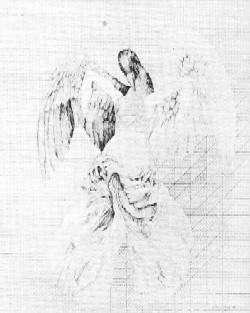
VIVIAN LYNN Heraldic Symbol 1976 pencil and watercolour, 630 x 513 mm. (Private Collection, Auckland)
The Pearsons were all 'portraits' - named individuals subjected to formulaic pastiches of Soutine - that is, luridly coloured, the paint piled on, as if squeezed on straight from the tube or applied with fist or finger. Does that now signify 'powerful emotion', or is it just plain messy painting? Different people all cast in the same mould, the Pearsons have nothing of the intense scrutiny, the vividness of characterisation of Peryer's photographs - whether that 'character' belongs to the sitter or is Peryer's invention, consummately acted, realised under his direction. (It is the latter, I believe.)
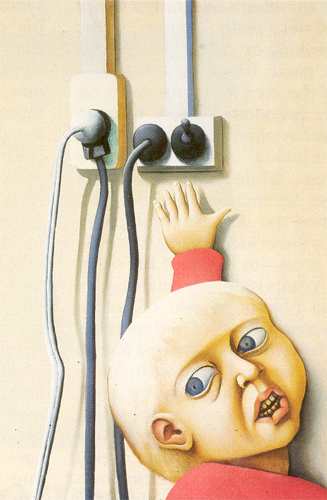
MICHAEL SMITHER Big Occity 1970 oil on board, 910 x 610 mm. (Collection of the Rotorua City Art Gallery)
Sylvia Siddell's pencil drawings feature domestic utensils - washing machines, mincers - getting out of hand. Poor Chook (1979) has an electric frypan just about to consume a supine, headless and naked female body. Even if the images can be related to her awareness of the plight of the defenceless and the subjugated (animal and human), as the catalogue suggests, they operate primarily in the realms of the grotesque and the comic - sometimes black, sometimes not.
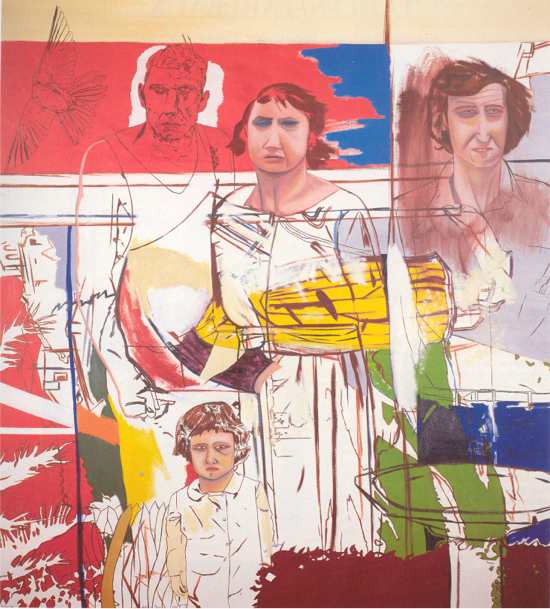
JEFFREY HARRIS Family 1981 oil on canvas, 1527 x 1374 mm. (Collection of the Dunedin Public Art Gallery)
And, to complete this alphabetical inventory: the seven Smithers from 1969 - 1978: mostly smooth-surfaced, hard-edged images of the grotesque (again) and latent threat in mundane domestic circumstances - represent a mode of painting that he has since rejected as unnecessary in this time and place.