
A Visit to Max Gimblett
ANNE KIRKER
Max Gimblett's recent work will be shown at the Auckland City Art Gallery in August. Here Anne Kirker writes of visiting him in his New York studio late last year.
22 September 1983 - it had been four years since I last visited Max Gimblett in his New York studio. At that time Len Lye was alive and based nearby in Greenwich Village. A supportive bond had developed between the two, not just from shared nationality, but through deep respect, especially on the part of Gimblett.
His own work space is roughly one-third of a floor in the Standard China Company building on the Bowery. Others have been taken over by painters Harvey Quaytman, Charles Hinman and Tom Wesselmann and by the sculptor Will Insley. Before Gimblett took it on in the summer of 1974, his studio was used by Pop artist James Rosenquist. To experience these lofts, all highly distinctive, is like coming in from the cold. They are sanctuaries apart from the chaotic street life outside.

Max Gimblett Photograph by Eeva-Inkeri
As we began talking in the late afternoon and I slowly came to grips with the latest of Gimblett's meditative images, more than ever Ad Reinhardt's remark of 1957 that 'Everything is on the move. Art should be still', rang true. Yet in this Post-Modernist age it's difficult not to be cynical or dismissive of 'pure' painting and formalist theory. Most viewers assume that the non-figurative existentialist canvases practised by the Abstract Expressionists in New York during the nineteen-forties and nineteen-fifties were superfluous by the end of the following decade and many artists moved towards the more detached and cerebral dictates of Minimal and Conceptual Art. Painting tended to be left on the sidelines. As an antidote to this stringent tendency, the nineteen-seventies saw an increase in attempts by other artists to integrate and collaborate with the world outside the institutionalised art scene and to reflect social and political issues in their work. Movements such as Arte Povera, Feminist and Performance Art gained in prominence. When painting emerged once again in the public eye as a viable activity it came in the guise of the New Expressionism from Italy, Germany and elsewhere with a representational style, vivid colour, heavily worked surfaces and frequently violent subject matter. Small wonder that many audiences in the nineteen-eighties are conditioned to believe that abstraction is a non-communicative and anti-populist mode.
But whichever way you look on it, abstraction originated as precisely the opposite. Artists of the Paleolithic and Bronze Ages for example and later Tantric and Islamic artists eliminated recognizable objects from their imagery in favour of an abstract symmetry of form and monochromy. In these older traditions, it is assumed that content was read comfortably from abstract form. Content was about ideas on the nature of the universe. This century, Mondrian's mature paintings can be interpreted as metaphysical realities with their interlaced horizontals and verticals and primary colours suggesting a geometrically ordered universe. Earlier, in 1918, Malevich had been even more reductive with his white on white painting, using colour alone to move painting into an abstract realm.
With Abstract Expressionism, the movement which Gimblett acknowledges as his starting point, it became apparent to perceptive writers of the time (Harold Rosenburg for example) that the new movement was essentially a religious one. In the hands of Barnett Newman and Mark Rothko especially, painting became a means to express the sacred in a contradictory and fragmented world.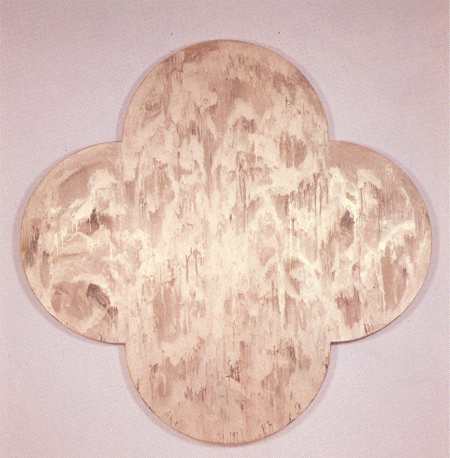
MAX GIMBLETT Island 1983 metallic pigments with acrylic polymer on canvas, 2250 mm. diameter
Newman produced a notable work in 1958 called Cathedra which was mural-like and engulfed the viewer in a vast expanse of blue. Vertical bands or 'zips' interrupted the monochromatic field and helped to establish a human scale within it. Gimblett places his maturity as an abstract painter from 1975-76 and during that period he began investigating a motif which invites comparisons with the senior artist. He arrived at what are essentially double vertical bars within a rectangle. This developed towards the single bar paintings (the two units merged together) such as Blue/Red-To Len Lye (1978), which is now held by the National Art Gallery. Above all, these works assert the primacy of the plane. They differ from the enormous scale of paintings by Newman and his colleagues and instead are confined to sizes which are aligned to human proportions. Characteristic of Gimblett's subsequent canvases these paintings with bars, or floating planes, have a remarkably iconic feeling.
In his seminal text On the Spiritual in Art (1921), Kandinsky stressed colour as the basis of all truly modern - i.e. modernist - painting, and he describes colour's relation to form, reality and human emotion. Throughout his career, Gimblett has similarly considered colour as a means to reveal content. Even when he restricts himself to monochrome, the muted surface of his canvases often conceals numerous layers of colours.
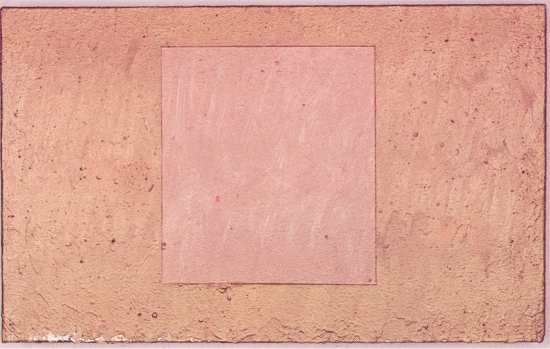
MAX GIMBLETT El Dorado 1983/84 metallic pigments with acrylic polymer on linen, 560 x 760 mm.
In the nineteen-fifties, Rothko's canvases were intended to engage the viewer in an intense Oarticipation with colour as a way to transmit the effect of sublimity. To ensure that his canvases were meaningful to the viewer, he sometimes indicated that they should be hung together in a single room (such as the Seagram murals now at the Tate Gallery and in the Rothko Chapel at Houston). In this way resonances could be encouraged to flow from one canvas to the other, creating a total spiritual experience. Similarly, Gimblett's paintings demand a degree of empathy and patience which is completely out of phase with the instantaneous response and secular bias assumed by much contemporary art.
As late afternoon moved into evening I was shown examples of the nine paintings and twenty-five works on paper, which have been selected by guest-curator Wystan Curnow, for the Auckland City Art Gallery's forthcoming exhibition. It concentrates on the painter's production since 1980. The most recent works, those dating from April 1983, will come as a surprise to most since the last New Zealand show Gimblett was involved in (Seven Painters/The Eighties) represented him by several of the bar paintings with strong, emphatic colours. (See Art New Zealand 28.)
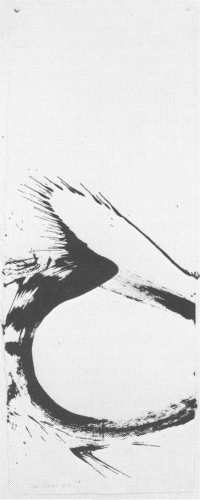
MAX GIMBLETT Ink 1983 black ink on handmade paper,1075 x 400 mm.
The new images are all worked with metallic pigments, up to six or seven different shades of gold and copper. These are applied in layers with clearly defined brushmarks and are marvellously rich in texture, range of tone and light-reflective qualities. The supports are either scalloped into a quatrefoil shape, or they are rectangular. Both series stand out from the wall by several inches. Gimblett explained the development to me, 'I've got two types of, support, one is a thickened curvilinear stretcher, it's 21/2 inches from the wall instead of my customary 1 3/4 inch and it's of course shaped. Then the other is the rectilinear one which is coming out from the wall 3 1/2 to 5 1/2 inches and has a 45' angle, cut back into the wall, which floats the plane and also closes you off from any information behind the painting. I feel the object now has more presence in the space, in the Jungian sense it's like amplification.'
Gimblett puts the change of the palette and shape of stretcher down to a 'mid-life transformation' and an intensified appreciation of Eastern philosophy. In his studio are two small gold Buddahs which have accompanied his working hours over the past few months and from which he quite consciously keys some of the light values in his paintings. The shaped canvases are large and in a way reminiscent of gateways in Chinese pavilions. 'Monumental - larger than a human being. I'm 70 inches, that's 90 inches and it's 10 inches off the floor, so in total it extends to 100 inches.'
To establish the right scale he starts out with cardboard mock-ups and then after living with them for a while, testing the way they feel, a stretcher is made. As the canvases developed so too have a closely-related series of drawings, which are essentially paintings on paper. All of them began with a cross structure in pencil and then through this framework the circles were built up. 'The measurement with me is always from the centre out in these drawings. So I establish the base-line, get a cross, establish centre and do all my measurements out from there.'
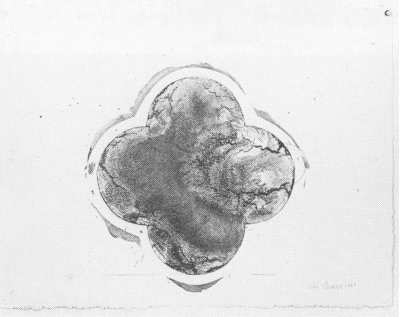
MAX GIMBLETT Transformation No. 15 1983 metallic pigments with acrylic polymer on paper, 550 x 750 mm.
Gimblett then masks off the area around the quatrefoil shape and begins to apply numerous layers of metallic pigment mixed with acrylic polymer. The whole process is done very wet on a base of heavy watercolour paper. In drying, the final surfaces become quickly encrusted and unpredictable in their configurations. Appropriately, these paper works are all titled Transformation.
There are two working methods Gimblett adopts: one is sudden, the other gradual. in other words, 'one-shot' or 'slow-painting'.
The most telling examples of the first category are his brush drawings using black ink. 'I've been drawing in ink ever since I started painting, which is twenty years now. But in 1978 it became for the first time something that had a definite rhythm. Done very fast, thirty or forty drawings happened in less than an hour and they were done with an attitude of "no mind". I thought of it as flow of being and I found my tradition was Motherwell, Jackson Pollock, Mark Tobey and obviously the East. Gimblett's closest mentor in this last respect has been the Zen master, Sengai.
For his own show, Gimblett anticipates having clusters of his 'inks' arranged frieze-like around one room. This would give a sense of the way he produces them, in concentrated sessions. They will include half a dozen on the tall vertical Motherwell papers (Robert Motherwell originally commissioned the sheets for a lithograph project), several on an absorbent Japanese paper, and a number using harder European stock. Gimblett uses mainly oriental brushes and both sumi and English inks. All his materials are prepared beforehand to take advantage of the appropriate moment for the drawings to happen; it is a spontaneous, intuitive process very much akin to 'automatism'. The resulting images have helped the painter develop his motifs, such as the circle, thee bar, and range of spatial relationships. The mood varies in each cluster; sometimes the brushstroke is energetic and animates the space; with others the sheet is left largely empty.
Outside of these sessions are the canvases, which may be conceived quickly or may be worked on at length, feeling an experience through over several months. Their clarity and simplicity results from the consideration of many possibilities and once a motif has been established it is then repeated and built on. Repetition emphasises the idea but within the chosen format an infinite variety of textures and colours (the effect of 'gold on gold') are articulated and distinguish one painting from another.
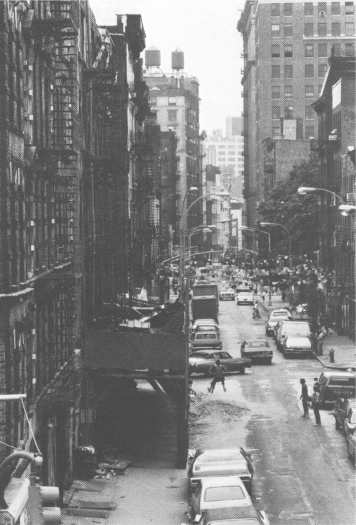
View from Gimblett's Studio, New York, 1983 (Photograph by Barbara Kirshenblatt Gimblett)
Through his constant and disciplined working methods Gimblett continues to make new discoveries. The major developments that have occurred in his studio over the past few months have predictably been gestating for much longer. As a child growing up in New Zealand, for example, he was aware of the country's proximity to Asia and often roamed through the displays of Indian and Chinese material at the War Memorial Museum. By the same token, when his exhibition opens in Auckland towards the end of 1984 Gimblett will have fulfilled his ambition to visit India and Japan. (As one of the instructors in an international honours programme for students in the United States he will spend several weeks in Benares and Kyoto.)
Returning to Gimblett's work, the titles during the nineteen-eighties have often reflected his appreciation of the East; and probably the most telling illustration of this, prior to his use of metallic pigments, is the large black and white circle painting known as Zen. Begun in 1980 it was gradually transformed and finally completed in 1983. Deceptively simple in its final form, this powerful canvas shares the basic premise that Gimblett holds today. 'At my best I think I am pure audience and when I paint I think I am a medium for the whole situation that is given to me rather than me generating it. So I'm receiving, it's passing through'.
Photographs by Eeva-Inkeri