
Art for Breakfast
Collection of College House, Canterbury
TOM WESTON
A University Hall of Residence is conducting an experiment in contemporary art that is almost radical. Considered so, it is ironic, as the aim is simple. It could be summarised: if the mountain won't go to Mohammed, bring Mohammed to the mountain (Mohammed representing the art).
The keynote is ease of accessibility, an almost 'domestic familiarity' being sought. The twenty or so pieces presently in the collection have been placed in well patronised areas. More intimate surroundings have been selected than would normally house a similar collection: a Brent Wong hangs over the Common Room piano; Patrick Hanly's Runner resides in the opposite corner by the magazine stand. One of Richard Killeen's series of cut-outs is assembled over the Top Table of the Dining Hall. And so on.
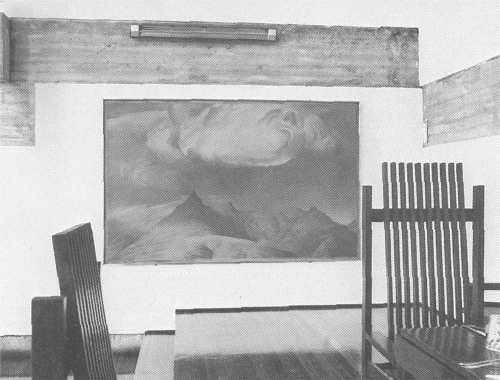
W.A.Sutton's Te Tihi o Kahukura
This particular use of site is purposeful. Many inexperienced viewers react negatively when confronted by contemporary art. This may be heightened (or induced) by the us-and-them separation of the traditional gallery: not always conducive to building a rapport. Many will not attend a gallery at all. The 'intimate' selection of site at College House is intended to close this gap.
Dr. Alex Baird is 'custodian' of the collection. He states: 'We want to enrich the environment for those who live in, or pass through, the buildings. At the same time, we aim to create an awareness of the place of art, that art is more than just the icing on the cake. If we succeed only to that extent, then we have done something useful. Naturally I hope it goes further'.
In this sense it is a subtle form of education. Alex Baird sees a unique opportunity to broaden the views of several hundred people a year. This goes further than displaying art 'in the classroom' as (for example) Victoria University does. It stops far short of active compulsion. The middle line (of sorts) is showing this small group of people that art is actually part of where you sleep, eat and live: part of your home. Not many institutions have the twenty-four hour a day attendance of a hostel: the few that do rarely use it to such advantage.
It is an experiment, however, where success remains intangible and difficult to quantify. An awareness of art will come in different shapes and sizes. Any effect may not become apparent for several years. Failure is more evident - at least in superficial terms: contemptuous dismissal is easier than ready acceptance. Few will be converted at once. Under-emphasis may prevent any conversion at all: if the art is too much part of the furniture it can then be overlooked. The works are not hung in rows; they are not spot-it. The dilemma is obvious: should more emphasis be made?
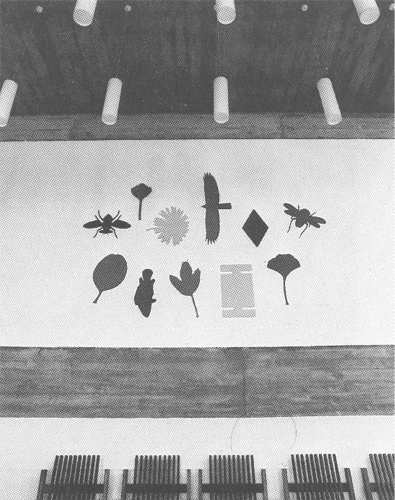
Richard's Killeen's You are what you eat in the Dining Hall
A fear worse than that of over-familiarity breeding neglect is that of vandalism. With one exception, this has yet to prove a problem. There has been some minor (though accidental) damage, most of it repairable. Neil Dawson tells with considerable amusement the story of the Bishop's robes catching in the delicate wires of his sculpture Boundary (Norwester). But it does illustrate the point-how far can you protect a work of art without preventing legitimate access to it? This, of course, is a decision any custodian must make. It's just that in this instance it is more acute. Tight security is impossible twenty-four hours of the day.
Stephen Clark's sculpture, Fore Stem, Skuldelew, is the one exception. Purchased in 1982, it was a free standing work situated in the Pyatt Study Centre. It had been damaged on two previous occasions but was once again on display, unprotected but for three white lines painted on the floor. All that now remains are the white lines and name/ title plate, the sculpture has been totally destroyed. The incident occurred after the students had left for the year.
Alex Baird still finds this vandalism hard to accept. 'What is it about art? Does it release some emotion that is normally latent? It horrifies me that someone's reaction to the work was so extreme they had to destroy it. Obviously it's a risk we run - but that doesn't stop the anger.' His immediate sense of frustration and despair has passed. If anything it serves to emphasise the need for art and for people to come to terms with it. Viewers must learn they cannot remove or destroy a source of unease without first examining themselves and their reaction. Ezra Pound wrote: 'It's always easy for people to object to what they have not tried to understand'.
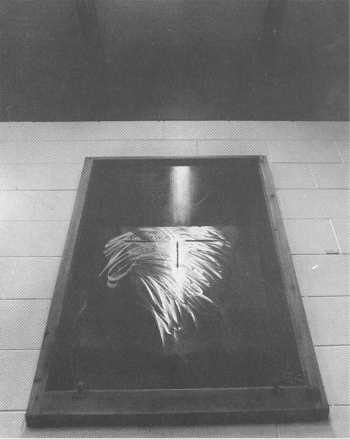
Ralph Hotere's Black Window
Involvement of the artist, wherever possible, is an important aspect of this collection. It may range from viewing the collection, selecting a site, to braving a meal with the House as did Killeen! It means that art extends beyond the artifact both for artist and audience. Principal Rob McCullough would like to see this relationship expanded in every direction: to create a whole atmosphere of art. He appreciates the difficulties. You cannot blithely usurp the roles of other institutions. There are no obvious models to follow; one proceeds in fits and starts.
The idealism is now becoming apparent: involve the artist and you move into another dimension. For example: in 1982 Alex Baird toured Michael Smither around the collection and asked whether he might execute some Stations of the Cross for the Chapel. Nothing was heard for some months until one day, a large package arrived. Smither had gifted eight working drawings originally prepared for a New Plymouth commission. Seven of the eight are black on white, the eighth is coloured. All are now mounted and hung in the Chapel. The stark grandeur of the building is reflected in the starkness of the works, their blackness heavy against the white block walls.
Judy Gifford, Director of Christchurch's Brooke/Gifford Gallery has played an important role in helping develop the collection. Most works are purchased from her and with her advice. if she feels a particular piece should be included she will contact Alex Baird who will arrange for a viewing. Judy Gifford's husband, and artist, Quentin MeFarlane is responsible for the high standard of presentation of the works. Both see the collection as an important development.
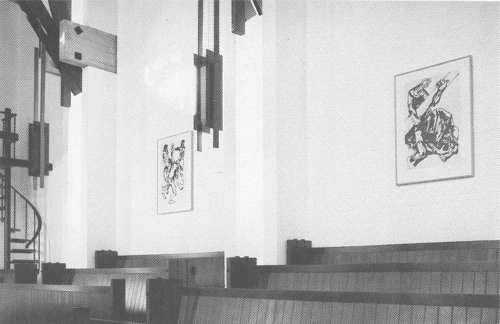
Two drawings from Michael Smither'sStations of the Cross in the Chapel
Contemporary art is a controversial subject in the confines of an institution such as College House. Previously linked to Christs College, it is still governed under the aegis of the Anglican Church. It is the last male-only Hall of Residence in the country. The Bishop of Christchurch is Warden of the Board; the clergy play a role in administering the enterprise. Its pedigree is safely conservative. The collection, since first being mooted, has stirred lively debate.
The initial impetus came from Dr. Baird. A member of the Department of French, he also sits on the Board. The initial reception was lukewarm, assets being seen in such traditional terms as real estate and buildings. Such a conditioning left little room for an acceptance of contemporary art as either an educational or financial investment. The ultimate acceptance by the Board translated the initial idealism into more practical terms. Four years on, the pragmatic (equate dollars) approach still works as a kind of thermometer in every purchase, but it does not overwhelm.
1980 saw the newly appointed subcommittee of three establishing ground rules for the spending of its $2,000 allocation. Working by a system of majority vote it purchased Killeen's You Are What You Eat and Quentin McFarlane's Cadena Painting, Clifton Bay. Both now dominate the Dining Hall. Works of art have been purchased every year since, the most recent being Ralph Hotere's Black Window.
The emphasis is on major works by living artists (the one exception is a Weeks).
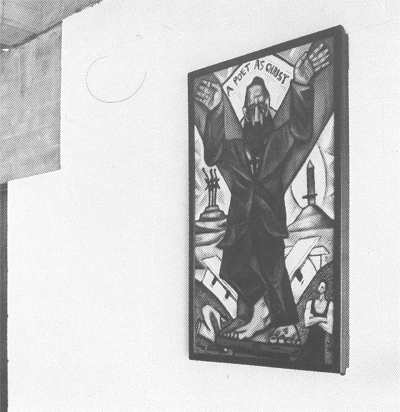
Nigel Brown's A Poet as Christ
Viewing the collection one cannot help but feel that a catholic hand has been at work. Excellence has not been restricted to one particular school or inclination. While there may be a noticeable proportion of local artists included, this is dismissed as mere coincidence. In fact, the only common theme apparent on first impression is the familiar face of Canterbury's Port Hills as either a subject or inspiration. Bill Sutton's homage to the Rainbow God, Te Tihi o Kahukura, might be seen as the centre piece.
There is little doubt that, in some form or other, the collection will continue to grow. With a regular allocation of funds and an idealistic hand at the helm it may travel who knows where. Considered in its individual components it is perhaps nothing new or exceptional. Taken as a whole, however, there is a stubborn quirkiness that bodes well for New Zealand art - a giving to both artist and audience that needs to be encouraged. The regular pattern of this giving becomes important: all concerned must benefit.