
Book review
Wahine Toa: Women of Maori Myth: Paintings and Drawings by Robyn Kahukiwa Text by Patricia Grace Published by Collins, Auckland, 1984
Reviewed by PRISCILLA PITTS
This large-format, well-presented book is, in part, a documentary of Robyn Kahukiwa's recent touring exhibition of paintings and drawings of eight women from Maori mythology. The myths concerning these women are retold in Patricia Grace's luminous prose and further explained by the painter's notes at the end of the book. Both artists aim not only to highlight the existence in Maori myth of such powerful females as Te Po, the Night; Muriranga-Whenua, possessor of enchantment and knowledge; or Hine-nui-te-po, the final conqueror of mortals, but also to emphasize their essential role in the myths, namely (in Kahukiwa's words) 'to hold the plot together and provide the knowledge and aroha necessary to enable the heroes to perform their deeds and fulfil their tasks.'
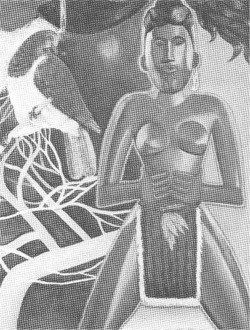
ROBYN KAHUKIWA Tauranga (detail) 1983 oil on hardboard, 1180 x 1180 mm. (Collection of the National Art Gallery, Wellington)
For those of us brought up on more traditional versions of Maori mythology, this is a refreshingly different approach. The negative aspects of Hine-nui-te-po, for instance, are mitigated, the positive emphasized - death is portrayed as a welcome, a homecoming; the underworld that is reached through her vagina is a reassuringly familiar, if shadowy, Maori village. The well-known exploits of Maui take second place to the power and mystery of the female characters he attempted, not always successfully, to master. Many will welcome this re-vision of the place of women in Maori myth.
There are, however, some aspects of Kahukiwa's art which I found unsatisfactory - in particular, the strongly Europeanised visual idiom which she employs. In the more successful paintings Maori and Pakeha elements are fused in a way that matches Patricia Grace's ability to express the essence of Maori storytelling in the English language. Yet in other paintings the Maori element, be it taniko or kowhaiwhai pattern, which Kahukiwa has been at some pains to include, sits uneasily with Western conventions of picture-making, seeming I tacked on', visually unconnected with the rest of the work. Another thing that disturbed me was the stereotypically idealised beauty (again, very much a Western stereotype) of most of her female figures; in some of the drawings, in particular, this approaches triteness. That Kahukiwa is capable of something more striking and forceful is evident in works like Te Po, Hine-titama and Papatuanuku.
As the artist states, her work for Wahine Toa was 'a long journey, one in which I still have many miles to travel.' I hope she continues on that journey, for hers is an uncommon and enriching vision.