
The Pastel Drawings of Caroline Williams
VINCENT O'SULLIVAN
It is unusual to see an exhibition entirely of pastels. It is a difficult medium, as any artist will tell you. The slightest gaucheness shows; a muffed line cannot be covered up, without reminding one of art afternoon at primary school. And it is perhaps more of a problem to suggest density, to give a hard defining edge, than with other kinds of drawing. Since it is definition and control that Melbourne-based, Ilam-trained Caroline Williams goes after so relentlessly in her seventh exhibition, she clearly took pretty big risks. Especially as one was likely to hear a viewer entering the gallery begin with `Ah, the eighteenth century!' Because they come off, these risks are part of the delight in these 13 pictures, 450 x 600 mm., on ribbed paper whose grain often contributes a subtle visual element.
It took only a few minutes in front of these drawings to realise that a very original mind was at work, and originality of a kind that cannot easily be set against other New Zealand artists by way of comparison. If you looked at the variations within the one colour, the suggestion of mass Williams managed to get into the swathes of drapery in Captain Spelling's Morning After (with Hogarth quite unashamedly there as an iconographic forebear), you knew this was something much more than 'interesting'. Or if you looked at the way the artist drew light in Mrs Spelling Confronts the Dog, simply by breaking the lines bounding the intermediate panes within the large firm window space. This was technical deftness that no-one hits on by chance. I suppose one of the things I admire most in Williams' work is precisely this feeling of composition, of being able to feel the mental energy that has gone into tone and design.

Caroline Williams, Charades: The Annunciation 1983, pastel, 450 x 600 mm.
Other reviewers have picked up Caroline Williams' dramatic quality. The figures in her drawings can challenge you directly—as does the man in the shrubbery in In the Bushes, a kind of Mozartian garden voyeur—or allow you to catch them in mid-act, as it were, heads together at a precise point of story-telling. A woman is formally seated in front of a blank canvas, about to draw—what? Two perruqued men face each other across what is not—as you first thought—a white cloth on a long table, but a draped coffin on a beach. The titles she has given these drawings often are amusing, but you musn't believe they are in any sense 'keys'. A title and picture, it's implied, are very different things. (Except in one fine visual joke: two male figures in Annunciation, the traditional lily there as a motif, a pair of beautifully textured wings sprouting from the kneeling figure.)
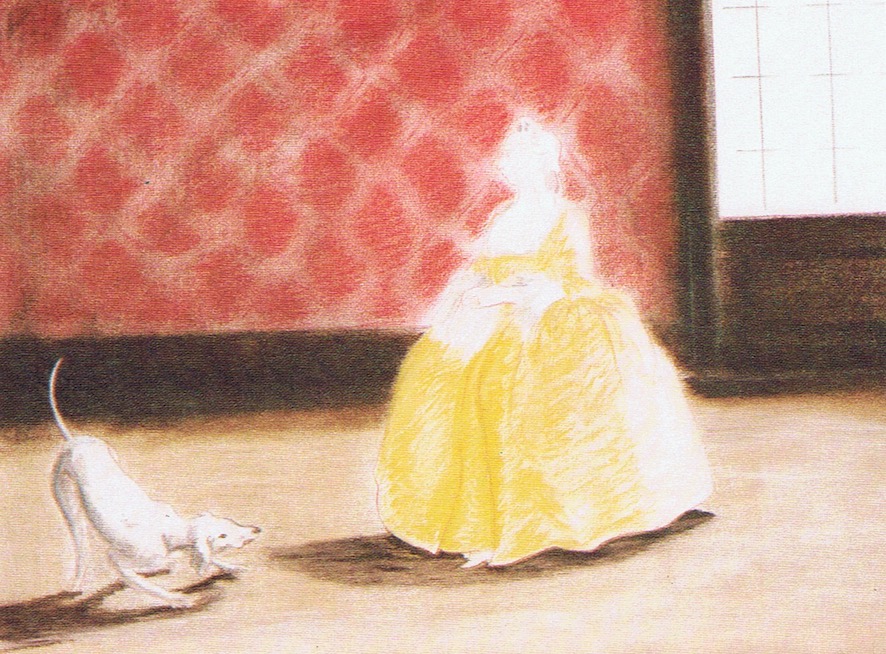
Caroline Williams, Mrs Spelling Confronts the Dog 1983, pastel, 150 x 600 mm.
But that word dramatic is appropriate in another sense as well. One may have seen many pictures like Goya's El Medico, say—pictures in which a figure seems literally to be set on a stage, the background suggesting more a scenery curtain, or a painted stage-flat, than anything vaguely 'naturalistic'. So in this exhibition. Constantly you are reminded that each work is not so much a caught moment of life, as a segment of performance. This in itself sets up the play of where does 'reality' lie, vis-a-vis these drawings? Where does it lie for the man in that fine drawing Thinking Person, a bewigged English gentleman against a background that could just be a park. but more likely is the Australian outback? He is a kind of Matthew Flinders figure, looking at one world with eyes prepared for another. The eighteenth century costumes, like the titles of the drawings, are redolent of Restoration esprit, the feeling that the world, by and large, is a stage. Thus the implication is often there that the artist is directing you to a certain admission—'What you are seeing is not so much a subject as a style’.
Eclecticism is another word one has to come to with Caroline Williams. The `imaginary museum' that a certain kind of artist is drawn to is, in her case, a very contemporary thing; it has nothing to do with an antiquarian acquisitiveness. You can, for the fun of it, pick up hints of Gainsborough or Watteau or the eighteenth century satirists as you look at her work, but that isn't at all the same thing as muttering heavily about 'influences". Something much more subtle than influence is going on. What is at work in this exhibition is an alertness so at ease with the artists of another period, that this particular 'imaginary museum’ is quite as contemporary a 'fact' as laser-beams or videos before they are pressed into service by another kind of artist. The art of the past is as much an artist's 'material' as a tree or a pile of sand. Of course, one needs to be very competent, and very confident, to take on a mode that only a little imprecision can throw into pastiche or caricature. What saves Williams is her certainty on several levels—with the tradition she attends to, with her own patient technical sureness, with so clearly knowing the stylistic effects she wants to arrive at. I think you feel with this exhibition that the artist respected what she saw, understood it perfectly, then quite reasonably decided, ‘Right, that is what I'll work on.’

Caroline Williams In the Bushes 1983, pastel, 600 x 450 mm.
And so these pictures are `witty' in the deepest sense. Not because they are socially amusing, as some of them are, and not because of their visual humour, nor because of their occasionally zany titles. They demand that adjective because, in the OED's definition, they are drawings of ‘ingenuity . . . good judgment . . . quickness of intellect and liveliness of fancy, with capacity of apt expression'. Another way of saying to watch especially for Williams's sense of line. It is there you see how space is disposed, how it is the border of things that finally dominates balance. In reviewing Caroline Williams' last exhibition, Elva Bett wrote in the New Zealand Listener in September 1981 of her `educated line', her capacity 'to make simple lines tell their truth'. That seems a neat way of proposing that if you ask `What is a good Williams picture about?', the answer must be, 'The way it has been drawn.'