
Adrienne Martyn's Portrait Photographs
BRIDIE LONIE
Adrienne Martyn is a photographer who has worked primarily in three areas: advertising photography, from which she has made her living, portrait photography and semi-abstract studies of buildings. Her 1980 exhibitions at the Peter Webb Gallery in Auckland and the Dunedin Public Art Gallery, Surfaces, presented studies of stucco walls, sections of which were photographed with almost hallucinatory clarity—tight geometric compositions which resembled constructivist paintings. She used black-and-white only, intensifying contrast, making of the painted surfaces she photographed something quite different: very crisp and clean, taking only the design of the walls and giving a curious impression of paradox—the function of the architecture being quite secondary. Whatever life goes on behind these walls has become something hidden, at odds with their stark simplicity.
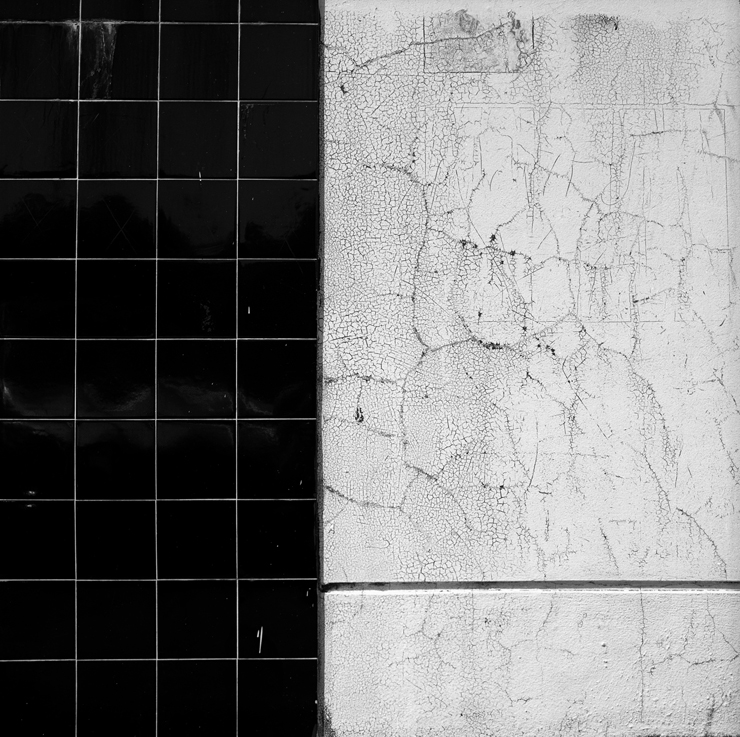
Adrienne Martyn Surface-Mission-Bay 1981
Gelatin silver print, 355 x 355 mm.
Her most recent work has been portrait photography: intimate studies of friends and commissioned works for people she does not know. She sees portrait photography as a contract between photographer and subject, in which the matter at issue is the subject's image of her/himself, something which lies somewhere between the public and the private being. To choose to have one's portrait taken means that a decision has been made, and Martyn's people often look as though they are questioning what they are, using the experience of being photographed as a test.
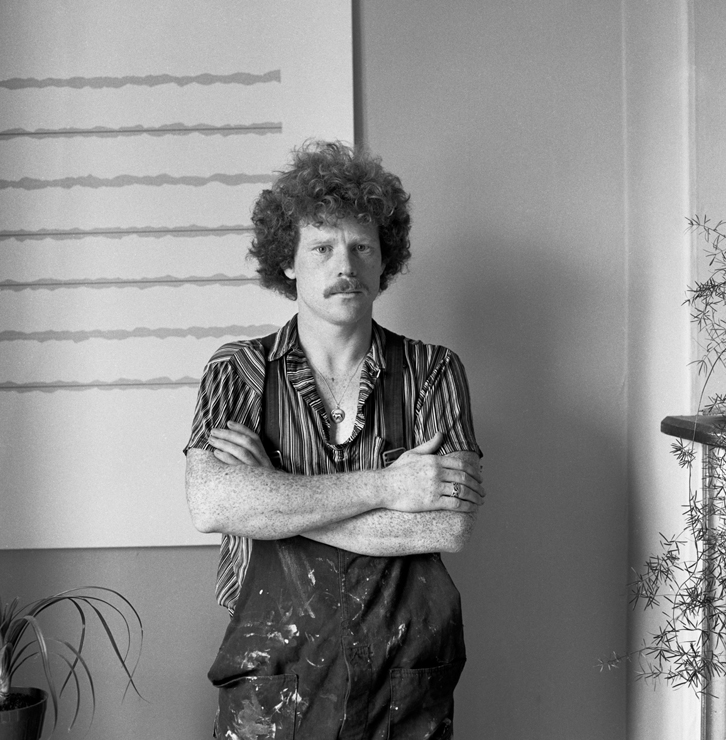
Adrienne Martyn Shaun Burdon, painter 1981
Gelatin silver print, 362 x 356 mm.
This contract is made clear in her portrait of Laurie Baker. He leans toward the camera, almost guarding his body with his arms. His expression shows a mixture of advance and defence: this is a photograph of a persona. Details of skin, hair, the texture of clothing, are keenly focused. The echoing curves of the composition heighten that sense of ambivalence: the aggression of his jutting shoulder is restrained by his left hand; the tight circles of his ear-ring and necklace are contrasted against the open, ragged edges of his shirt. An earlier photograph shows him relaxed, leaning against a brocade couch. Here the impression of sensuality is conveyed by textures of skin and cloth rather than by expression and pose. There is in both these portraits a theatricality which both photographer and subject are creating. Her portrait of the painter Shaun Burdon, taken immediately prior to the Surfaces series, is a tightly composed study. Graphic details echo the physical qualities of the subject: plants at lower right and left seem to follow the curves of Burdon's hair and head; and the corners of the recessed wall counter the lines of the painting. The musculature of his forearms is parallel with the lines in the painting; the paint stains of his jeans have a graphic similarity to the plant at the left. All these repetitions lead into the centre—Burdon's face, which looks out: warily and no wonder. The combination of subject, painting and Martyn's gentle but insistent details add up to the description of a real personality. The impression given is strengthened by the painting itself, in which the horizontal simplicity of the lines are softened, made a little uncertain, by the undulation of the paint.
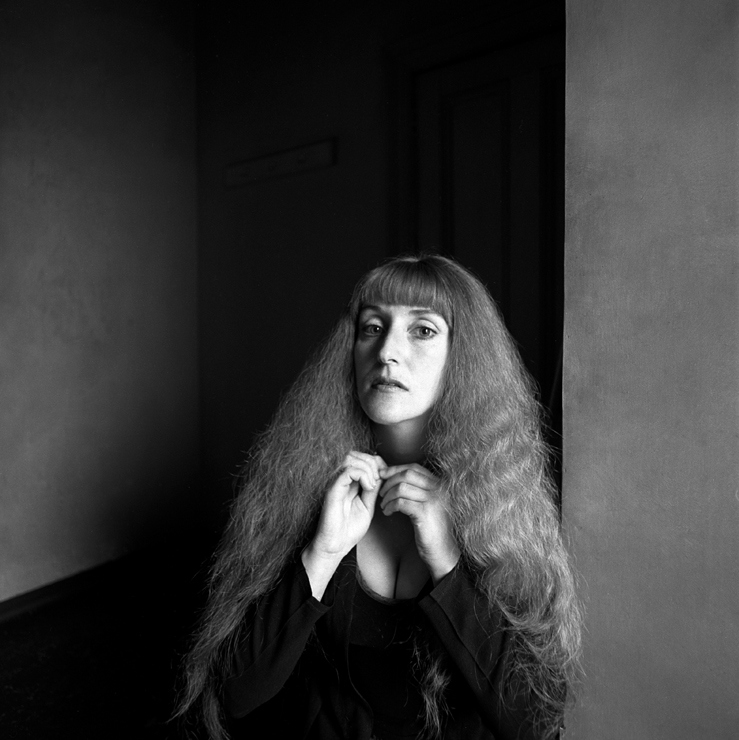
Adrienne Martyn Juanita Ketchel 1981
Gelatin silver print, 356 x 364 mm.
In the portrait of Juanita Ketchel, Martyn balances the dramatic qualities of the background, and the subject's hair and dress, with the rather nervous openness of her pose. There is decided sensuality in the way the line of her breast is shown, like a fifteenth-century Flemish portrait. This sensuality, the clear presence of the physical self of the subject, is a constant theme in Martyn's portraits. It can be relaxed or aggressive, but it is never ignored.
Steve Thomas, performance artist is a study of manners. Here, the elegant shabbiness of the 'eighties recalls the 'thirties. Tones are soft and grey, and the plaster walls are part of the period flavour. The pose is a very conscious one: something which is pointed up by the positioning of the glasses. But despite the artifice it remains an intimate portrait of a gentle mood. The shallow ground and the way the subject half-shelters against the wall contribute to this intimacy.
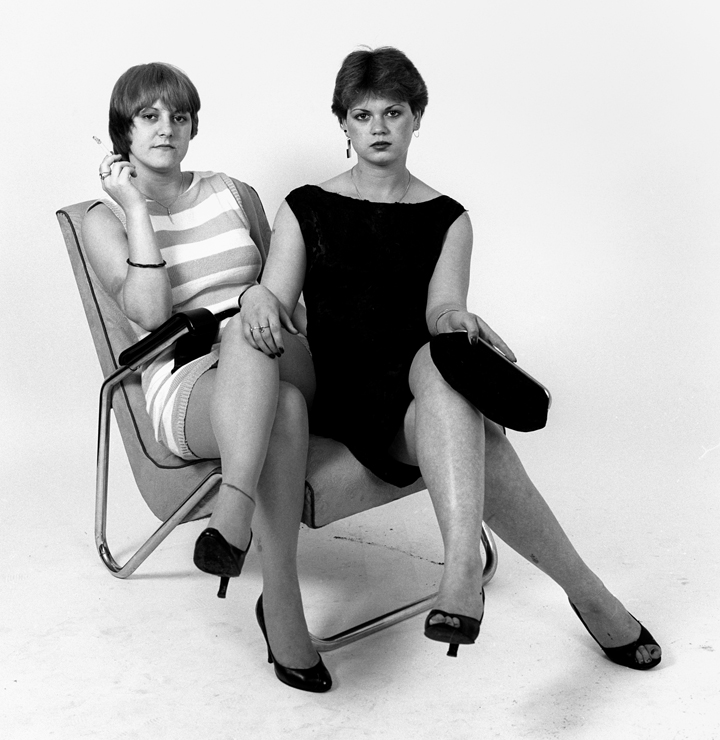
Adrienne Martyn Marie and Diane 1980
Gelatin silver print, 364 x 356 mm.
The subject of Diane and Marie is two sisters Martyn saw in a nightclub and asked to come and sit for her, dressed as she had seen them. The composition emphasises their closeness, creating a circle around them. They are completely at home with the situation, using it as a form of self-appraisal, but also as a demonstration of what they are.
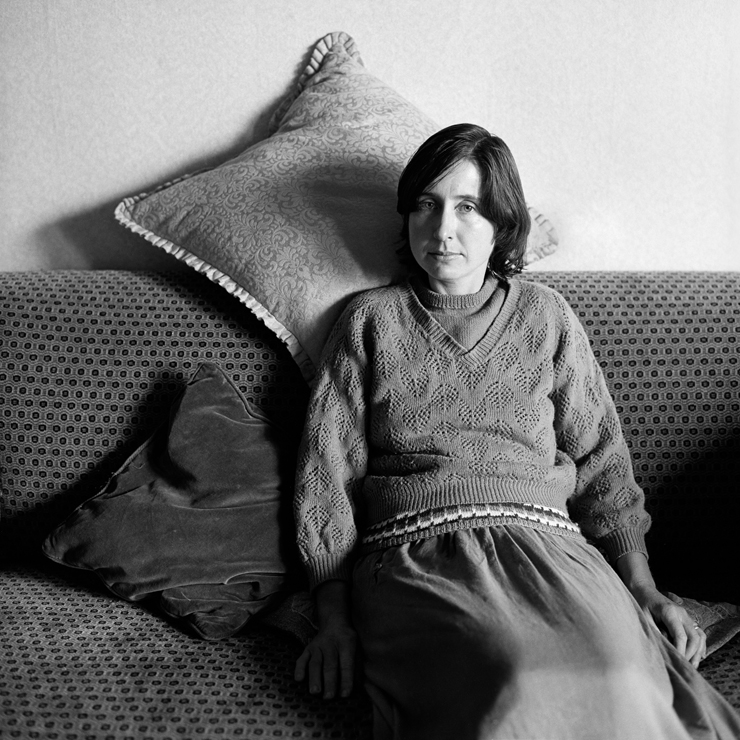
Adrienne Martyn Joanna Paul 1981
Gelatin silver print, 355 x 355 mm.
The two portraits of Joanna Paul make an interesting contrast. The earlier one shows the painter seated on a soft couch, with cushions behind her. It is relaxed, but there is a feeling of distance in it. It has quite clear formal parallels with Rita Angus's portrait of Betty Curnow—parallels which are heightened by a physical similarity between the two women, of hair, shape and strength of face, pose. This suggestion of fertility is also present in both portraits, in the placing of the hands, emphasising the abdomen. But there are no explicit references in Martyn's portrait to that of Angus: the similarity is purely formal: in the design, and in the associations one makes, suggesting a quiet continuity.
The second portrait is one of Martyn's best. There are no external details; there is no added information. Only the strength of the face is here heightened by the contrast of light and dark. And there is no explicit discourse between photographer and subject: but instead a complete acceptance which needs no eye contact.
Martyn has worked in photography since she left school. After a period as a darkroom assistant she went to work for the photographer Euan Sargenson in Christchurch, who lent her his cameras in the weekends, and helped her to clarify the images she photographed, teaching her to crop and to alter contrasts, but otherwise leaving her alone. In 1972 she went to Sydney, where she worked for the Sydney Morning Herald on large format black-and-white shots for magazines. While working there she also made photographs for the women's movement, and exhibited in a group exhibition at Womens House in Sydney. Her work was printed in Refractory Girl, Me Jane, and POL, and she was commissioned by the Sydney Womens Film Group to supply still shots of the way young girls were treated in Welfare Homes, shots which were used in a film called Home. She was also commissioned to photograph schools for Dannie Humphrey's book School's Out — a study of educational institutions published by Penguin, and her photographs of women were used in Mother I'm Rooted, an anthology of Australian women poets. In 1974 she was commissioned by the Australia Council Community Arts Board to photograph recipients of community arts grants in their occupations.
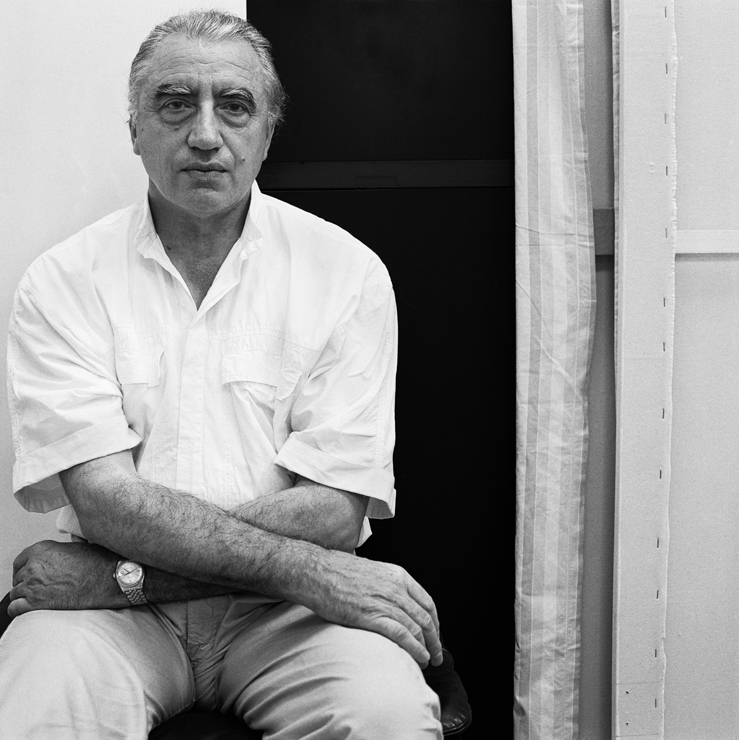
Adrienne Martyn Milan Mrkusich 1987
Gelatin silver print, 355 x 355 mm.
In the same year she was given a grant herself, to make a film called The Object. This was a study of a woman alone. It is now in the Vincent Film Library in Melbourne: it has not been shown in New Zealand.
She made The Object here, and went briefly to the Dunedin Polytechnic School of Art, but left to concentrate on photography. She had her first exhibition at the Bosshard Galleries in 1978. In 1980 she set up her own Dunedin studio, and has worked since then in Dunedin and Sydney, either free-lancing or from her own studio.
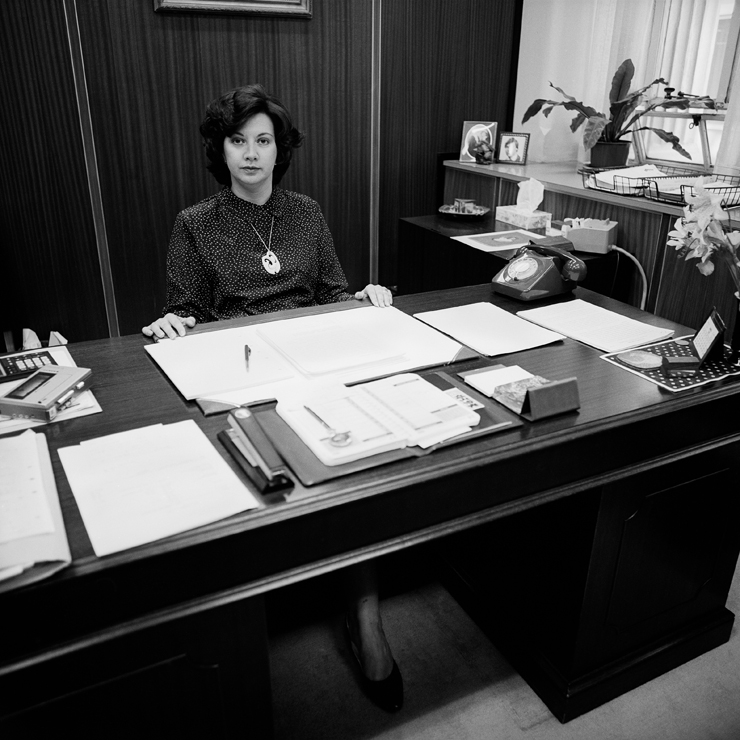
Adrienne Martyn Denise Henare 1987
Gelatin silver print, 355 x 355 mm.
Martyn gives as her first influence the work of Arnold Newman, whose portraits span 50 years. He shows artists in the context of their work, making formal references to paintings, or to similar qualities in work in other media. He shows Stravinsky dwarfed by the rounded shape of the raised lid of his grand piano, Soulages peering between panels with vertical lines. He crops and composes mercilessly: each detail is chosen to reinforce his meaning. Her second influence is Diane Arbus. Here the thing taken is the relationship between photographer and subject: an open one in which the protagonists are equal; the subject in the strength of his character; the photographer in accepting and showing that character. Martyn also recognises the influence of Richard Avedon but finds his treatment of his subjects too autocratic.
The formal limits of Martyn's work are clear-cut. She only uses black-and-white: there are no extraneous details. The relationship between photographer and subject is a formal one, in another sense. The photographing is an occasion for which both parties are equally prepared. This narrows her field, and gives it a traditional context. The rules are known. What spontaneity is left can only be in the essential characters of the participants.