
Exhibitions Auckland
CHERYLL SOTHERAN
Ralph Paine, who exhibited new and old works at Space Gallery in September, has had shows before in Auckland, but it seems that the time has arrived for his blend of whimsy, cynicism and irony with acute political and social perceptions. The gallery in which he showed his work is an environment which has been much criticised by devotees of the white cube, as its walls are all vertical tongue-and-groove panelling, and include some rather determined architectural features, like pillars and large windows, which give the room a domestic and decorative rather than neutral feeling. However, some shows, such as Peter Peryer's idiosyncratic collection of photographic and other memorabilia, have worked well there.
Paine's work is also highly personal, and has a very distinctive quality: it wasn't at all daunted by the setting — in fact a strong sense of seriality, of sequence from one work to another which was a marked feature of the material, was actually enhanced by the serial nature of the panelling.
There were many works, all the same size and all having a very strong sense of the flat surface about them, rather like book pages or pages from comics — a resemblance reinforced not only by the presence of images derived from popular sources, but also of inscriptions, directions, quotations and numerous other verbal elements. In the sense that these images have such popular derivation, and occur on an unashamedly two-dimensional picture surface, they have connections with that brand of contemporary figurative art which has been labelled New Image: Gavin Chilcott and Denys Watkins are two of that group whose art could be compared with that of Paine.
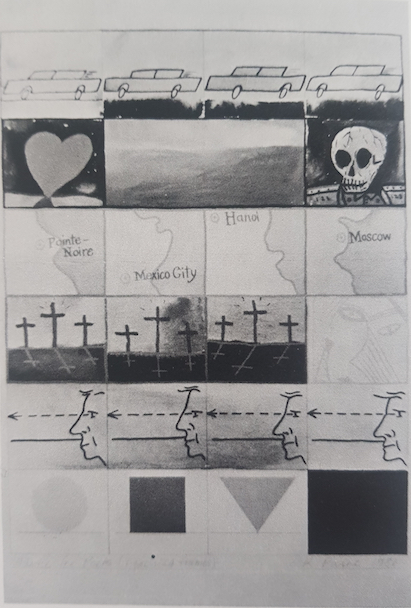
Ralph Paine,
Advice for Poets 1981,
mixed media on paper, 450 x 620 mm.
But Paine's work has very individual qualities through the sheer density of the content, the complex layering and juxtaposition of images. Chilcott and Watkins have refined their statements to a large extent: the basic narrative incident, the bare bones of a visual pun. There isn't the same sense of elimination in Paine's works, although I'm not suggesting disorganised clutter either, as the way in which the images/words are arranged in these works has a patent order and cohesion. The works don't follow a rigid narrative pattern, but they are interconnected — in a way that has a lot to do with biography, the illustration of a voyage of discovery undertaken by the intellect/sensibility of the artist.
Not a lot of art in Auckland gets out of the galleries, so the decision by Leo Jew to mount an installation in a Green Lane warehouse a little way out of town, was a welcome one — even on the level of diversion. It proved to be more than that: a noteable art event in a very appropriate location.
Just off the motorway, in the middle of a light industrial/commercial area, Leo Jew worked with the 'given' to create a disconcertingly effective installation. The work called Fishing for a Complement and it took place more or less over a working day; a working day in a fish-farm-cum-factory. The farming of fish isn't of course a ludicrous proposition per se: we think at once of mussel farms in the Hauraki Gulf, diversification, export subsidies ... but this isn't the sort of farming the artist has in mind. This context was one of earth, not sea: computerised support-systems and scrupulous quality control and all the paraphenalia of horticulture ensured the efficient operation of a farm where the fish grew in the earth like plants. They began life in a nursery, under glass; they passed through a healthy infancy and then were planted out in neat rows under a huge replica of a marine scene, to give them (or the farmer) a sense of security and encouragement. All the assistance of technology was available to guarantee the success of the pro-ject: thick coils of tubing, carrying measured doses of nurturing and life-sustaining substances, twined throughout the factory and delivered the goods to each individual product. The white over-alled and gumbooted artist/farmer kept an eye on things, and carried out the rigid culling needed to keep up the standards: there was no scope for products which didn't measure up.
The whole effect, because of the meticulous care with which the installation had been set up, the realism of the details, was so efficient, so plausible, that in no time at all, as you sat and listened to the rhythms of machinery, watched the fluids (real blood included) pulse through the tubes and literally enliven the growing fish, it became quite reasonable to accept the (ludicrous) proposition that fish could grow in the earth.
In itself, this was quite enough to go away with. But other notions questioned by the artist/installation surfaced on reflection. That ease with which the whole enterprise was accepted drew attention to the faith we place in technology, as well as in so-called rational keys to understanding. The artist acknowledged an intention to make viewers of the work aware of the generally unquestioning nature of their perception: the general willingness to accept anything and everything, as long as it looks O.K.
In the search for the all-new art-form, installations aren't so popular these days: but this one was scrupulously well set-up, had a point to make and made it in an effectively three-dimensional way. In fact, of course, it was made four-dimensionally, with the introduction of the time factor. The sculptural as well as the theatrical ancestry of the art installation was equally apparent though, in the self-contained and complete nature of the process: a perfect tension was established between the static notion and the rhythms of its execution.
Both Jacqueline Fahey and Philippa Blair are artists with well-established reputations; Jaqueline Fahey's show at the Auckland City Art Gallery focused on an aspect of her past work which she sees, rather in a reflective or retrospective sense, as significent and coherent. Philippa Blair's show at RKS Art in September was more of an exuberant moving on: the works were bigger in scale and moved more emphatically off the gallery walls. They used the sculptural potential of the heavy canvas with greater purpose and conviction than earlier shows. although the continuity which runs through her work remained evident.
It was interesting to see, some weeks later in the same gallery, a move by the expatriate feminist artist Alexis Hunter, towards a very much more active picture surface than was apparent in earlier works, based on photographic and photocopying techniques.
This is not to say that the suggestions of such textural disturbances, implying a tension between smooth commercial images and less pleasant actualities of existence, were not present in the way in which the artist worked up the image or added free paint work to the photographic or lithographic pieces. What has happened in these most recent works is that the free painterly effects have entirely replaced smooth glossy images.
The content of her work shows development too: in her last show here she included a small group of works dealing with what she has called 'Mythical archetypes of patriarchy: the Witch, Siren, Amazon and Foolish Woman'. This small group, using a more painterly and expressive style, gave a clue to the preoccupations of this more recent collection: the artist has moved, however, from seeing woman as victim of stereotyped attitudes towards sexuality and creativity, to showing woman-as-artist in an active role, seeking creative inspiration on her own account. The female figure is shown nude, in a questing pose reminiscent of antique figures like those on Egyptian bas reliefs, The apparent object of her quest, who appears and disappears in a dark and suggestive forest setting, is a stereotypic representation of rampant male sexuality, also recalling its antique sources in phallic sculptures of such deities as Pan.