
Book review
Images of Early New Zealand by Hamish Keith
David Bateman, Auckland, 1983
T. P. GARRITY
This book, relatively small for its kind, is designed it seems to me in such a way that opening it is very much a conscious act, like opening the doors of a family icon to which the closest relative these days would be the family photograph album. And one's first impression is not so much a visual one as one of blessed silence compounded with a certain degree of awe that these images in fact refer to home. From originals to hand it is apparent that much care has been taken to ensure as faithful a rendering as possible. A short, informative but refreshingly unpretentious introduction, augmented by carefully chosen extracts from diarists contemporary with the artists, is extended throughout the book in the captions, thereby co-mingling two themes contrapuntally, the predominantly visual with the literary in a shared enthusiasm for place. It is a pleasant book to handle in every sense.
Keith, the prime mover of this publication and defined on the title page as compiler rather than author, plainly wishes to be considered not as the ear-bashing theoretician, as is commonly the case with such books, but rather as midwife to the knowledge we already have deep within us, but which through glib living may have been forgotten. It is indeed a pleasure to be able to open this book upon silence, to be able to use one's eyes alone for a change without the background noise and careerist clap-trap of academic exegesis, without which some of us may actually have come to believe no art can survive let alone exist. Seeing is a silent act. But these days it is almost as if art's sole purpose is to shore up the whole of that incredible staff of academics, apologists, exegetes, critics, curators, dealers, speculators etc.; and that, unbeknown to all, art has long since turned autistic, willed itself out of existence and vanished unnoticed back down into the interstices of life whence it came long ago.
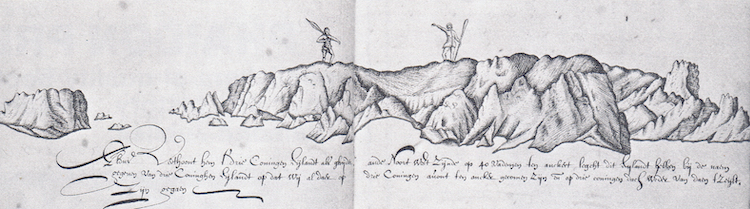
Isaac Giselmans, Three Kings Island (detail),
ink, 460 x 355 mm.
(Algemeen Rijksarchief, Holland)
But one suspects that the word 'art' was probably reserved for something a good deal more high-minded than the sort of watercolours we find in this book. So it is with reason perhaps that words like 'art' or ‘painting' have been dropped from the title in favour of 'images'. This retrospective pigeon-holing of things as 'art' is one of the queer facts of Western culture. Such labelling can subdue the wildest or most unlikely products of human imagination into something fit for the quiet interiors of art galleries. Neither is the term 'masterpiece' applicable to local art in context. So in a sense the works in this book belong to the above mentioned 'long ago' and have since been ordained as 'art' by default of time's passing and the peculiarities of our culture. The relative silence of this book worthily fulfils, with respect to art at any rate, the McCahonian injunction of 1959, ‘Let Be Let Be'. For in any culture worth its salt art simply is and needs no explanation or justification from any quarter. In fact, the indications are that in the not too distant past it was art that did the explaining of things external to both itself and us.
It was in the mid-1950s that Keith and other writers such as Una Platts, Eric McCormick, Peter Tomory and Colin McCahon first drew attention to the fact that there was such a thing as New Zealand art history. I refer of course to a series of monographs brought out by the Auckland City Art Gallery. But their's was a low-key approach quite unlike today's cottage-industry. So it is salutary that a member of that group should return in this noisy age to that original cool, quiet, hands-off and let the art speak for itself approach.
Here at last is Isaac Gilsemans on equal footing with the rest. Surprisingly, the time spans between Gilsemans, Hodges and O'Brien are approximately equal. But perhaps a chance was missed here to mention the strange event that marked Europe's first encounter with this country's population: a bizarre sort of concerto for trumpet and conch which according to Tasman's journal rang out across the orchestral space and light of what is now Golden Bay: before blood was spilt. It is tempting to see in this absurd event an inadvertent, almost Johannine conjuring up of an inchoate art-like form from out of the antipodean void. Interestingly, most of the pictures in this book include figures one way or another: which gives the lie to the perennially fashionable notion that New Zealand artists cannot out of squeamishness, ineptitude or disinclination people their landscapes convincingly. While this may be true of quite a number of today's better-known artists, it certainly was not true of their predecessors, as this book shows.
There is something about these early watercolours which brings to mind not the late eighteenth and nineteenth centuries but earlier essays in the medium by Durer. Possibly few if any of the painters in this book would have come to much had they stayed at home. At most they would, like many of today's artists, have been content to play to the gallery in a socially approved manner, or engage in what one artist I know calls 'serving time'. Kinder's European work was dreary in the extreme. However, finding themselves for reasons other than art in an extraordinary antipodean paradise must have prompted them to disinter their talent: it was a chance too good to miss.
But the environment was such that they were hard put to it to make the old formulas work properly. Any observant person returning to New Zealand after a long sojourn abroad will have noticed with surprise and delight how sharp our horizons are without the fig-leaf of haze. A long sea voyage would permanently etch the horizon into one's brain-structure. And the goddamned place was not laid out like a park either. Those all too frequent high distant views of visually granular bush must have been a headache for anyone taught to render foliage as millions of little bunches of bananas, and trees as individual sculptural elements complete with chiaroscuro. The problems would have been endless. So it is small wonder that artist subjected to a continuing ambush by the superior forces of light and space should have bridged the gap between the learnt response and direct experience by partly turning into a bricoleur. And as long as the artist remained the victim of this ambush, bricolage was an essential ingredient of the art. But with the reversal of roles, art gained the upper hand and slowly began to clone itself autistically upon itself under the hubristic aegis of the artist's ego. Keith's book wisely limits itself to the period before the roles reversed in favour of the artist; and it affords a glimpse of one of those rare brief audience-less moment in history when art paradoxically not knowing itself as such is most truly itself. Today, individual artists enact this historical process within a lifetime. This is not to say that the same thing did not happen elsewhere. But what makes New Zealand unique is that it was the last of the Fairburnian bulbs to sprout under the wet sack of Empire.
There are artists whose absence from this book may surprise: Buchanan and Williams for instance. Everybody will have their favourite list of absentees. It is inevitable, but the meaning is clear: the story of New Zealand art—'history' is too portentous a word for so young a country—can be told ten-times-over with a different set of names each time.