
New Facilities For Print-Makers
ROSEMARY HEMMINGS
The Atelier
In a quiet corner off upper Queen Street a new amenity for artists has recently been set up. The Atelier is a lithographic printing studio/workshop organized by artist and master printer Graeme Cornwall. His aim is to provide creative working space for artists to collaborate with a master printer in producing their own lithographic prints.
Many artists find the idea of making a limited edition lithographic print on their own an intimidating one. Ideas have to be translated to an image on stone or aluminium, and then that image has to be transferred again on to paper, using colours which are not visible on the initial work. Working with a printer has the advantage at this stage of giving the artist confidence in his direction, and technical help in its execution.
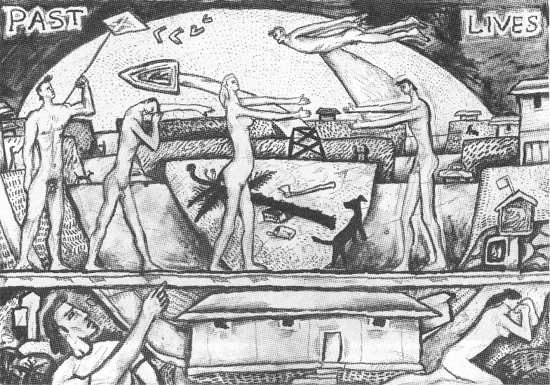
NIGEL BROWN
Past Lives
lithograph
(Atelier)
When the drawing is completed on the stone (or aluminium), the printer treats the stone with gum arabic to fix the image on to the surface. This complete work is then proofed by the artist and the printer before being printed on the flat-bed transfer proofing press. All the inking and printing is applied by hand and carefully supervised by the printer.
Although the artist may choose any size of image, three standard sizes are recommended because of the availability of stone and paper in these sizes. Fees paid cover the cost of preparation of the stone for printing, printing and pressing time, and material costs. Paper is charged separately as there is enormous variation in the requirements of individual artists.
Before setting up The Atelier, Cornwall has packed a variety of international experiences into the last few years. After he left Auckland University with a Masters Degree in Fine Arts, he spent two years at Reading University, studying printing and painting. This was followed by a year of extensive travel, looking at exhibitions and collections of prints in America and Europe. When he arrived home in 1982 (loaded down with discarded lithographic stones from various English 'newspapers who had discarded them when hot press printing became widely used) the old studio in Karaka Street was newly vacant, and he was able to set his vision into motion, and create his own printery.
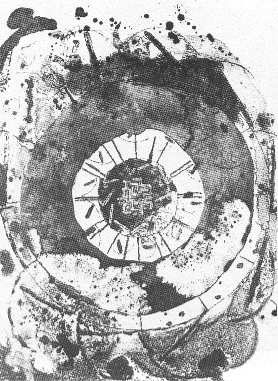
GRAEME CORNWALL
Z
lithograph
(Atelier)
With such an asset so readily available, contemporary artists may well decide to emulate their eighteenth century predecessors, and make available to the public advertisements of their work-either in poster form, or as invitations to their exhibitions-but certainly in ways which will make contemporary artists' work more cheaply and readily available to a larger public.
Portfolio Gallery
Portfolio Gallery was set up by Kath and Allen Jenkins, in 1979, to provide gallery space and street-level shop facilities for selling the very best in New Zealand and overseas prints.
With the rapid increase in recent years of the 'print' made by using a photographic reproduction of a work (which is signed by the artist, but is usually in an unlimited and valueless edition) it has been necessary for the Jenkins to provide a venue where the art of print-making in its truest sense can be displayed and sold. Portfolio sells no posters, photographically-reproduced prints, or commercial cards. Instead the Jenkins concentrate on offering the customer the largest range of handworked prints available in New Zealand.
The Gallery is in a busy commercial street, off Auckland's Queen Street. At ground-floor-level the public can browse amongst the large collection of works in the bins, and see framed on the walls a great number of contemporary works.
Upstairs, in a quiet gallery space with remarkable curved windows which reflect the buildings Victorian heritage, exhibitions from New Zealand and abroad can be viewed. Recently David Hockney followed close on the heels of Carole Shepheard. Shepheard's warm human images were vividly contrasted with the cool pragmatism of the Hockneys.
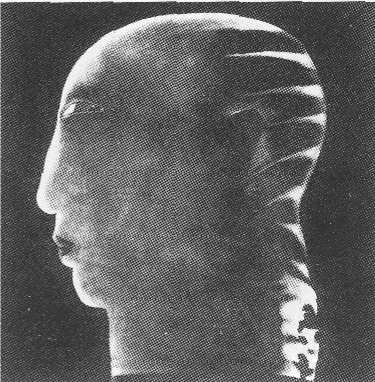
KATHRYN MADILL
Tiger
mezzotint
(Portfolio Gallery)
Alien and Kath Jenkins are both ex-teachers. They are committed to an educative role in the gallery - encouraging customers to ask questions about the works and the processes, and encouraging teachers to bring classes into the gallery space. This not only teaches children about print-making and printers, but takes some of the mystique out of going to a dealer gallery.
A printing press, printing plates, screens and wood-cutting utensils are kept on the premises. The Jenkins like to think that when someone buys a work they will not only enjoy that particular work all the more, for knowing about the artist and the processes that went into the making of it, but will be more discerning and informed buyers as a result.
A wide range of international work can be seen in Portfolio Gallery. The Jenkins travel widely, visiting artists and printers, arranging shows. When these shows are over, unsold works go into the basic stock held in the gallery.
Print-making, as a way of artists' work being made widely accessible to the public, has been popular since the Neo-Classicists sent home reminders of the joys of Rome to patrons and friends. These days, artist/ painters make limited-edition prints of their own ideas and print-making has tended to become an end in itself. Artists like Stanley Palmer, Rodney Fumpston, and Marilyn Webb, to name just a few New Zealanders, have specialised in it almost exclusively, and stand to be seen in that category of artist called print-maker.
The directors of Portfolio Gallery are particularly interested in the medium of mezzotint. They have shown works by recognised masters in this technique, such as Mario Avati, and would like to encourage its revival in this country. One New Zealand print-maker specialising in mezzotint is Kathryn Madill, who currently has an exhibition at the Gingko Gallery in Christchurch.