
Exhibitions Wellington
AVENAL McKINNON
The 1983 exhibition year opened with great éclat with Debra Bustin's installation at the City Art Gallery an amalgamation of pure imaginative invention which bordered somewhere between sculpture, painting and theatre. As this exhibition has already been dealt with in a separate article it suffices to say that Debra Bustin emerged from this show as one of New Zealand's most freshly inventive artists.
Also of note in recent exhibitions were the sculptures by Bing Dawe at the City Art Gallery, works by Victoria Edwards at the Janne Land Gallery, drawings by Graham Bennett at the Louise Beale Gallery, and two recent paintings by Colin McCahon at the Peter McLeavey Gallery.
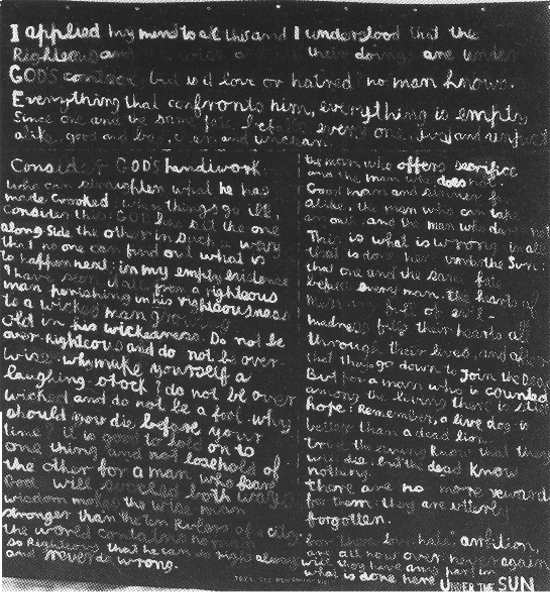
COLIN McCAHON
'I applied my mind...'
April-May 1982
acrylic on
unstretched canvas,
1930 x 1810 mm.
Bing Dawe, a thirty-one year-old Christchurch artist who divides his time between the freezing works and his studio at the Christchurch Arts Centre, created two remarkably powerful works: Large Soaring Bird Ensnared and Study: Bird Removing Foreign Object from Its Wing. Assembled from carved, blackstained, boneformed kauri, bound with wire and fettered with cord, these long, slender, tapered forms recreated in graphic elevation the soaring wingspan of flying creatures. His scaled-down delicately-formed carcasses, condensed and flattened to emblematic bone forms conveyed a fine and limiting fragility.
In Large Soaring Bird Ensnared the entangled wing forms were ripped apart by gleaming wires, the body pitilessly pinned down. In Study: Bird Removing Foreign Object From Its Wing the bare, suspended wing forms were sensitively bent and clawed in an almost calligraphic gesture of pain. Moving away from traditional concerns of mass and volume, Bing's sculptures were intensely lineal. His forms, extending from floor to walls and ceiling, appeared to be literally drawn in space.
A critical or polemical content, directed at specific concerns for South Island ecological issues, may have been inherent in these works; but they suggested a wider all-embracing metaphor of vulnerability and aggression. As potent images of predatory violence and struggle they looked back through the metaphoric sculplures of early David Smith and Picasso to the sacrificial drama of Giacometti's Woman With Her Throat Cut.
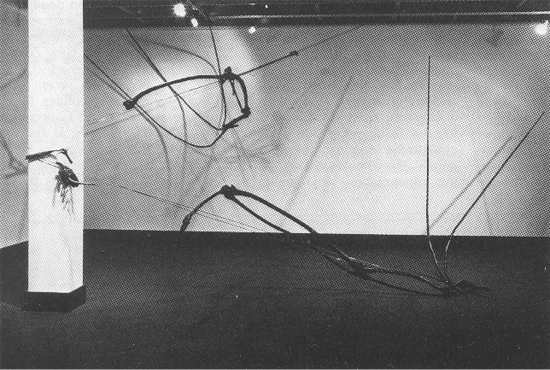
BING DAWE
Large Soaring Bird
Ensnared 1983
sculpture in kauri,
chain, wire and marlin cord
Victoria Edwards' exhibition at the Janne Land Gallery concentrated upon the female form in a series of figure studies in charcoal, pastel, white chalk and conte crayon.
Two preliminary sketches, swift spirited summaries of angle, pose and gesture, showed an unusual confidence. Her figures were viewed frontally, or presented a muscular back, the legs abruptly cut, the hands scarcely indicated, the face squared out or missing altogether so that the force of her concentration fell upon the torso.
Patches of light and shade emphasised the volumes, suggesting the underlying vitality of the form while adding mystery and depth to the pose. In an overtly tactile handling of her medium the limbs were moulded with pastel that was rubbed, smoothed, even caressed into place, the paper punctuated with charcoal-laden fingerprints. A rich glowing harmony softened the weight of her forms while emphasising skin tones in a manner that seemed to reach back to that master of scrutiny in pastel, Edgar Degas.
Christchurch artist Graham Bennett's assembled drawings in pencil, oil, paste, acetate and thread showed a consistently sensitive handling of illusory spaces. Bennett's pictorial geometry was concerned with the interaction of forms in space. A fine skein of fluent filament-like markings and graphic flourishes bound his surfaces together, unifying them with agile linear rhythms.
His use of acetate, folded or overlapped, created crystal-like refractions, while the floating quality of his boxes and rectangles was emphasised by the trailing strands of coloured threads which hung freely from the actual picture plane.
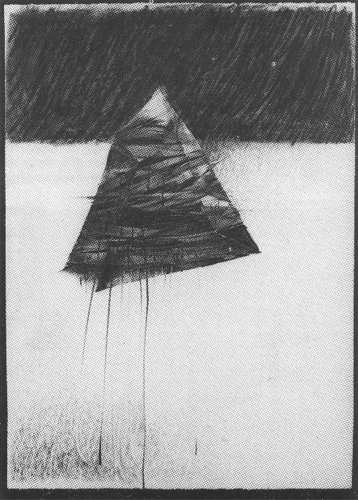
GRAHAM BENNETT
Flax Box III 1982-83
pencil and oil on paper.
1000 x 700 mm.
Recently Wellington has had the chance to see some early works by Colin McCahon from among the National Art Gallery's latest acquisitions, together with two of his latest paintings at the Peter McLeavey Gallery.
McCahon's early works included the Ron O'Reilly bequest King of the Jews (1947), a 1950 Double Portrait, Alpha & Omega (1953) and two drawings Madame Cézanne at Titirangi (1953) and Pastoral a black wash drawing dated 1954. In these early works with their monumental, solid drawing, the artist acknowledges his debt to Cézanne, and employs a predominantly religious symbolism which is a potent blend of almost medieval spirituality and expressionism.
Of the two 1982 works, one is inscribed Is there anything of which one can say, Look, this is new?; the other, I applied my mind ... As in his previous 'wordscapes' both title and text combine in an overall rhythm of shapes, a repertoire of forms, an outpouring in McCahon's rounded handwriting which flows or is scraped upon the surface, leaps into capitals and is dramatised by punctuation marks creating a concentrated stream of pictorial energy.
The words themselves, apocalyptic proclamations from Ecclesiastes in the New English Bible, are set within a cosmic landscape. Below is the barest indication of the earth's curved surface. Above there is infinite darkness, divided by chains of dotted lines and illuminated by the words which glow upon the surface.
These are searching paintings, intensely human in that they express the artist's own beliefs and ideas with palpable immediacy, together with his vulnerability 'as the man who offers sacrifice.' Using the naked force of black and white, McCahon's paintings reactivate the dialogue between painting and words, art and life.