
Exhibitions Christchurch
EVAN WEBB
Paul Cullen
John Hurrell
Two past graduates of the Canterbury school of Fine Arts recently exhibited at the Brooke-Gifford Gallery. John Hurrell showed a series of different and provocative paintings while Paul Cullen demonstrated his continuing interest and expertise with constructed sculpture.
When Rodin attempted to place his bronze Burghers directly on to the ground in Calais one hundred years ago, he initiated a self-consciousness about bases and pedestals which still concerns modern sculpture. Supporting plinths can visually intrude, especially in the case of constructed sculpture. This concern becomes problematic when the works are so small that they need to be raised off the floor for protection and proper inspection.
Paul Cullen's solution to this is simple and effective. Each of his small, fragile constructions sits on its own table which acts as a base and also becomes part of the work.
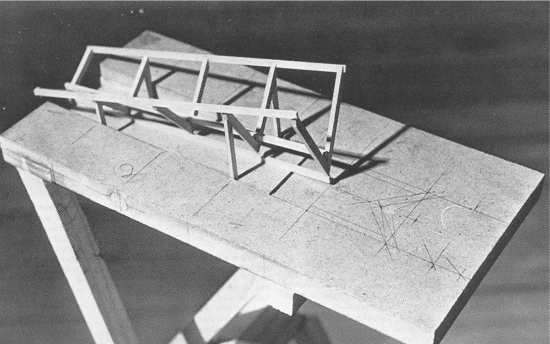
PAUL CULLEN
Construction Number 3
This is achieved by integrating the table with the work it supports. The constructions are glued on to the table surfaces which, in turn, carry pencil drawings and plans used to construct the works. Furthermore, the table planes are cut, tilted or rotated, and the constructions conform to these planar shifts. The fact that both are constructed of wood also helps preserve a congruence between the table and the work it supports which might otherwise have been lost because of the unusual scale difference.
Indeed, the constructions, which are made from fine spruce sticks, are scaled to resemble models of partly completed buildings or boats. As such they protrude from their drawing boards like preliminary sketches of projects yet realised. This sense of process and experiment is further reinforced by the works, as a whole, appearing unfinished.
Unfortunately this concern with process boarders on being contrived because some of the drawings and bits of joinery on the tables bear no apparent relationship to the small works they support. Some of the timber used for building the tables seems simply to be recycled rather than providing a coherent record of the process.
This is both an interesting and an awkward feature of these works. The unaccountable marks and joints add an intriguing visual quality, which looks good, but is at the expense of constructivist virtue.
Of his previous work Cullen has said '... I want everything that's in a work to be there for the reason that it's needed. it's not an ornamentation. It's not there because I thought it looked nice but because it has to be there.'(1)
It seems, therefore, that Cullen's recent work pivots about this problem of successfully marrying the form with the function: or, more specifically, in properly accounting for all the marks and joints he uses.
This is illustrated in Table Series Number 2, where the splaying action of the table legs plays no part in effecting the folding of the table plane. However Table Series Number 4 is a well-conceived and well-resolved work. Its table surface is rotated, allowing one corner to drop slightly over its supporting frame. This disjointed plane allows a shadow to be cast from a flat spruce construction, resulting in a subtle interplay between model, shadow and drawing.
These works entitled Table Series (Disjunctions) were accompanied by several drawings which further explored shifting and articulating planes using 150 metric projections. By presenting the drawings in series Cullen effectively animated them much like comic characters and with the same humorous results.
John Hurrell's recent paintings depart from his previous preoccupation with chance and optical play and instead voice his concern about the quality of local art reviews and commentaries. Consequently, these works, while still having painterly qualities, critically examine an aspect of art usually reserved for critics, philosophers and academics who transmit their ideas in language.
Attempting to convey complex ideas in painting which are usually dealt with in language is very difficult, because painting does not have a semantic structure like language This partly accounts for why some paintings appear esoteric and obscure. However, Hurrell partly overcomes this problem, and gets his message across by resorting to some clever and subtle devices.
Reviews from local newspapers and other articles about art with which Hurrell has found fault make up the content of these unusual works. Painstakingly they are copied on to hardboard panels using pasta alphabet letters. These are stuck down, then painted over with white acrylic followed by several coats of polyurethane varnish. The resulting build-up of paint and varnish embeds the pasta letters as if they were in a plastic consommé.
Although the varying layers of paint and varnish almost obscure some of the letters, all the panels can be read as enlarged versions of the original texts. At a distance these copied reviews look like sombre and important memorial plaques only to reveal, on closer inspection, the irregular and banal characters from which they are made, which, in some cases, metaphorically reflect the content of the reviews themselves. Obscuring some of the phrases with extra layers of varnish is an effect Hurrell controls well. it makes us search the works for 'hidden' meanings only to discover uneventful commentary. it is with the manipulation of surface opacity coupled with the absurd use of pasta as a serious painting medium that Hurrell effectively ridicules these articles.
Specifically what Hurrell finds discontent with is highlighted with colour, underlined or made obvious by juxtaposing one article with another. Inconsistency, romantic ideas, meaningless statements and straight forward nonsense are all dealt with.
For example, work number 10 entitled, Idea (with pants on) makes fun of the aphorism that ideas in art must stand naked or by themselves. By quoting and isolating such a statement Hurrell shows how empty it is with nothing but its reflection (the statement repeated back to front) to accompany it.
Lightweight Painting is the only framed work in the exhibition which reinforces the point it is making. This work deals with the trivial concern of a particular art competition which stipulates that paintings must be framed within a particular weight and dimension of timber. Hurrell points this out in the text, then, with tongue in cheek, obediently frames the work.
One or two of the works are not so clearly intentioned. Some pasta phrases are displaced for somewhat obscure reasons. On one work, a tense change adds subtlety which while clever, is not in line with the main objective of the work.
The question remains though as to how far these works go in examining the problems of art reviewing and criticism in New Zealand. At their best they draw our attention to the problem in a humorous and satirical way. But, as paintings, they cannot effectively put forward arguments, facts or opinions, and so remain as vague insinuators. Consequently, they are successful only because we are able to read the words from which they are made.
Ironically, Hurrell has recently began writing art reviews for a local newspaper, and these have been intelligent and well researched. As such his writing might now be said to complement his recent painting.
1. Art New Zealand 20, p.58