
The Reconstruction of the Auckland City Art Gallery
RODNEY WILSON
When, in 1971, the Edmiston wing of the Auckland City Art Gallery was opened, the Auckland City Council entered into a 'gentleman's agreement' with the trustees of the Edmiston Trust to develop the remaining portions of the building - those recently vacated by the City's Central Library - as Art Gallery space. Somewhat longer in coming than was expected at the time, the first of these spaces is now open. The remainder become available in early and late 1983.
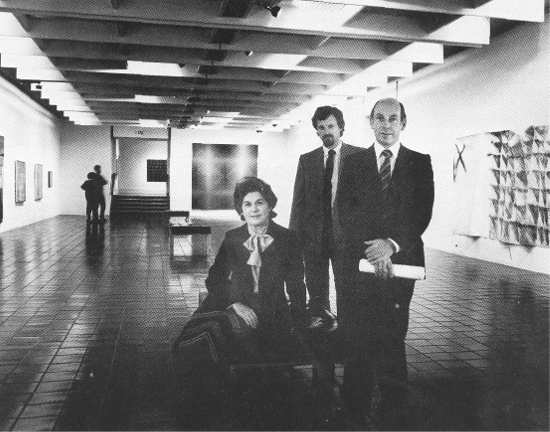
Councillors Cath Tizard and John Strevens (in front) with Gallery Director Rodney Wilson (behind)
Photograph by Marti Friedlander
The Auckland City Art Gallery buildings were designed in 1884 by the Melbourne architects Grainger d'Ebro. Construction was completed and the fine building (which initially housed the City's administration as well as Library and Art Gallery) was opened in 1888. It was a splendid edifice on a commanding site, the advantages of which are readily apparent today. Close to Aotea Square, the developing heart of uptown Auckland; two small blocks from Queen Street; adjacent to Albert Park, a beautiful glade of Victorian design; over the road from the Central Library and a few steps from the University of Auckland, the siting could not be better. Although P.A. Edmiston's bequest envisaged a new Art Gallery to be built on a commanding site removed from the City Centre such as the Auckland Institute and Museum, serious consideration has never been given to relocation. At the time of the First World War the first addition to the Art Gallery complex was made, the Mackelvie Gallery; now to be a services block. At the time of the first Director's appointment, Eric Westbrook, this same wing received some architectural modification which included a mezzanine floor and sweeping staircase. Other spaces have received adjustments but the first really major renovation was that undertaken at the end of the 'sixties and opened in 1971. It included a new Gallery entrance, four large galleries rebuilt on two levels, new library, new administration and revamped service spaces. It was a major initiative and the current building programme is the second stage of that.
In 1967 the cost of continuing with the programme would have been £140,0001; now it has escalated to a total figure (projected to the end of 1983) of $6.5 million. If that figure seems daunting, the salutary lesson, surely, is the difference between the 1971 estimates and today's costs. It will never be cheaper to build than today and it is this realisation that has prompted Art Gallery Board Chairperson, Cath Tizard, and Deputy Mayor, John Strevens, to promote the Art Gallery project as a top priority in the Council's capital works programme. Indeed their vision, and that of their fellow Councillors, could well inspire their political peers in other centres to devote similar attention to their galleries.
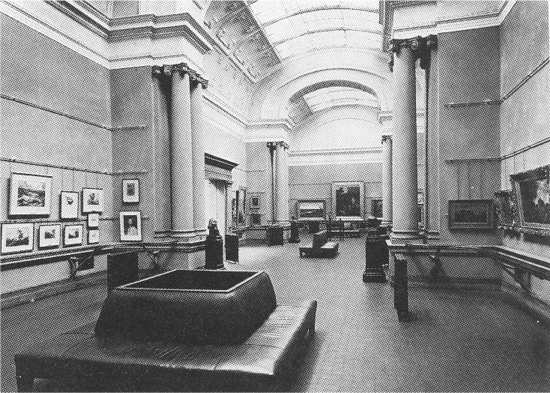
The old Mackelvie Gallery before the addition of the mezzanine floor in the 1950s and before its complete rebuilding in 1982/83 as a services block; the 'East Wing', circa 1910.
The development of the City Art Gallery's fine building is a rewarding but not easy task. Preliminary plans were produced back at the end of the 'sixties and into the early 'seventies, and these have been changed from time to time. Successive directors and staff have each placed their imprint upon the design, not the least ourselves: but, despite differing notions about the functions and purposes of the building, the various solutions differ surprisingly little. The truth of the matter is that when working within a building of as ,particular' a design as the City Art Gallery, sited to leave almost no possibility of expansion beyond its walls, and mindful of the need to preserve the integrity of one of Auckland's richest pieces of architecture, the building will largely determine what is possible. That sounds like an imposition, but it has long been my observation that many of the most exciting museum buildings are those that have been converted from previous functions rather than purpose built. it is as if the compromises that are inevitably necessary enrich the design. In any case that is certainly true of the Auckland City Art Gallery where the new spaces and their, at times complex, relationships provide for a stimulating and wholly different experience to that found in most other buildings.
The rebuilding programme involves two distinctly different projects. One is the renovation and conversion of the original buildings, the other is the erection of a new five-level block in the rear, fitted to a triangular space between the Kitchener Street wing, the Wellesley Street wing, and Albert Park. Both projects are, however, intimately inter-related. Because of the considerable costs of by building to the seismic specifications of the Ministry of Works, the Auckland City Council resolved to build to their own, less costly, code, thus forgoing the opportunity to finance that part of the operation from loan. The renovation programme, therefore, has been a charge against Council revenue and this cost has been spread over the tail end of the 1980-81 financial year, the 1981-82 and 1982-83 financial years, and will carry forward into the 1983-84 year. Completion is scheduled for October 1983. The new building is not beset with the same problems however. Seismically separated from the original buildings, it is of modern construction, meets Ministry of Works requirements and is being financed from loan. It too is scheduled for completion in October of 1983.
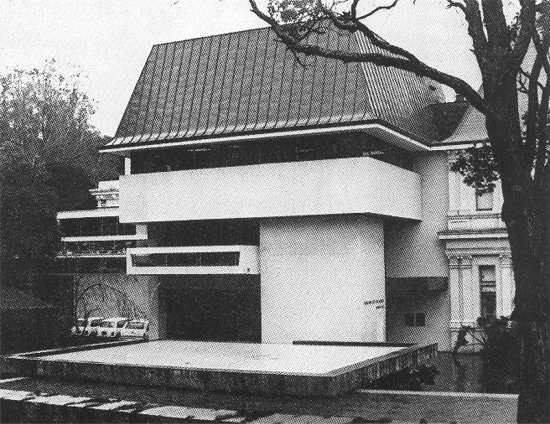
The Edmiston Wing entrance and revamped galleries, opened in 1971, were the first step in the rebuilding of the Auckland City Art Gallery.
Construction has been programmed into three stages and an intermediate stage. Stage One, that portion which opened on August 17 last with the dedication of the two 'Works on Paper' galleries to the memory of the late Waiter Auburn, a print collector of rare discernment and a friend and supporter of the Gallery for many years, involved the rebuilding of the Kitchener Street frontage and the Wellesley Street corner. Contained within this stage, on two levels, are the two Auburn 'Works on Paper' galleries, two Temporary Exhibition galleries, two Education galleries, a Maori portrait gallery, a watercolour gallery, a small audio-visual room and a small public lounge in the corner tower with views out into the city. The four large, 1971 rebuilt, galleries will gradually assume the permanent functions of European painting and sculpture, British painting and sculpture, New Zealand contemporary painting and sculpture, and Temporary Exhibitions.
Throughout the Stage One galleries the walls have been simply treated with smooth painted 18 mm Customboard. This can be regarded as a working surface and may be screwed or nailed into and easily repaired. Project Architect, Richard Harris, has understood well the need to provide working spaces that are vehicles for the works which they will contain rather than impressive architectural statements in themselves. For all that-or perhaps because of it - he has produced an architecture of dignity and restraint, elegance and austerity. With the exception of the grey-walled Auburn Galleries, the new spaces are white, the ceilings uncluttered in their accommodation of the various lighting systems and services. The carpeted 1971 ground floor surfaces have been continued through Stage One on that level. The first floor, by contrast, is a beautiful polished matai tongue-and-grooved timber floor, random cut and laid in short lengths.
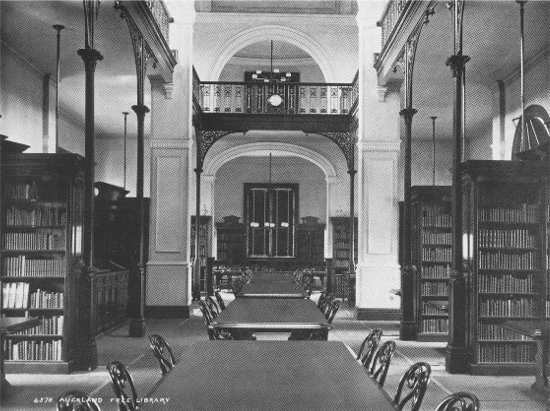
The Wellesley Street wing - 'old reference library' photograph by Alfred Henry Burton, (circa 1889).
Discreet detailing around door openings and gallery thresholds becomes, in the treatment of wall-ceiling and wall-floor junctions, a delightful and subtle historical statement. Where the ceiling and wall meet with a severe right-angled junction in the galleries nearest the 1971 modern spaces, those leading into the (yet to be finished) restored Victorian space of Stage Two pick up a white plaster cornice. Similarly, negative skirtings in the former spaces become skirting boards of the original 1880s moulding in the latter. Painted white, the skirtings and cornice melt into the walls and ceilings. They are ripples of light and shade making historical references in otherwise modern spaces and preparing the visitor for the unequivocally historical Stage Two galleries.
One of the great delights of Stage One is the circular egress stair in the corner tower. Slabs of granite are cantilevered out of the tower walls to form a long spiral passing through three floors. With the domed ceiling at the top, thick white masonry walls, undisguised stone steps, kauri hand-rail and cast iron balusters, this staircase is sheer magic.
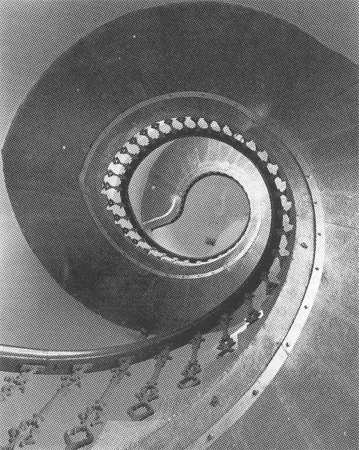
Looking up through
the spiral staircase
in the corner tower.
Due to open early in 1983 is the East Block. Many readers will remember this as the original Mackelvie Gallery; others as the Mezzanine Gallery, which it became in the 1950s. Now it has been stripped of all public functions and, indeed, of the floor inserted in the 1950s. The building has been gutted, the original buttresses, paired columns and arches which formed internal structural members removed, and it has been strengthened by the addition of reinforced concrete piers along each wall and two new floors which tie the structure together. The top two levels will contain two separate painting storage systems. On the lower levels are top hung rolling mesh screens similar to those recently installed in Detroit, Rotterdam and Munich, and on the upper level, under the barrell vaulted ceiling, an Auckland City Art Gallery developed system. The ACAC system provides a storage box for each painting. Paintings clip in with quick release fastenings, and the entire assembly slides into its allocated space on a series of smoothly running PVC rollers. Access to the paintings in storage will soon be as good as it is now to the works on paper.
On the lowest level the East Block provides a new Security Room which will monitor a wide range of Security functions. These include all staff and goods entry to the building, a twenty-four camera comprehensive CCTV system, space and perimeter intruder control systems, egress stair, monitoring systems the Education Department/ Auditorium street entrance control, all fire alert systems and a series of air conditioning malfunction alerts. The Security Room also receives back-up monitoring services. On the same level are the various workshops of the Exhibitions Preparation Department and the Cart Dock/Loading Bay area. The Cart Dock too is to be rebuilt to provide greater ease of access for large trucks, some of which must load and unload aircraft containers packed with heavy crates.
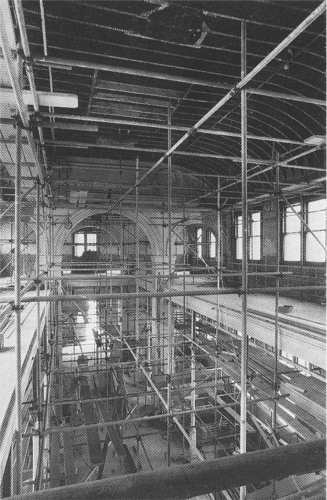
The Wellesley Street
wing under reconstruction..
Stage Two is the final renovation component and for many people it will be the most spectacular part. Stage Two is the Wellesley Street building, the graceful Reference Library as it once was. This lofty hall must - along with Christchurch's Provincial Council Chamber - be the finest Victorian space in New Zealand. Some 30 metres in length, with a mezzanine floor supported on slender cast-iron columns on all sides, capped with a beautiful vaulted plaster ceiling and terminating in apsidal ends with views into the Park, this Gallery will be restored to its former state. Only the flank windows will go. Suspended in the void in thecentre of the mezzanine level will be Bing Dawe's Large soaring bird (dead); beneath it, the same matai flooring as the top level of Stage One. On this matai we hope to be able to lay two or three large Persian rugs.
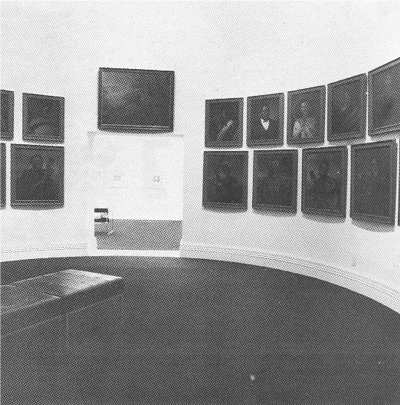
The Maori in European Art; a recently opened Stage I gallery permanently devoted to paintings of the Maori.
The bottom level of this Wellesley Street Gallery will house the historical New Zealand collection and, above, on the mezzanine level, will be the early contemporary collection. At the eastern end, adjacent to the Park, will be a second lounge area for visitors to relax away from the works on display. Beneath the Wellesley Street Gallery will be the Auditorium.
The Auditorium has been designed as a flexible space to seat 170 persons for film, lectures, jazz or chamber music. The floor is raked for half the total length, the remaining half, at the stage end, is flat. For larger performances the front two rows of seating will be easily removed and the stage itself will collapse into a series of short sections. At this point, half the total space is available as flat floor stage area for dance, artist's performance and so on. The Art Gallery Associates have a lounge on this same lower ground floor level, and the Education Department offices and classroom are also to be found here. These spaces will be accessible from a major staircase linking all levels, a lift and a separate street entrance for night-time auditorium use, school parties and the like.
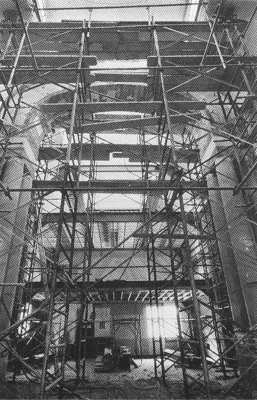
The East Wing before the removal of buttresses and paired columns and before the complete insertion of the two new floors.
In many respects the new building - Stage Three - can be seen to be the engine room for all the new stages. It contains the main vertical circulation; a passenger lift, a 5.5 metre goods lift, a large staircase, a fire egress stair-well, and a large air conditioning plant room. Within it are also to be found the sculpture store, Registrar's office, Registrar's file room, two curators' offices and sundry small circulation and service spaces.
The Stage Three building has also meant that the attics on the corner of Wellesley and Kitchener Streets can be developed as a new, expanded Photographic Department. The move of Photography to these new quarters has in turn meant that Conservation - pressed for space in their existing two laboratories - has been able to obtain a third laboratory for a number of specialised functions including X-ray photography and examination.
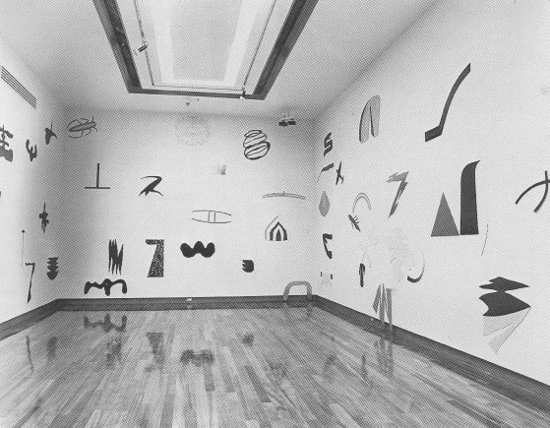
Richard Killeen's Chance and Inevitability, 1982, an 'Artist's Project' commissioned for the opening of the Stage One galleries.
Perhaps the most common problem facing museums the world over is their shortage of service space. All too often architects and Boards of Trustees are intent upon placing their money where it is most visible - up front in the galleries. As a consequence service functions suffer, conditions become cramped and ultimately the storage, treatment and handling of the collections becomes dangerous. An equal amount of service and public space should be regarded as a minimum. The proportions in the new Auckland City Art Gallery are more favourable than that and provide Galleries with 2500m2, Public circulation with 850m2 and Service with 3570m2.
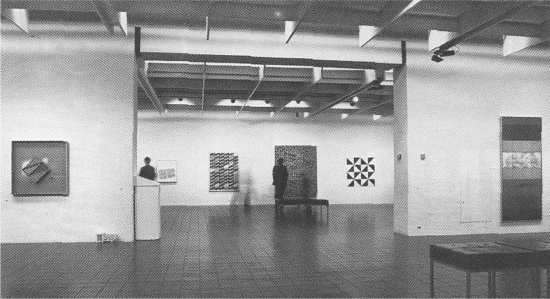
Aspects of New Zealand Art:
The Grid exhibition, 1983.
What can the Gallery's public expect from 1984 onwards? For the first time they will find a Gallery offering a full range of services and adequate housing for each function. They will find galleries permanently devoted to the display of the European collection, the Victorian collection, the Historic and Contemporary New Zealand collections, the Maori portraits and Maori subject paintings, Galleries providing regularly rotating installations of watercolours, prints, drawings and photography, three galleries for temporary exhibitions and two for educational displays. They will find regular slide/tape or video programmes, regular events in the auditorium, study collections with readily accessible storage, excellent library and archive resources, and properly functioning Conservation, Photography and Preparation departments. With the right decision from Council we may even have an Education Service functioning. Should Government also see fit to provide the education assistance received by Museums, but for some inexplicable reason denied to the Galleries, we may even have a really comprehensive Education service.
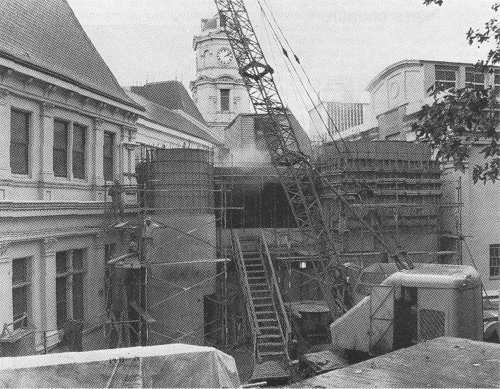
Stage Three (the new building) under construction in the triangular plot between the Wellesley Street wing (Stage Two) and the East Wing.
1. The Edmiston wing, the rebuilding undertaken at that time and the construction of the sculpture court were estimated at £260,000 in 1967. The cost of building the entire original building in 1888 was £21,851.