
Visualising A New Theatre
ANDREW MARTIN
Deep rooted in the very soul of our basically Anglo-Saxon cultural bias is the curse of Puritanism - and it is a curse. It not only prohibits the sensual but would even restrict the sensuous. It would like to make us suspicious of the melodic charms of music, the brighter hues of the painter's palette and, in the field of theatre, will often ignore the power of the visual image in favour of the spoken word.
Yet, in 1982, some of the theatre seen around Auckland was showing a new concern with a more full-blooded visualism. A figure like Warwick Broadhead, who has sustained an underground reputation for many years with his fantastic and bizarre theatre-pieces mounted in such unlikely places as the steps in Cornwall Park, or under the oaks in Albert Park, gained the sponsorship and support of the Labour Department. This enabled him to stage a major work - One Moment - at the Maidment Theatre: a dazzling masque-like creation, alternating a group of chanting singers with stylised processions of bizarrely-costumed performers. Broadhead was also responsible for an exciting Queen Street procession which provided a lively dash of colour in the grey, urban environment for a short time.
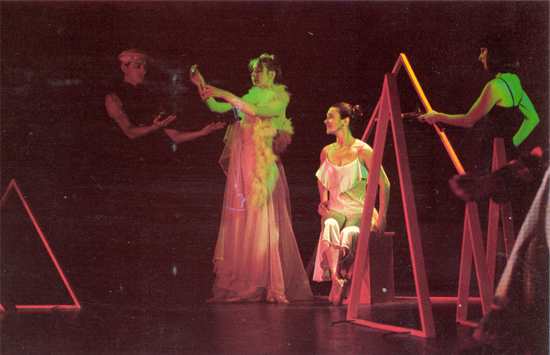
Steven Bradshaw,
Melanie Harland,
Pauline Tronson
and Shirley Kauter
in Janette Heffernan's
production of
Seven Deadly Sins
(Photograph
by Megan Jenkinson)
The Labour Department came to the aid of other theatre groups in the city. One was Dramadillo; another was Janette Heffernan's Opera and Ballet Workshop, which took over the Town Hall Concert Chamber for a lively six-month season, with works ranging from Beethoven's Fidelio, using designs by Tony Fomison, to an evening of cabaret which included Weill's Seven Deadly Sins, the Schönberg Brettl-Leider and Satie's ballet Parade.
This last production was Ms Heffernan's finest achievement to date. The central Brecht-Weill work is a fascinating theatrical oddity - half-opera, half-ballet and totally theatre. Two sisters, both named Anna, leave their home in Louisiana and trek around various American cities experiencing the limitations of the Western bourgeois existence - sin by sin, as it were.
There were the projected slides which have become part of this company's house style: but this time they were particularly effective right through to the final American primitive painting for the return to Louisiana. Brecht himself was in favour of slides, a feature conspicuous by its absence in the National Opera's visually rather drab production of Mahagonny, all in modulations of black and charcoal grey.
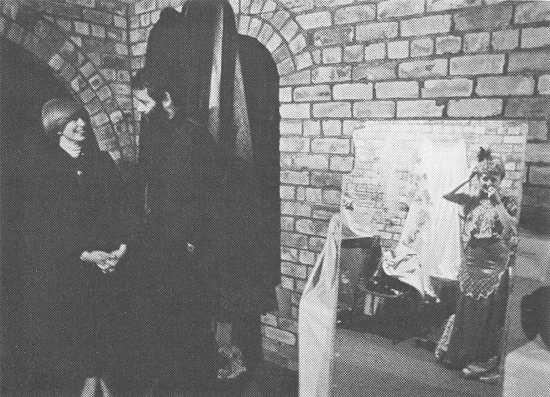
Louise Malloy,
Janette Heffernan
and William Dart
in rehearsal for the
Schönberg
Brettl-Leider, 1980
(Photograph by
Bruce Connew)
Otherwise, Heffernan's concept revolved around the performers and their work with the seven constructed triangles, which could, in their various permutations, even suggest the Golden Gate Bridge for the penultimate song. The energy of Heffernan's production also dictated that, in true theatrical troupe style, the performers were always a vital part of the mis-en-scène even to the point where a group of dancers formed a human fountain to accompany a tryst in the park.
Musically, the work was indeed memorable. Shirley Kauter as the first sister was svelte and dynamic, with a throaty quality of voice that was the quintessence of Kurt Weill; and Pauline Tronson as Anna II gave an eloquently moving performance as the dancing sister. The male quartet acquitted themselves well, and William Dart's musical production and performance showed a deliberate and successful attempt to transfer the Weill score into the area of musical cabaret.
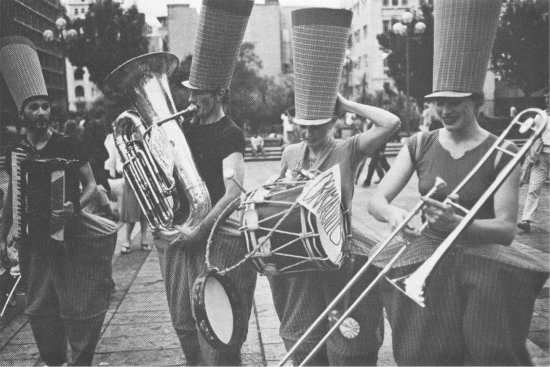
Dramadillo
(photograph by Gil Hanly)
But then the whole evening was perfectly conceived and presented within this cabaret concept. Louise Malloy's presentation of the Schönberg Brettl-Leider was as elegant as it was in its original 1980 season, and Pauline Tronson's staging of Satie's Parade was a total delight. Particularly notable was Sheree Woods - Meletti's virtuoso turn as the Little American Girl and the two cubist design costumes for the show managers made by Alan Leatherby and John Callaghan.
With the obvious problems of sustaining a National Opera Company in this country, and the sad decline in the standards of Auckland's Perkel Productions over the last few years. Heffernan shows that an energetic and lively musical theatre is still viable in our so-called Pacific Paradise.