
Maria Olsen at RKS
ELIZABETH EASTMOND
Maria Olsen's six pieces in her winter exhibition at RKS Galleries were named after Indian villages and Indian people, real and mythological; and after the ubiquitous banyan tree. These works leap dramatically on from her earlier solo exhibition (in 1980), although certain concerns remain she is still interested, in some of the works, with, for example, the delicate presentation of small, often pallid objects, both identifiable and enigmatic (memories of Morandi) and with their associations, which range from the obviously domestic to the ambiguously ritualistic.
Abandoned, however, is the more representational nature of the earlier works: in those particular paintings and constructions - domestic still-lifes / votive-offerings on ledges - one aspect frequently explored was the potential ambivalence between two and three dimensions. In the new works, the very independent objectness of these large hanging constructions is clearly stated. Space, when visible between and around the limb-like components of the works, is the actual surrounding space of the gallery and its walls.
MARIA OLSEN
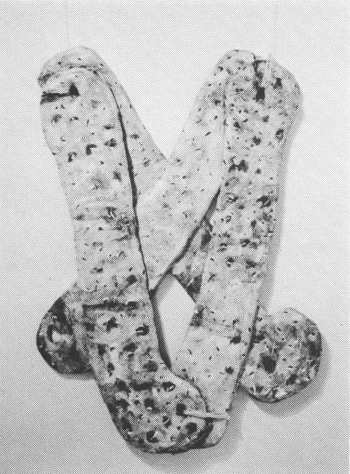
Leylia and Meinum
mixed media construction
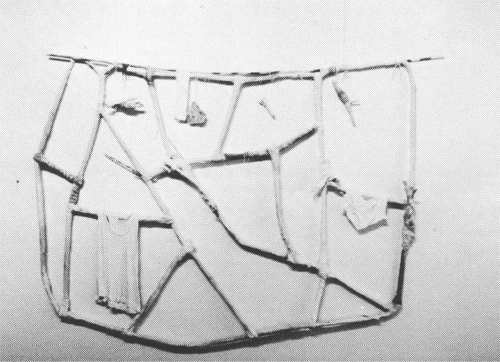
Pimpalgaon, for example, hangs as a light, very open, very flexible, and fragile grid, its thin bony limbs (gessoed, twisted rolls of newspaper) interlocking in a loose, irregular network. In its iconography, it contains these signs/obsessions from earlier works: the all-important bones, both real and simulated, bound and bandaged; items of clothing, both actual (stiffened, white child's singlet) and suggested (flourish of crisp Zurbaran drapery); a small, baffling, symmetrical object (of asbestos): spiky, arrow-like clusters of painted sticks. In addition, there are three four-inch galvanized nails, sharp ends jutting out. These objects are reminders of the organic nature of life in the small Indian village that Olsen visited, and from which the work takes its name. They also have associations with poverty, pain and death. (Interestingly, Pimpalgaon was underway, Olsen says, while she was involved in working with crippled children.)
The evocative content of this work remains fluid, however, and is partly dependent, of course, on the experiences the viewer brings to it. (I would expand, for instance, on the associations between the bones, sticks, nails and loin-cloth-like garment and the Crucifixion; or on those boxes full of bones I collected as a child.) Nevertheless, whatever the precise content is (are), it is felt, is strong, has a depth, an aspect which links the orientation of these works in a very general sense with recent feminist art, where content is a primary concern. Not that Olsen's works have a particularly feminist content: but at the same time, I feel there is much about her method of working, her use of materials, that has links (connections rather than influences) with recent art by women artists both in New Zealand and elsewhere: the American Harmony Hammond's large, wrapped, 'matriarchal' (Olsen's term) sculptural 'presences' - like her recent Hug, or Hunkertime pieces - show some of these connections. Such use of the techniques of binding, bondage, bandaging, wrapping, can be actions of healing, protection, nurture. They can also be restrictive, muffling and stultifying: either supremely loving or supremely destructive. In Olsen's work (especially in Pimpalgaon and Banyan) their use is healing, protective: actions associated with women's experience in the caring of children, especially.
MARIA OLSEN
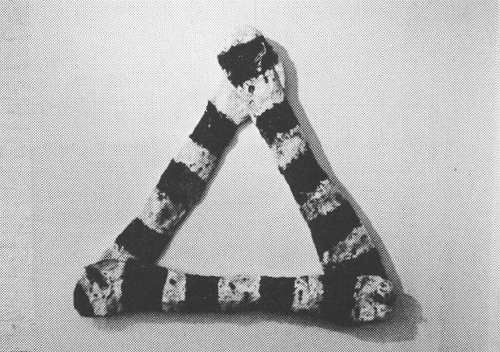
Rabia
mixed media construction
In Banyan, the thicker binding, lightly coloured, covers its knobbly, organic structure in a more uniform sense, so that the core of the structure of this tree is transformed; its branches/roots are masked and softened, swaddled.
Leila and Majnu, Rabia and Sheridi are three major works for Olsen, and ones where I feel she gets very close to what she wants to express. Their almost comically enlarged bony-ness verges on clumsy lumpishness - in a most curiously effective manner. These sculptural works are cast pieces and have resinous surfaces, expressively splashed with flicks and dabs and bands of paint. They are the unwrapped, unbound, unbandaged bones of the other pieces, exposed: the actualized yet totally fabricated bones of her earlier drawings. They exhibit, for me, an imaginative and major release from the more hermetic and detailed qualities of her other pieces. They also have an inchoate character not unlike some of Eva Hesse's works. In their large-scale and minimalist focus on a very small number of component parts (four for Leila and Majnu, three for Rabia, one for Sheridi), they literally get right down to 'the bones of the matter', its essence, and make a strong point about doing so.
MARIA OLSEN
Pimpalgaon
mixed media construction
Leila and Majnu (mythological lovers) suggests an interlocking of lovers' limbs and a more psychic interlocking. The Indian woman saint, Rabia, suggests, to me, in its triangular format, a spiritual equilibrium, or the outlines of the lotus position, even the power of ancient fertility goddesses. Sheridi seems almost 'wilfully' (Oisen's description) shapeless in shape, and like Leila and Majnu and Rabia, is decidedly indelicate in scale and presence.
I feel it clearly touches the threshold of an area that Olsen has now crossed, and is into developing: her new, very unique language. These three works are perhaps its first fully formed characters. it will certainly be interesting (and Olsen's approach also promises unpredictability) to watch the development of the rest.