
The Real & the Unreal In New Zealand Painting
A discussion prompted by a new edition of
An Introduction to New Zealand painting
FRANCIS POUND
The material brought together in An Introduction to New Zealand Painting* is, within the limits of its particular slant, and those of a book of this size - a book intended for a general audience - both ample and well organised. Of a chaos of fact, a clear picture has been made. It has been, therefore, a most powerful instrument, both for students in their first approach to the history of New Zealand painting, and in the provocation to thought it offers the more specialist reader - the reader capable of grasping its underlying polemical stance.
This book's usefulness, and the very real need it answers, are clearly testified to by its repeated reprintings. Its importance in forming a picture of New Zealand painting, from 1969, the date of its first publication, until 1982, its most recent edition, can hardly be overestimated. it is itself now an item of art history.
However, several aspects of the theoretical stance of An Introduction to New Zealand Painting are open to criticism, as this essay will try to show. The extended discussion which follows - necessitated as it is by my generation's fundamental disagreement with the underlying theoretical stance of Brown and Keith's book - may itself be seen as a tribute to the influential character of their book.
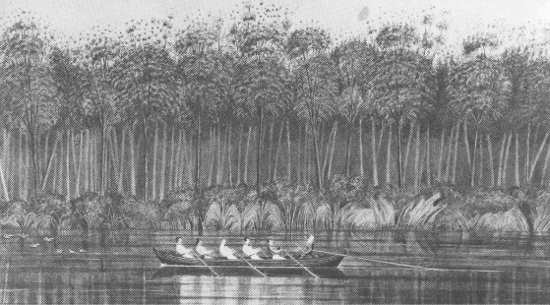
CHARLES HEAPHY
Kauri Forest on a River
watercolour
(Collection of The
Alexander Turnbull Library)
I return to the organisational capacity displayed in An Introduction to New Zealand Painting. As Baxandall has recently pointed out, no school of artists begins or ends in one moment: there is a continuous progression of artists and artworks, overwhelming in its continuity as in its number. Yet, if we are to make any sense of it, we must select and arrange. 'The historian', as Baxandall vividly puts it 'whenever he sees the hint of a gap or a group or a change of gait or leader, thrusts his way into the cavalcade and waves an expository placard.' The need for patterning sense into a chaos of fact makes this necessary. 'But', says Baxandall, 'one does not mistake the placards for something less crude or more authentic to the flux than they can be.' 'One would not deny', Baxandall finally remarks, 'or even wish away the subjective or culture-bound element in this process.'(1)
It is about the 'expository placard' waved by Brown and Keith, and about its 'culture bound element', that this discussion will revolve.
We see the past, unavoidably, through the frames of our own time and place, through the frames of contemporary concerns. . .
The past is changed by the present.
And so the fact that the 1982 edition of An Introduction preserves the text of the 1969 edition substantially unchanged, except for the extending of some chapters, and a rather breathless additional chapter to note recent developments, is of some significance - for a book not old-fashioned in its time of writing may well become so in other times.)
Let's turn back, then, to the book's time of writing . . .
From the 1930s until the 1960s, there was in New Zealand a self-conscious and explicitly-stated search for a national identity in painting and literature, a search for New Zealand subjects and a New Zealand style. This 'Search for a National Identity', as Brown and Keith title Chapter Eight of all editions of their book, was still for them in 1969 a contemporary concern: and was in fact the contemporary frame through which they viewed the whole history of New Zealand painting. It might well have served as their book's subtitle. It actually did offer itself as the final thought of the last sentence of the last chapter of the 1969 edition-a sentence looking forward, as its last words said, to 'the immediate future'.)
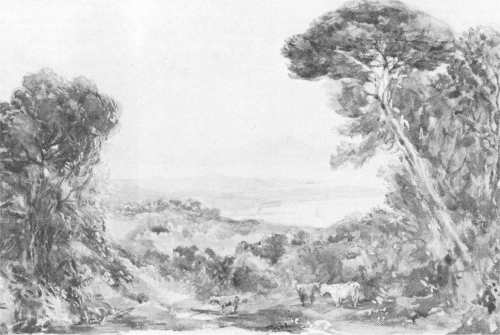
ALBIN MARTIN
Landscape in the
Environs of Auckland
Watercolour
(Collection of The
Auckland City Art Gallery)
The expository banner Brown and Keith waved in 1969, and which their book still waves in 1982, though it is now somewhat tattered and torn by subsequent internationalist painting here, is that of nationalism - of a national New Zealand style of painting. It is a polemical banner, held aloft by contemporary concerns of the 'sixties and especially by the painting of Colin McCahon, who designed the cover of the first editions of An Introduction, and who gets the last word in the last chapter of the latest edition. McCahon's painting, then, literally covered, was the beginning and the end of, lay literally over, everything Brown and Keith wrote.
Alienated from subsequent developments in New Zealand art, none of which are consciously or unconsciously nationalist, Brown and Keith's national style theory has now retreated into history: where it is still attempting to reclaim and conserve some earlier New Zealand painters as heroes of a truly national style. Brown and Keith's book, which was not so conservative when they first wrote it, now essentially is.)
Their expository banner led Brown and Keith, as it had led their predecessors in the march toward a New Zealand identity in art, into the pit of a theoretical fallacy - the fallacy which is the present discussion's central concern.
This fallacy, baldly stated, is that there is a 'real' New Zealand, a 'real' New Zealand landscape, with its 'real' qualities of light and atmosphere, to which some artists are true and others untrue: the true artists being then 'good', and the untrue 'bad'. And a corollary fallacy: that the 'real' New Zealand causes style in painting-a kind of geographical determinism.
This, it seems to me, is a fallacy based on mistaken idea of what art is and can be. It is a misapprehension that fails to provide a plausible view of what goes on in making or seeing a representation; it imposes a theory of aesthetic experience which is inadequate; and it is quite useless if applied to the blatant 'unrealities' of twentieth century painting as perhaps Brown and Keith realised, for they did not so consistently apply it in their twentieth century chapters.
Brown and Keith, as E.H. McCormick did before them, have posited two kinds of nineteenth century painting here, and created an artificial opposition between them: first the 'topographical tradition'; and second, a more 'cultivated activity'; the topographers 'who derived their style from an immediate response to the landscape', and those unfortunate painters 'who did little more than impose on the New Zealand scene the forms and light of a landscape concept they carried with them from Europe'.(2)

JAMES ALEXANDER
GILFILLAN
Native Council of War 1853
oil on canvas
(Collection of the
Hocken Library)
But, no 'immediate response to the landscape' is possible. There is no innocent eye. Nature is always seen through the frames of culture. All painting here is a 'cultivated activity', carried from Europe: all painting takes place in the light of previous painting, represents as much a response to the world of art as to the world of nature. And this is as true of topographical painting as it is of any other.
The fallacy that Brown and Keith adhere to, the fallacy of a 'real' New Zealand and its true reflections in art, derives, in the final analysis, from the old and discredited naturalistic theory of art: art as a mirror of-or a window to-reality.
However, a styleless way of painting is impossible. That metaphorical glass is always full of paint: and any attempt to make it transparent quickly becomes a style itself. Ail the styles of painting, in New Zealand and elsewhere (in the nineteenth century, the Sublime, the Picturesque, the Ideal, the Topographical; or, more lately, the Cubist, the Impressionist, the Expressionist, the Abstract Expressionist, the Hard Edge Realist, the Colour Field, the Post Modernist) all stain the window; they all impose their shapes and colours on what little (if anything) can be seen of the world through that glass.
Even so-called 'realistic' painting, even nineteenth century topographical painting (allegedly the most realistic style of all), far from being transparent, is on the contrary heaped with the most flagrant signs of fabrication.
One example here will have to suffice. Look at the innumerable Claudian repoussoir trees that so artistically, so artificially frame our topographical landscapes; and see how, in fact, even topographical painting is structured according to a simplified Claudian model.
Each singular, individual New Zealand landscape tended to be seen as a version of the Claudian Ideas; so that the Claudian grammer could be used to structure the ungrammatical chaos of nature. The topographers did seek to show a specific place in New Zealand with its specific qualities, as the genre of topography required: but, just the same, they sought in nature for a simplified version of the Claudian Ideal - from a high viewpoint, a darkened foreground, and framing trees or rocks, through a midground, through overlapping planes parallel to the picture plane, to golden distances ending in mountains blue as cigarette smoke.

CHARLES HEAPHY
Mount Egmont c.1840
watercolour
(Collection of the
Alexander Turnbull Library)
The topographers, in New Zealand as elsewhere, did not lie. They painted a given bit of nature as it 'really' seemed to them, as it could only seem. If the painter had sometimes to change the Claudian vocabulary, swapping a nikau palm for an umbrella pine, he still kept (he could not help but keep) the Claudian grammar.
Brown and Keith claim that 'the very real qualities of topographical painting derive directly from the landscape'; and they oppose such topographical painting to 'the imposition of European forms of art on the New Zealand landscape'(3) by painters like W.M. Hodgkins and J.Gully. However, this opposition is largely one of their own fashioning - is an opposition which answers to their own polemical concerns, rather than approaching the reality of the painters on whom it is imposed.
For the genres in the nineteenth century were not necessarily seen as contradictory - one right and one wrong - but as co-equal possibilities, all theoretically valid. This remains true, even if sometimes they were arranged in a hierarchy of moral worth, with Ideal landscape at the top, and Topography, that 'tame delineation of a given spot' at the bottom.
The absolute opposition between the foreign Ideal and the true to New Zealand Real is purely a twentieth century critical myth.
Nor did the nineteenth century artist have to take one genre only and stick to it. The same artist could accept say the Ideal brief in one picture, and the Topographical in another.
Gilfillan, whose Poussinesque/Claudian Native Council of War answers so exactly to the Ideal brief, also did topographical work.
The Topographer Buchanan, whose Milford Sound is praised by Brown and Keith as 'magnificent', pasted down in his albums, cheek by cheek with his own Topographic work, blatantly Picturesque works by such artists as Chevalier - who Brown and Keith rebuke as 'singularly untouched by the special character of the New Zealand landscape'. He pasted them down because he liked them.
It was not until twentieth century commentators like Brown and Keith had their say, biased as they were by their own theoretical stance, weighted as they were by their own expository banner, that any one style came to be seen as better and truer, and such artists as Sharpe and Buchanan came to be seen as 'good' and 'true', and such as Chevalier and Hodgkins as 'bad' and 'untrue' to New Zealand.

J.B C. HOYTE
Rocky Gorge
watercolour
The nineteenth century, like the twentieth, offered to its artists a number of styles with which they might represent the multitudinous facts of nature. The Topographical was one such style. It might include a large variety of natural facts - that is one of its stylistic qualities - but that it is a style, and not a truthful transcription of nature, may easily be seen by looking at the blatant, linear, rhythmic stylisations of such Topographic works as Buchanan's Milford Sound - surely as stylised as anything done by Hodgkins in the Sublime or Picturesque style. 'William Fox', according to Brown and Keith, 'is perhaps the first painter to capture the essence of the local landscape in a natural and unpretentious way'; for 'Fox possessed a natural gift for capturing the characteristics of a given locality.'(4) But there is no natural way to paint. All ways are learned, all are cultured. All we have are the various styles of painting.
What Brown and Keith call 'a natural gift for capturing . . . a given locality' is, quite simply, the topographic style, the genre of Topography. If the Topographic, as opposed say to the Ideal, allows the presentation of more facts of a given landscape, it is just the genre that does that. It draws Ceylon, England, America or New Zealand with a certain amount of natural fact, but the landscape does not create that natural fact in the art: rather that specific genre of art seeks for and finds fact in the landscape.
For Topography is not 'a natural gift', but a specific style, of a specific place and period. No style is 'natural' - no style can be cultureless, and thus suited to all times and places: all art is culture, an arbitrary imposition, not nature. It is only the special character of bourgeois ideology which everywhere makes us see its culture as nature. It does that because it is in its interest to do so, to so hide itself - but we should not be fooled.
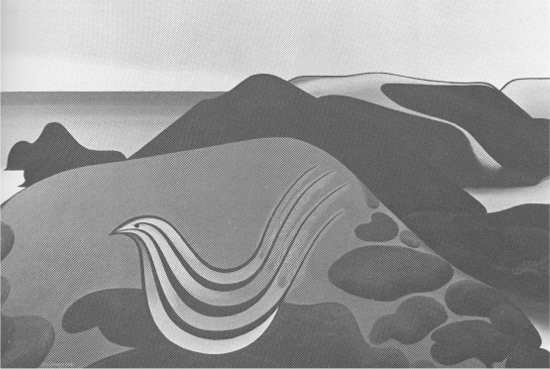
DON BINNEY
Sun shall not burn
them by day,nor moon
by night 1966
oil& acrylic on canvas
(CoIlection of The
Auckland City Art Gallery)
It was often claimed in the nineteenth century, that naturalism is an innocent mirror of reality, suitable for all times and places - in other words, is not a style at all. Brown and Keith have succumbed to such nineteenth century claims when they see topographic naturalism - or, indeed, any style - as offering the 'truth' about New Zealand nature.
The idea of clarity, for instance, is purely an attribute of style, is intrinsic, is internal to the Topographical style, as later it is to Don Binney's or Robin White's Hard-edged Realist style. It is not a feature extrinsically determined, determined by the external world (by, for instance, as Brown and Keith say, such aspects of the external world as the alleged 'harsh clarity' of New Zealand light). To claim that it is, as Brown and Keith do, is to be a victim of myth, is to accept the bourgeois ideology which everywhere pretends its representations to be nature, to be eternal, to be inevitable: to be just how things are.
Two final examples from Brown and Keith's examples . . . Arguably, Heaphy's Mount Egmont, with its radically simplified and symmetricalised profile, offers less of the natural facts, of the 'truth', than similar mountain profiles by the derided Hodgkins or Gully. Or, to compare Heaphy to himself, his 'Topographical' Egmont is no more or less truthful than his late Bream Head, Whangarei, where Brown and Keith say he has 'abandoned himself to the picturesque'. In fact, the latter work shows an outline far closer to that of the actual Whangarei Heads than that of the praised earlier work is to the actual Egmont. But, Heaphy's Bream Head floats in a beautiful, unreal, and purely painterly, Turneresque glow. The point is that no style offers 'truth' - all are filters, through which only a few selected 'facts' may emerge.
The above discussion should be sufficient to suggest how the polemic of nationalistic concerns contemporary in the 1960s have 'distorted' the picture Brown and Keith offer of the history of New Zealand painting.
This discussion has concerned itself with Brown and Keith's treatment of nineteenth century painting. But it might just as easily (or more easily) have focused on their approach to twentieth century painting. It might have shown, for instance, how their belief that in New Zealand painting 'two main patterns emerge: a general orientation towards landscape . . . and a positive response on the part of a number of more important New Zealand painters to the distinctive qualities of New Zealand light'(5) led them virtually to ignore such major painters as Mrkusich. Having the misfortune not to be a landscape painter, nor to be concerned with a national style or content, Mrkusich could not be seen to be important. The best that could be said of him, though he was succumbing either to a 'servile formalism' or to the 'exploitation of surface nuance' (6) was that he shared with such painters as Don Binney 'a specific interest in light'.(7) Mrkusich and Binney? An implausible coupling! But only by putting him with Binney, who did answer to Brovwn and Keith's nationalist, light and landscape concerns, could anything be said of him. The framework adopted by Brown and Keith made it impossible to deal intelligently at all with painters like Mrkusich: through the narrowness of that frame, Mrkusich, simply could not be seen.

MILAN MRKUSICH
Monochromatic blue Linear Series
acrylic on board, 120 x 890 mm.
(Collection of The
Auckland City Art Gallery)
What we end up with then is a bias: in its statistical sense, 'the distortion of result by neglected factor'.
But now the contemporary concerns of this writer, his expository placard, must, in all honesty, be stated: for he does not of course claim a final truth for what he has written. His text too has been dictated by his time; his text too will, one day, be rewritten.
So - to save subsequent writers the trouble of saying it - this discussion was 'distorted' from the viewpoint of modernist and post modernist painting, with all its concern forthe language of art; and, above all, by the semeiology of such writers as Roland Barthes. just as Brown and Keith saw the whole history of New Zealand art through the frame painted by Colin McCahon, so too, my ideas are concurrent with a New Zealand painter who is my contemporary: Richard Killeen, whose concern is, as much as anything, and much as mine is, with language - with the language of art.
Such 'post-modernist' or 'new image' art as Killeen's, rather than being a simple return to the figurative after its banishment by modernist abstraction, is, just as my present text tries to be, 'a critique of representation, an attempt to use representation against itself to challenge its authority, its claim to possess some truth or epistemological value . . .' To quote again:
. . . The post modernist critique of representation proceeds ... to undermine the referential status Of visual imagery and, with it, its claim to represent reality as it really is, whether this be the surface appearance of things (realism) or some ideal order lying behind or beyond appearance (abstraction).
Post modernist artists demonstrate that this 'reality', whether concrete or abstract, is a fiction, produced and sustained only by its cultural representation.(8)
*An Introduction to New Zealand Painting 1839-1980 by Gordon H. Brown and Hamish Keith, new and revised edition, Collins, Auckland, 1982
1. Michael Baxandall, Limewood Sculptors of Renaissance Germany, Yale University Press, 1980, pp.9, 10.
2. Brown and Keith, An introduction to New Zealand Painting, Collins, 1982, p.39.
3. Brown and Keith, ibid,p.22.
4. Brown and Keith, ibid, p.35.
5. Brown and Keith, ibid, p.9.
6. Brown and Keith, ibid, p.182.
7. Brown and Keith, ibid, p.181.
8. Both quotations are from: Craig Owens, 'Representation, Appropriation and Power', Art in America, May 1982, pp.9,21.