
The New Zealand Landscape Show 1982
SHERIDAN KEITH
The landscape attracts photographers as certainly as camping parties or butterflies in summer. But the landscape is a very difficult subject for the photographer. What nature carries off in spectacular fashion can often, as an image, dash on the rocks of melodrama. Where nature can unfold vistas of overwhelming serenity, the photograph may flounder in cloying sweetness.
The emotions aroused by landscape prove curiously elusive to reproduce by the medium of photography. The photograph is primarily a truthful medium: but its reduction in size defeats much of the impact of mass and space in the landscape - and the deletion of the sensual qualities experienced in the open, of sound and touch, air and wind, makes the factual presentation of landscape in photographs, of necessity, dilute. While it is impossible to encompass the dimensions of any subject by the eye alone, when the subject is landscape it seems to matter more.
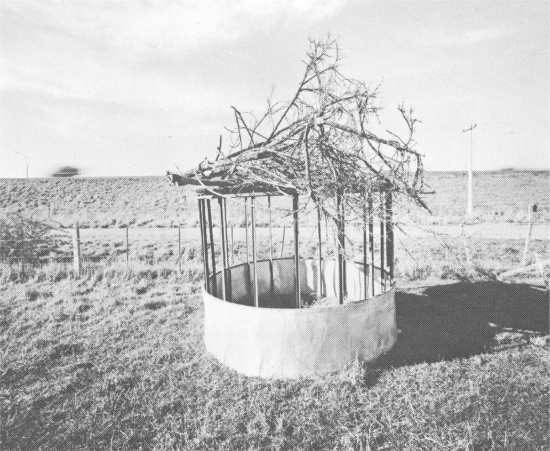
JOHN HAWKHEAD
Tin Rotunda, Clarkville,
Canterbury, August 1980
black-&-white photograph
There are further pitfalls in the very familiarity of the subject, and in avoiding this familiarity by a deliberate quirkiness.
None of this is to say that the landscape should not be photographed. Landscape photography can be as moving emotionally as any area of image making - only the photograph has to be artful. It doesn't follow that an amazing sight, faithfully photographed, will be an amazing photograph. If that were true photography would not be an art. What nature does naturally, art must do artfully.
The New Zealand Landscape Show 1982, at Real Pictures, was a large exhibition with each photographer showing only one image. The majority were in colour (more and more photographers take up the challenges of colour). Black and white photographs with their inherent drama and tension, austerity, and reduction of experience to primal elements of dark and light, shape and pattern - contrasted sharply with lush images of colour.
There will always be photographers who prefer to work in black and white, enjoying the control they can exercise over the subtle balances of light and shade: but in this exhibition, in the company of so much colour, black and white images start to feel like elder statesmen-dignified, controlled and unwilling to indulge in mere sensual pleasure. They seem almost to have a moral superiority. Gary Blackman's Elm Row, Dunedin 1980 was such an image. Stately, with a sure sense of propriety, this eloquent image was intricate yet simple. Elizabeth Leyland's Maungakiekie 1982 was a very pleasing black and white image where a swirling dramatic sky contrasted with gentle mounds of the grassy earth, and a tree dominated with its strong shape. A fence like matchsticks cleverly imposed scale. In this work the components united to convey spaciousness, grandeur and an underlying balance nature confident of her own purposes. Jenny Urquart uses the black and white medium effectively in Lake Wainamu 1982, an image that draws the viewer into a private revelation of textures and contours.
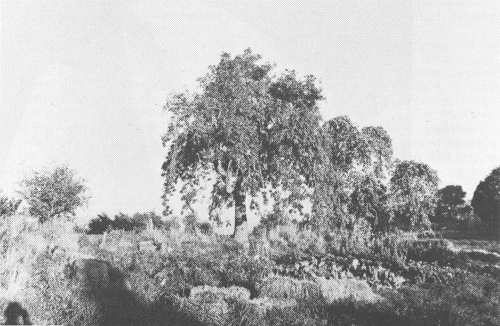
GARY BLACKMAN
Elm Row, Dunedin 1980
black-&-white photograph
Hank Cavendish's Lang's Beach 1977 and Ron Alien's Ponsonby Landscape were both pleasing black and white images; and John Hawkhead produced one of the most arresting images in the exhibition with Tin Rotunda, Clarkville, Canterbury August 1981. Here an unusual structure jolts the scene, disturbing the serenity and imposing an order of its own-part of the landscape and yet in juxtaposition to it. This is an image which conveys landscape, not as cosy retreat, but as a stage in which men and women put things and do things.
Anne Noble's image Hiruharama (Jerusalem) Wanganui River 1982, from The Wanganui series, is an essay in the nuances of light, where feathery palm trees and river mists enchant the viewer, where the loveliness of landscape is a fragile and mysterious being. Four Cats in my Mother's Garden by Marie Shanon, was an enjoyable composite work, with enigmatic and humorous overtones.
In appreciating colour images we are immediately confronted with innumerable difficulties. The colour photograph is perilously close to the advertising image: 'promoting' landscape, rather than portraying it. Colour photographs provide so much immediate information that they can seem shockingly indiscreet. It has been said hat while form is something we experience intellectually, colour is mere sensation - like stepping into a hot bath. That maybe so: but colour is part of life, and colour in the landscape is the very matter of life itself.
Colour, as it were, gives everything away. Those coloured images that were the most successful, worked somehow to limit colour's open handedness. Robin Morrison's Northland, Wellington 1982, was an evening study where colour startled against the black of night, where the illumination from house windows and street lights excited the imagination and a purple swirling sky added a fantastical dimension.
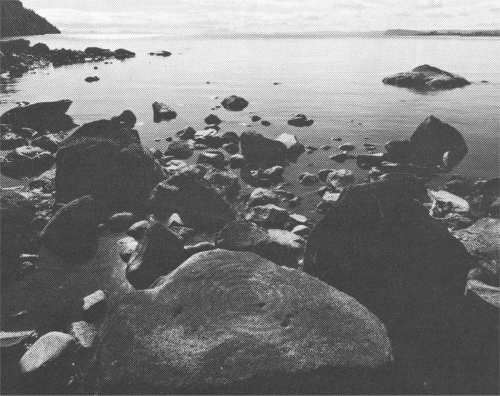
MARK ADAMS
22/4/82. Waihi,
Lake Taupo, Toka Tapu
black-&-white photograph
Joanna Paul's colour xerox Eugene on Otago Peninsula, of a mother and child in a landscape setting, and Rod Wills's Gone Bush, Auckland, of a flamingo emerging from fronds of vegetation, were both interesting in their muted use of colour: though neither seemed strongly interested in the landscape for itself. Mary MacPherson's From Johnson's Hill, Karori, Wellington 1982 was an interesting colour image taken from the vantage point of Johnson's Hill - almost like an aerial photograph, where boundaries become the curiously precise, neat rectangles of the surveyor, and the houses of the suburb encroach on the edges of wild farmland, a dialogue between the contrivances of men and the purposes of nature.
Gil Hanly's Figures, West Coast Landscape was a very successful colour image, the figures appearing as shadows in a seascape of coast and impressive rock formations. Here colour was a real turn-on, bringing swampy greens and wet browns to enhance an already powerful composition. Murray Hedwig looked at landscape as microcosm in his detail of straited rock form in Desert Road, 1982. Pinks and greys blended in a pleasing fragment of landscape condensed into geological strata.
There were many other interesting colour images - Ken Browning's Presbyterian Church, John Henry's Land Series No 37, Mike Keelings's Rock Pukaki, Paul Barton's Remuera Golf Course Subdivision, Doug Harris's Zen Landscape Series, George Kolap's Mt Egmont - many intense studies of rather private ideas of landscape. It is a problem for an exhibition of this nature that the over-all impact is so fragmented the viewer becomes bemused. The serenity that one feels in the presence of evocative landscape images is shattered perhaps by so many and varied approaches. (Real Pictures, September)