
Exhibitions Dunedin
PETER LEECH
Jeffrey Harris In Acceleration
The announcement in February that Jeffrey Harris (along with Milan Mrkusich and Greer Twiss) had been invited to exhibit at the important Carnegie International in Pittsburgh later this year could not have come at a more auspicious time in the painter's working life. For what has emerged with stunning clarity in recent months is that Harris has reached a point where the searing, expressive energy which has always characterised his work has at last been fully harnessed.
In discussing the major retrospective of Harris's paintings at the Dunedin Public Art Gallery in April 1981 (see Art New Zealand 20), I commented that, in what amounted to a pictorial diary of the artist's inner world over ten years, the more recent works - such as Two Young Russians 1981 - seemed to have been projected out from that intense privacy in which Harris has tended to work. And in this projection there was something new: a stronger sense of resolution, a starker simplicity, and no longer that symbolic over-determination which used to tempt the artist. The suggestion was that these qualities had arisen precisely as a result of the outward projection: the pain and torment that is central to Harris's art seemed to have been examined from the outside rather than the inside.
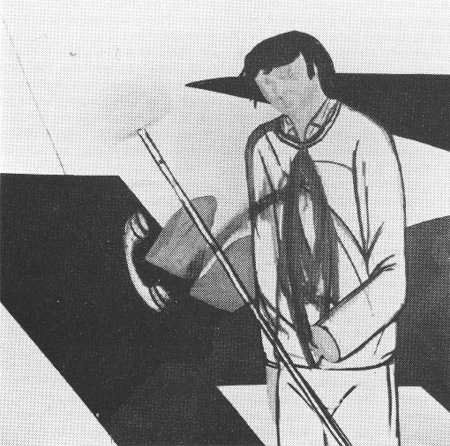
JEFFREY HARRIS
Self-portrait figure
oil on canvas
(Bosshard Galleries)
It is from the later - if not quite the most recent - period of Harris's work that Gene Baro of the Carnegie Institute selected three paintings: Untitled (Judith), No 4, 1978-9; Untitled, 1980; and Untitled (Self-portrait), 1980. Together with Milan Mrkusich's three Carnegie paintings (Monochrome Blue, Four Areas, 1979, Two Areas Orange and Maroon, 1980, and Two Areas Dark 1981), Harris's paintings have formed a small exhibition at the Dunedin Public Art Gallery during May. But if it is the Public Art Gallery which has offered a further chance to see these works, the greater credit must go to the Bosshard Galleries, who originally exhibited all the paintings and from whose stock Baro made his selections. It is a nice tribute to a gallery which has so well represented the interests of two of New Zealand's strongest contemporary artists.
The contrast of the two styles of work is awesome. The full power of Harris's hurling expressivity stands against the equal power of Mrkusich's elegance and subtlety. Oddly, the juxtaposition of the two painters' work is mutually enhancing. There is the sense that, between the two of them, lies the equilibrium point of art. But in the meantime, a further magical transformation has taken place in Harris's painting. Shortly after the Carnegie invitation occurred, in March this year, Jeffrey Harris presented six new works at the Bosshard Galleries. The effect was undeniably apocalyptic.
The first revelatory feature of the six works is that, for the first time, Harris has worked in oil on canvas instead of his customary oil on hardboard. The visual change is dramatic.
Canvas, of course, is an infinitely richer and deeper chromatic base, and the new works are aflame with colour in a manner which never so clearly emerged on hardboard. The paint seems now more at one with the paintings.
The canvas texture also brings to prominence Harris's other great talent in the inscription of figurational lines of paint with a resilience and power unmatched by any New Zealand contemporary. The lines - or rather the interstices between them - make greater sense on canvas insofar as a blank area of canvas does not have that shrill and pictorially fragmenting absence in raw undercoat on canvas. Once again the stuff of the canvas becomes a working component of the painting in a way that hardboard never quite could.
But the sharper focus which the use of the new medium lends to Harris's work is not merely formal. The artist's subject remains inner mythology: but in the new works that innerness is no longer so private or autobiographical. The characteristic themes of suffering, mortality, mutilation, tragedy, the bitternesses and sweetnesses of human relations have been universalised to the point where one can now read in the outer what Harris had always sought in painful self-examination.
The outside of the innerness is no more evident than in perhaps the most potent of Harris's six new paintings, It Takes Time. Though the pictorial components are very much Harris's, the source is in fact a well-known photo-journalistic image from the Vietnam war. It is interesting to observe that if that photograph, seen a hundred times by millions, has lost its power to agonise, then the agony is renewed and redoubled in Harris's paintings.
The universality of theme appears too in the triangular tangles of loving in Times Triangle; or in those potent overlays and underpinnings of a family history in Family - a kind of Freudian collage.The greater accessibility of Harris's new work has the strength of simplicity: but without at all the false messages of simplisticness. There lies the danger for artists of the expressive mode: for those great screams of emotion can, without subtlety, turn out to be the merest juvenile whimpers. In re-reading a lot of Harris's early works in terms of the stunning new paintings, it occurs to me that it has perhaps been the risk of appearing simplistic which has led Harris into his more arcane and autobiographical realms. No man (or woman) represents another, even if there is the shared foundation of humanity. The trick - the trick which Harris has mastered - is to reveal the levels of inner mythology at which humanity is shared. And it would be impossible now to imagine that, for Harris, those levels could ever be superficially sentimental.