
Exhibitions Auckland
ROSEMARY HEMMINGS
Time Release ... photographs from John Turner's private collection
John Turner's photographs from his private collection cover a wide range in time scale: from Alfred Burton's and W. J. Harding's historical documentations in the nineteenth century to the contemporary art photographers of the 1980s. The 155 photographs in the exhibition are not intended to be a historical anthology of New Zealand photography so much as an exhibition of interesting photographs intended to encourage a general audience to enjoy the complexity and richness of photography.
Most are New Zealand images: but a few come from a wider cultural context - such as the Americans Edward Weston, Paul Strand, Joseph Jackna and David Heath. (Heath's Silver Print bears the photographer's good wishes to Turner. It was, like so many other prints in the exhibition, a gift to Turner for his help and encouragement in the technical and artistic processes of producing a satisfying image.
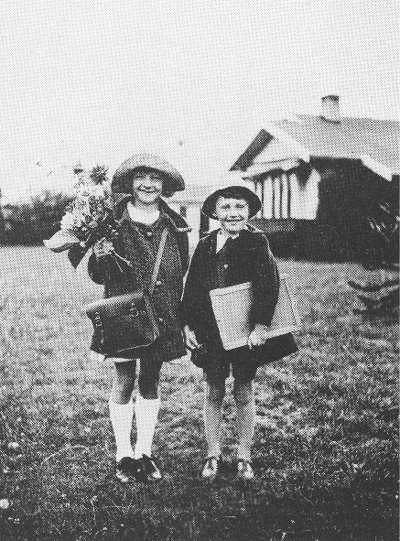
G. LESLIE ADKIN
Nancy and Clyde, 'Woodside' Levin c.1925
black-&-white photograph
The quality of the prints was a primary consideration in the selection of works for this exhibition. Images in photography depend for their success on the nuances of tone, of texture, of scale and of colour in relation to content, to key in the viewer's emotional and intellectual response; and the placing of American works alongside New Zealand works gave the audience a chance to see a direction which contemporary photography here is moving in (even although the American works were a somewhat random sample). Turner's humanistic attitudes come through in the selection of the material: though, disappointingly, there was none of his own work in the exhibition. We are as moved by the pathos of the Maori figures in Alfred H Burton's Ti Eke, Wanganui River and WJ Harding's Circus Giant and Friends as we are by the gentle eroticism of Carol Jerrem's Australian image Vale Street, where two young men and a woman reach out to the viewer in their pain, and by Glenn Busch's compassionate study of a nun with another woman. The Iron Punishment Band by John Watt Beatie (1859-1930) evokes the same suppressed feeling of alienation as Dr Alfred Barker's Unidentified Girl - which Turner has had printed and gold-toned from negatives held by the Alexander Turnbull Library. A sense of nostalgia, and forgotten social orders is present in G. Leslie Adkins work; and we experience a similar echo of the past, of the 'fifties, in the silver print by an unknown artist of men in a car at Titirangi, and in Gary Baigent's Jimmy Keogh and Dalmation, where the mood of the 'sixties is timelessly recorded.
Jeff Healy at Trappings
Trappings in Karangahape Road, is to weaving what Portfolio Gallery is to prints, and Fingers is to jewellery: a place where the seriously motivated weaver can exhibit in an uncluttered gallery space and sell work alongside other quality crafts. The first exhibition, Jeff Healy's Variations on a Warp Face Theme, combines all the tactile and textural qualities of the woven object with the subtlety and expressiveness of the painter. Healy's ability to abstract from such realities as the city at night and a car-tyre tread, are the result of two years working and studying at English art schools. This has moved his work away from the previous dimensions of the New Zealand genre in weaving - heavily influenced by our colonial past, and the rawness of our landscape, or extremely derivative of European and Asian ethnic design. Healy says his time in Europe taught him to see, to transmit that seeing to design, and then into the tactile area of hand loom weaving. He uses the warp to form the design instead of the more conventional weft, so he has to have the design thoroughly resolved before he begins, and this is apparent in the majority of his works.
The most resolved and satisfying work, Warp Face Plain Weave Combined, is based thematically on the patterns of the tread of a car tyre. It is visually a strong statement, though the colours are muted. Where the warp thread picks up the fine strands of the weft thread, a deeper dimension is added to what could be a formal, and rather lifeless design in cream and grey, giving it a confidence and vitality often lacking in natural-coloured hand-woven rugs.