
Book review
Rebels And Precursors: The Revolutionary Years of Australian Art by Richard Haese
Published by Allen Lane, 1981
Reviewed by ROSS FRASER
Those interested in the development of modern art in this country would do well to read Richard Haese's important study Rebels and Precursors. They will see in it most interesting parallels with the struggle for the acceptance of innovative ideas on these shores. (Gordon H. Brown's essay, New Zealand Painting 1940-1960, reviewed in Art New Zealand 22, may be read along with it.)
Where in New Zealand the arguments simmered below the social surface however, only occasionally becoming public with such 'scandals' as the Frances Hodgkins Pleasure Garden affair in 1948, or the controversy over the Henry Moore Exhibition at the Auckland City Art Gallery in the 'fifties, with Australia the volcano erupted more spectacularly, throwing out a lava-flow of red-hot manifestos, pamphlets, articles; spawning a brood of academies, societies, coteries and cabals of all kinds. As Haese says in his introduction: 'Artists and writers lived together, talked, argued and exchanged ideas on levels and in ways that have few parallels.' This 'Communalism' was necessitated by 'the actively hostile or uncomprehendingly indifferent world in which radicals found themselves in the 1930s'. One hears an echo in reading: 'It was evident, too, that an even greater danger than artistic orthodoxy lay in the philistine character of Australian life and the degree to which this debased the values of what culture there was'.
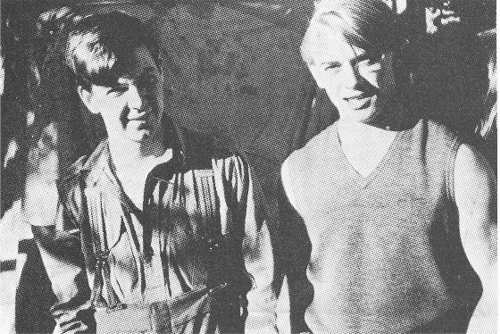
Arthur Boyd &
John Perceval at the
Boyd home in Murrumbeena,
c.1945
Rebels and Precursors follows up all the manifold implications of 'the two main threads of the story of Australian modernism. The first was the discovery of the European modernist tradition and its transplantation. The second concerned the rediscovery and re-examination of an authentic Australian cultural tradition'.Opposition to the growth of modern ideas came from 'the older of the law-givers and Iuminaries' such diverse talents and personalities as, for example, `Percy, Norman and Lionel Lindsay, Ernest Moffit, Will Dyson, Hugh McCrae and Max Meldrum'. Lionel Lindsay, a trustee of the National Gallery of New South Wales, declared: 'Modernism in art is a freak, not a natural evolutional growth. its causes lie in the spirit of the age that separates this century from all others: the age of speed, sensationalism, jazz, and the insensate adoration of money'. J.S. McDonald, director of the National Gallery of Victoria, waged the reactionary battle in the name of the 'pastoral' tradition of Australian painting. He made lavish use of the rather dubious concept of 'decadence' as he contrasted modern tendencies with the 'timeless virtues and veritieswhich appeared to be found for all time in the canvases of Arthur Streeton and Hans Heysen'. MacDonald assured the public that modernism, on the other hand, was 'gangrened stuff [which] attracts the human blowflies of the world who thrive on putrid fare'.The tide of progressive ideas, however, could not be held back. The influence of the Australian Academy of Art, founded in Canberra in 1937, was, as it were symbolically countered by the conception of the Contemporary Art Society, out of initiatives of George Bell in 1938. John Reed was spokesman for the Society's more radical wing; and early exhibitors included Sydney Nolan and Albert Tucker.
As in New Zealand, exhibitions of modern art from Europe and America had a great leavening effect on the local scene (c.f. Arm Calhoun's article on Edwin Murray Fuller, in this issue) 'in 1939 the Herald Exhibition of French and British Contemporary Art gathered together in the Melbourne Town Hall canvases that included many from the most advanced of Modernist painters in France and Britain. It was a triumph for liberals and radicals, in that order. Then in 1941 the Contemporary Art Society held its most notorious exhibition, which brought together works testifying to the dynamic changes that had taken place in Australian painting since the 1930s. And this too was a triumph-for modernist radicals and for all those committed to the political left.'
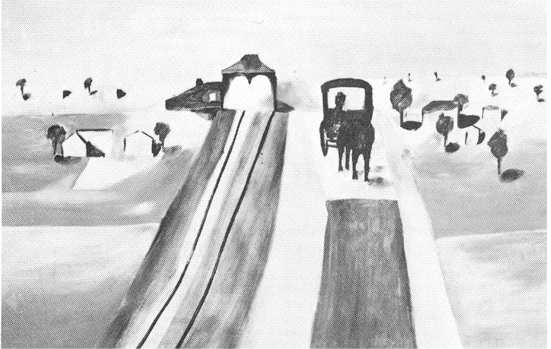
Sidney Nolan Kaita
c.1943
Richard Haese's book is, quite simply, an indispensible work for anyone with a serious interest in the development of modern art in Australasia. Its publication was made possible by grants from the Literature Board of the Australia Council and the Visual Arts Board of the Australia Council. It prompts one to ask the question: when will the work be commissioned or supported in New Zealand (Gordon H. Brown's outline mentioned above notwithstanding) that will do for this country's cultural history what Haese has done for that of Australia - identifying and disentangling all the threads that were woven between painters, poets, musicians, critics through those years when it was exciting to be a pioneer in matters which (contrary to philistine belief) are of central importance in our lives.