
Four Recent Small Films
PETER WELLS
It seems to me one of the self-defeating ironies of false perception that feature films are seen in New Zealand as the most visible facet of local film art. The publicity surrounding Roger Donaldson's Smash Palace is a case in point. It would perhaps be going too far to say its arrival was greeted with some of the panache of a second coming. Certainly it was difficult to be alive in New Zealand in January of 1982 and not be aware of its presence. I went to the premiere. While we waited anxiously to get our gullets round the Charles Heidseick champagne, an accountant from the Film Commission spoke at length about the three qualities of Donaldson's epic. One was that half a million dollars worth of contracts had been signed within three days. Another was that here at last was a quality 'product' of 'international' standard. Finally, there was the fact that it contributed to a sense of self-image in these islands. Personally, I think Donaldson's film is an excellent commercial American film. I can see, too, how our politically oppressive climate breeds a cinema in which the archetypical New Zealand (male, heterosexual, kid-burdened, car-crazy) finds his authenticity by shaking his fist at society and authority. We all need these illusions, in Muldoon's third term, to swallow the bitter pill of individual impotence. In a true sense of the word - just as Busby Berkeley's glitterama films of the 'thirties were - Donaldson's film is a film for depression. My point, however, is not the content of Donaldson's film. It is that a feature film like his should be taken so seriously, reviewed so earnestly that, reading reviews, it is difficult not to feel that inward sob one feels at the sound of our national anthem being played at an Olympics. Here, we are told, is a great New Zealand film. How do we know? It has been sold overseas. Once again, by a kind of Chinese somersault, we are learning about ourselves by the test of 'overseas' applause. Is this the self-image we feel most at home with?
It seems to me that the images of ourselves we are literally most at home with come in small films. These pervade our vision to the extent that we are almost unconscious of their power. I refer here, of course, to television advertisements.

Image used
in the preparation
of Ron Brownson's
film, Springbok
If we reflect for a moment on the size of the audience they reach, the frequency with which they are blasted into our living rooms, we can see immediately the power of 'commercials'. In very real terms they are the bedrock activity of the film industry in New Zealand. This is hardly surprising. It is, after all, the most direct juncture between cash and film image. Literally, the man or woman who holds the money says what the image will be (mediated though this may be through advertising agents). And the image the money holder wants is ceaselessly passed before our eyes, presenting us, if only we could step back a little from the constant visual persecution, with images of ourselves. A repetitive equation is made: if you only buy and consume this item you can be made happy, clever, complete. And because the juncture between cash and film image is so smoothly jointed, the money flows out to filmmakers who are willing to work in this area. It is not unusual for an experienced director of an advertisement to be paid $1000 for a day's work. Similarly, recently, we have had these miniature dramas of late-twentieth century consumption costing as much as a half-hour, or even hour length, film. A recent 'Crunchie' ad, for example, cost around $120,000. What I am trying to say here is that not only are advertising films the ongoing reality of film in New Zealand while feature films are the rare exception - not only are they most richly rewarded in terms of constant film work in New Zealand: they are also the most potent use of film imagery on a mass audience - and hence on our self-image. The self-image we get from these minute films is an excellent index of ourselves as Muldoon's New Zealanders. Caught in a mirage of glossy living conditions, we fret about fly problems, dandruff, bad breath and other quietly personal failings. But the remedy is really quite simple. Purchase. Consume. And purchase afresh. Advertising films create an image of a world of political impotence wherein situations reduplicate themselves as endlessly, in similar short-circuit: as an advertisement appearing on television night after night, programme after programme. There is literally no solution beyond consumption. I want to examine another type of short New Zealand film. And I want to look at them because they contrast so completely with, on one hand, the Barnum and Bailey publicity blare which almost completely submerged the quieter qualities and failings of Donaldson's latest feature, and, on the other, the Croesus route which rewards a filmmaker for servicing so astutely a conservative vision of life in Aotearoa. Four of these small films are Shereen Maloney's Irene 59, Gregor Nicholas's Mouth Music; Ron Brownson's Springbok; and Foolish Things (by the author of this article). Let us start by looking at several quotes from Shereen Maloney. By suggesting, rather than giving a full explanation, the film evokes feelings in the audience rather than pushing information on to them. It lets the audience fill in the gaps with their own information from their own experience and thus, hopefully, allows them to identify more closely with the subject. It was important to me that the film I made would be useful to others and this is the central issue whenever I made decisions about it. I wanted to counter the prevalent image of woman that women must live with every day. It is an image presented by all media, the 'advertising woman', the 'Mills and Boon woman' ' the 'Woman's Weekly Woman', and the constant parade of almost invisible, one-dimensional women who pass across our television and cinema screens. I wanted the audience to be somewhat aware of the film-making process. I wanted the film to retain some roughness and awkwardness. I didn't want it to look smoothly wrought and even and I wasn't interested in trying to create the illusion that this was 'real life'.
We see very quickly how this type of small film differs from the advert-as-small-film. It is not directed at enslaving the perceptions and sending them harried to the nearest cash register. Its purpose is, in fact, directly opposed to the effects of advertising on modulating character. We see in Maloney's film a quintessentially ordinary pakeha housewife, aged fifty-nine, looking at how she has battled against these very modulating pressures. She literally strips herself naked and talks of her internalised sense of inadequacy and how she has grasped - not through a new dandruff treatment or a recoating of 'Spruce' - a sense of self-worth. In one way, Maloney's film is an advertisement for freedom, for self realisation.
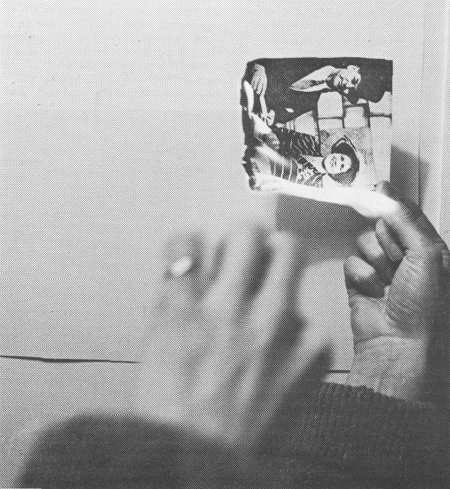
Image used
in the preparation
of Peter Wells's film,
Foolish Things
A further interesting point, especially seen in relation to the varnish-thick slickness of television commercials, is Maloney's desire to create a film which 'looks' different. She does not mind the fact it does not look like a quick kaleidoscope of shots flicking in front of the eyes to create the chimera of glamour. Her confidence in what she is talking about allows her to give the audience the thing an advertisement never can do: time She wants the audience to work: she allows the audience time. She even wants the audience to realise the process through which the film came about. This process differs significantly from adverts in that the connection between film and money does not function so smoothly I was terribly unconfident for a start ... I didn't want to get peoples' money or help even without knowing I could do it ... so l just sort of hobbled along on my own... and bought film stock out of my own money ... but also I want to step outside the confines of being a person with no money, and no experience ... an independent film maker in that sort of situation ... I wanted to explore that, with the medium, and make something which reflected that situation ... and it does ... the technical quality is very poor really ... I don't know whether that adds to it or not . for me ... it's very real. (Taped conversation). Maloney is that rarity in the world of New Zealand film making: a woman holding the camera. It's impossible to see her film separately from the battle which went into its making: not merely against her own lack of confidence . . . 'I was terrified at first . . . to even move the camera'; not merely against the males who people the industry and who, on seeing her rushes, gave her only the most lukewarm reception. Irene 59 was also purely and simple the battle for the expression of an idea. The thing which pulled Maloney through to completion (with the aid of the Arts Council and the Committee on Women) was her steadfast commitment to her film's ideological content. She had seen recent Australian feminist films at the United Women's Convention at Hamilton in 1978. I thought: God I could make something as good . . . It just looked so possible'. What she saw was a demystification of the process of film. We in New Zealand are so used to seeing film from the prayer-mat of cultural interiority that it has taken quite some time to realise we should get off our knees, walk up to the magic eye, and tug at the levers which are ceaselessly presenting us with images supposedly 'about us'. I want to return to this idea of 'roughness' and 'awkwardness' in film as a broadly ideological statement. Maloney states that these very qualities made her film 'more real'. More real- less of a trick- If advertisements can be seen as a ventriloquist's trick whereby the viewer is persuaded he/she wants what she/he sees (rather than choosing what one sees accurately), then Maloney's type of film can be seen as an attempt to shatter this very spell. She even wants the audience to stand just that little bit back from being sucked in. It's a curious counterpoint: Gregor Nicholas writes that by using film self-consciously the audience is forced to be objective: this very distancing allows one to present a naked, rawer truth. We see this concern for placing an audience in relation to new information in all these four small films. Ron Brownson for example, sees the way the film is experienced as of key importance. I'm quite interested in how one's reception of visual and aural information can change the Springbok tour ... you're sitting alone watching the news ... then with a group of friends inside news you had physically been present amongst ... it's a totally different experience and one's emotional well is dug out in other ways ...
He orientates his Super-eight films so strongly in this direction that they sit within the performance genre. Watching his film is an entire physical experience. For example in his latest film, Springbok, you sit in the dark for an appreciable period, aural senses bombarded with unfamiliar rhythmic forms. When the film begins, you pass into a long period of strangely flickering film. Browson deliberately articulates the audience's first reaction - 'oh God, the film's fucked in the camera'. What he is really doing is forcing the viewers into their own personal sense of film-time. He prolongs this period to the point where the viewer must accept that everything she/he sees from now on, no matter how 'rough', 'awkward' 'out-of-focus' it seems, has a single purpose.
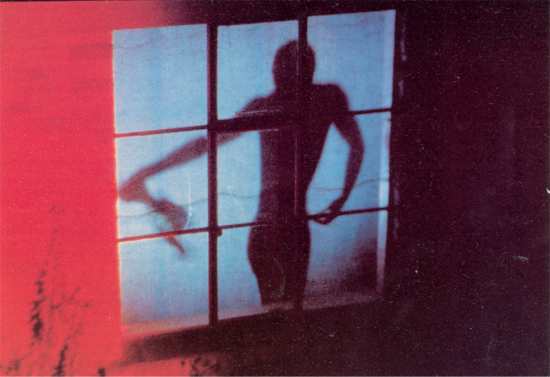
Still from
Peter Wells's
film Foolish Things
Three of the films I'm talking about here plan to disconcert stylistically. Springbok starts with music long before the images commence then goes into a flat spin which hardly ever recovers to show a single focused image; Mouth Music has people conversing animatedly, yet you never hear a word; Foolish Things has a voice but no body. These films all attempt to break awake the stunned viewer caught forever in the slumberland of commercial vision-making. It's of interest that the exception here is Maloney's film. Maybe this was because she orientated her film deliberately towards a group of women normally outside the feminist range: Plunket mothers ' suburban women. Could we say her less disruptive film style was necessary to disguise her quite 'disruptive' message? This disruptive film style, this 'meticulous seconstruction of realist narrative (Phillip Drummond, Notions of Avant-garde Cinema) is sometimes associated with structuralist cinema (wherein the shape of the whole film is pre-determined and simplified, and it is that shape that is the primal impression of the film' ). I asked Gregor Nicholas whether his film fell within this criteria.Mouth Music is absolutely structural in the sense that it has a rigid order and its method of construction [is] in picture frame composition and overall pattern . . . [I] wanted to work through Eisenstein theory in that direction - collision of opposites/dialogue of confrontation)
He certainly woke up the audience at its Wellington premiere. There it received a reception usually associated with The Rite of Spring in an earlier Paris. There were cries of outrage. Gregor Nicholas: 'It either surprises me the extremes of reaction - some are extremely involved in what unfolds, while others are totally alienated and probably hostile - I feel this is a rich and interesting response' Shereen Maloney: 'People are so conditioned by television maybe . . . or just by our whole culture that something has a beginning, a middle and end . . . and a story, and is told in a certain way . . . and although Gregor's film has these things in a way . . . it's just that people don't read it, they can't speak the language in a way . . . because it's something you just have to let yourself go with, I think . . I if you try and figure out what it means, it doesn't work . . . but it works on you if you let yourself go. (Taped conversation.)
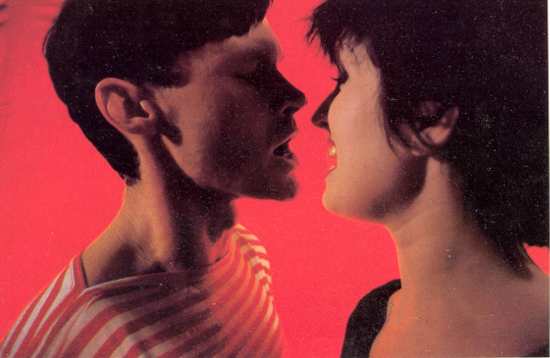
Still from
Gregor Nicholas's
film Mouth Music
The irony is that, as Nicholas says, 'My film is pure and basic 1+2+3+4 narrative construction of such simplicity that people fail to recognise a conventional construction stripped to its barest minimum'. People fail to recognise . . . they can't read . . . can't speak the language. This can be a problem in films of this type. Does the self-enclosed world of signs and rituals of the film-maker shut her/him out of the world of other people? One can let oneself go along the path of Brownson's Springbok, successfully losing oneself and finding the film in the shimmering virtuosity of his camerawork: but it certainly deepens one's understanding of his film to know that areas so fleetingly depicted are closely connected with New Zealand's racial conflict - The Alexandra Redoubt, or the 1860s borders of the Waikato. Also that the haunting soundtrack comes from the laments and death rituals of the New Hebrides, Solomon Islands, as well as Stockhausen's 'From the Seven Days'. When I asked Ron Brownson if his film came from too subjective a core, he reacted strongly. 'My films grow from something more general than an individual's reaction that is personally specific . . . My life is not on screen . . . but Ours may be . . . so some will change in time perhaps while the paths are searched for? He later told me how he felt the film image could live through itself long after it had been physically received. Certainly it interests me that he chooses as the content of his film something so politically loaded that our very own form of paramilitary found it necessary to reconnoitre his film, presumably as a preamble to seizing it. The humorous thing is that our Red Squad spy witnessed, not documentary footage of 'Our recent revolution in microcosm' as Tim Shadbolt has called the tour but a new film vision of racism in Aotearoa. But could he recognise it? It is not possible in an article of this length to push the discussion in directions where I'd like to look. Some of the ideas which occur to me at present are . . . Is there such a thing as a commonly accepted New Zealand film language? A recent short film by Justin Keene looked at Elam in the style of an old Picture Post documentary. It was so convincing that the person on the seat beside me put her hand over her face and said in a sepulchral whisper, 'This is so embarrassing'. She didn't realise it was a take-off.
Maybe this was because it conveyed the kind of realism or naturalism which is an uneasy amalgam of camera-consciousness plus or minus acting as if the camera isn't there. This has long been the hidden smirk of our own self-image.
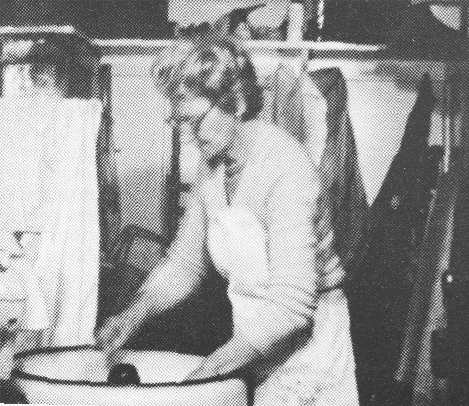
Still from
Shereen Maloney's
film Irene 59
These recent short films all show an effort to present sharper self-imagery, conveyed through a style which consciously attempts to break out of older moulds of seeing and speaking. In a very basic way they represent an attempt by people outside the area of commercial film to use image-creating equipment to project concerns which haven't been put through the informal censorship of commerce (will it hit a mass audience, will it sell?). The converse side of this is that these films find a relatively small audience and certainly do not finance lunches at Melba. I would like to close on the words of the Czechoslovakian film-maker Ester Krumberchova, spoken after listening to endless talkbacks on the radio during the Springbok invasion (its sense applies as much to these short films as to other issues, such as the Listener) 'You can have freedom here . . . so long as nobody listens.'
Peter Wells is an Auckland writer and film-maker. A recent article, Fassbinder, Film Noir and Foolish Things, was published in the Summer '81 issue of Alternative Cinema.