
Frances Irwin Hunt
1890-1981
A Personal Note
E.H. McCORMICK
Frances Hunt, the Auckland artist, died recently at the age of ninety-one. She honoured my sister and me with her friendship and left us to dispose of many pictures she had acquired during her lifetime as well as the far greater number she herself had painted. I am still listing the two collections but have broken off to write this tentative note. For some biographical facts I have used an obituary by Ron Tizard and have drawn others from imperfect recollections of her own remarks.
Ancestors meant more to Miss Hunt than they do to me. Gilt-framed portraits of two, a husband and wife, hung rather balefully in the entrance hall of her home in the suburb of Epsom. I think the grim-visaged forbears were of Yorkshire stock but am not certain and gladly pass on to a more deeply formative influence: the farm near Te Kuiti where, after early years in the Waikato, she grew to womanhood. The farm often figured in her conversation, was the subject of innumerable paintings, and, I would say, provides the background for a superb group photograph which has come to light since her death.
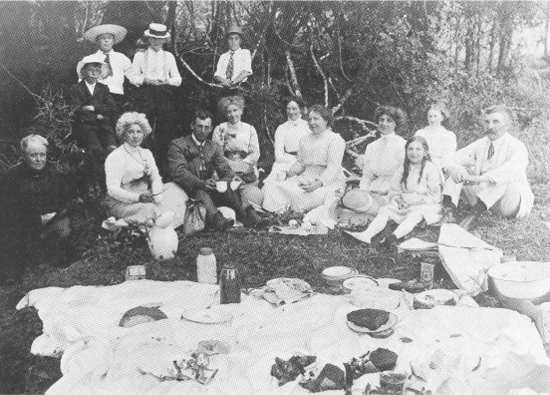
The plump-faced, muslin-frocked Frances is undoubtedly the central figure, and she appears to be surrounded by family and neighbours. But when and for what purpose- It is tempting to date it 1911, and identify the function as Frances Hunt's twenty-first birthday party Alas for that supposition she was born in July, so the gathering, obviously held in summer, must have celebrated some other occasion: perhaps Christmas or New Year. Whatever its nature it is almost certainly pre-1914, and points to the kind of community in which Frances reach adulthood: rural, prosperous, stable, genteel, but not excessively so. There are no menials - and, the thought occurs in this race-conscious era, no Maoris.
That glimpse of a King Country fête champêtre in the early decades of this century conveys no solemn intimations. But change was of course impending. Frances, with her merry eyes and abounding gusto, was not lacking in attractions. She would in the normal course of events probably have found her destiny as the wife of a farmer - a gentleman farmer for preference. Or, married to a professional man, she might have presided over 'society' in some country centre. Instead, she joined that generation of spinsters whose future was determined on Gallipoli or beside the Somme. Meanwhile, since there were no men to employ on the farm, she donned riding breeches to become shepherd and general rouseabout. At this time she began to smoke, rolling her own cigarettes, as she did when we first met. Of greater moment was her increased intimacy with the land and farming in all its aspects. How naturally and inevitably in the later years she made a wool-shed or a five-bar gate the focal point of a landscape painting.

FRANCES HUNT
Still Life Composition 1959
oil on board, 455 x 355mm.
(John Leech Galleries)
After the war, Frances and her widowed mother shifted to Auckland, finally settling in the large, comfortable house in Ranfurly Road that was her last home. I never thought to ask her when she began to draw. I suppose it was at school; and there is evidence that while still living in the country she took lessons from a correspondence college. Now that she was in the city, there were opportunities to develop - or discover - her talents. She attended Frank Wright's academy in the Victoria Arcade; acquired the art of painting in watercolour; and in 1924 was elected a working member of the Auckland Society of Arts. Quickly mastering the Wright formula, in the next few years she turned out countless renderings of Auckland 'beauty spots' romantic, mildly pleasing, rather mindless - much like the poetry of the period.. In 1927 a European tour with her mother and a brother contributed a handful of landscapes not remarkably different from those done at home. Dutiful visits were paid to the galleries: but the only episode I recall from her travel saga was the account of a power struggle on one ship between Mrs Studholme of Ruanui station near Taihape and a rival dowager. The Hunts, I need hardly add, travelled first class.
In 1932 she enrolled as a student at the Elam School of Art. For a woman already in her forties it was an unusual step and a courageous one. She took it, I suppose, because she felt she was getting nowhere (which was the truth) and needed the stimulus of fresh teachers. She was lucky enough to find them in two men, A.I.C. Fisher, principal of the school, and John Weeks, who taught painting there. She had the greatest respect for 'Mr Fisher', as she distantly termed him, and I am sure she profited from the rigorous curriculum he had introduced in emulation of the Slade. For John Weeks, then at the height of his powers' her feelings fell little short of adoration. He was teacher, master, friend, the guide who gave her confidence in herself and eased her way in the transition from tentative amateur to assured professional.
For three years she applied herself diligently in the company of fellow students half her age. She drew from the nude, she painted portrait heads and still lifes and landscapes and seascapes and cityscapes. She did some modelling (notably a head of her mother) and she became proficient in the technique of oils, which became her favourite medium. It may have bee in the Elam years or soon afterwards that she took another decisive step in committing herself to a career. She added to the house in Ranfurly Road a studio so well designed and equipped that the best professional advice must have been sought when it was planned; and who in Auckland better qualified to advise on such matters than Mr Fisher and John Weeks- As one entered it through a door in the upper storey it seemed of vast proportions, soaring to top lights on the south and east. In the centre stood a large easel, a raised chair for the model, curtained screens for the background, and similar accessories. The walls were lined with shelves holding art books, ornaments for use in still lifes, and plaster casts - a Benin head, a bust of Julius Caesar, a Greek frieze, a fig-leafed Apollo. In a quip now rather frayed at the edges, I have remarked that the place would have done nicely for Michelangelo.

FRANCES HUNT
Portrait of Jim
oil on board, 375 x 295 mm.
(John Leech Galleries)
From the mid-thirties onwards for more than a decade Frances Hunt painted indefatigably. She travelled far beyond the city seeking motifs - to Taupo, to Rotorua, to Waikaremoana - but most often to the King Country with its fertile valleys and wild gorges and rock crowned ridges. She would set off in her old-fashioned car, so high and roomy that she could draw or sketch without getting out. John Weeks sometimes accompanied her, to partake of the delicious food and varied drinks packed into a picnic hamper. She introduced him to the King Country, where they worked together in friendly emulation, and he in turn introduced her to Rotorua and another of his followers, Dr Wallis. She would return to the studio to translate drawings into large, thickly painted oils or to contrive still lifes that increasingly lost their representational character to become intricate designs of form and colour. She occasionally invited a small group of fellow painters to work with her in the studio where they shared a model and, doubtless, social gossip. And in stealthy solitude (I imagine) she laboured over strange little compositions perhaps inspired by the more abstract of Cézanne's Bathers. (One of his landscapes, incidentally, was the only modern reproduction on her walls.)
In that dim era of the 'thirties and 'forties Auckland had no dealers; though the John Leech Gallery hung a few originals with its colour prints. The only way to show one's work was through the Society of Arts. Frances Hunt was a regular exhibitor, but, along with most of her contemporaries, rarely sold a picture, even at prices never exceeding twenty five guineas. She did, however, buy the work of others. So, while her own paintings accumulated in the studio, she gradually built up a collection by Auckland artists active during her career: several Frank Wrights and, predictably, an assortment of oils and watercolours by John Weeks. Related to these were works by his friends, students, and disciples - Helen Brown, Louise Henderson, Alison Pickmere, Stanley Wallis; then, characteristic specimens of the Elam school (in the wider sense), mostly by women - Bessie Christie, Vida Steinert, Frances Wright, Ron Stenberg; finally, a very odd group - two early Ralph Hoteres, a whimsical Sina Woolcott, a triptych by Elva Bett. Frances Hunt was not a systematic collector, much less one who regarded works of art as an investment. She was that rarity among Aucklanders, someone who acquired paintings because she liked them and because, as a lady of means, she considered it her duty to support local artists.
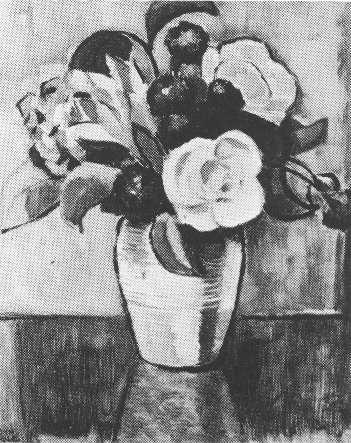
JOHN TOLE
Yellow Vase
oil on board
(collection of The
Auckland City Art Gallery)
Our first meeting occurred in the early 'fifties when I called at Ranfurly Road to get particulars of a unique item in her collection, Frances Hodgkins's After the Bathe (unique in being a work of European origin and by a painter not known to her personally). She was still very active and, as our acquaintance grew into friendship, she gave my sister and me one of her spiky still lifes. Gradually her powers declined until by the time of a retrospective in 1975, organized by the Society of Arts, she had ceased to paint. In July 1980 another function was held to celebrate her ninetieth birthday. Relatives and friends gathered in about the same numbers as they had in that picnic held some seventy years earlier. Frances was again at the centre, now obese rather than plump, but with the same merry eyes and still ready to utter a witticism or make one of her sharp, shrewd observations. And so she continued to the end. This note cannot possibly do justice to her qualities as woman and painter, but with Mr Tizard's obituary in the Auckland Society of Arts's Art News it is a beginning.